



British Pound tumbles as UK turmoil, Iran risks lift USD
- Political turmoil fuels fears Starmer’s successor may widen deficits.
- WTI rally boosts Dollar as Iran tensions revive inflation risks.
- Strong US production data reinforces hawkish Fed repricing.
The GBP/USD extends its losses for the fourth straight day, poised to finish the week down more than 2% as political turmoil in the UK and increased speculation that Starmer’s successor could widen fiscal deficits weigh on the currency. At the time of writing, the GBP/USD trades at 1.3343, after peaking at 1.3403.
GBP/USD drops as Starmer pressure and Oil shock deepen
Risk aversion dominates the financial market as US President Donald Trump said that he is not happy with Iran and that “I am not going to be much more patient,” pressuring Tehran to make a deal.
The US crude Oil benchmark, WTI, extended its gains by more than 2.39%, while the Greenback —positively correlated to WTI—surged to a four-day high at 99.29, according to the US Dollar Index (DXY), up by 0.39% in the day.
However, the story is that the Iran conflict is underpinning energy prices. Consequently, global bond yields are soaring amid speculation that major central banks, including the Federal Reserve, will begin to tighten monetary policy.
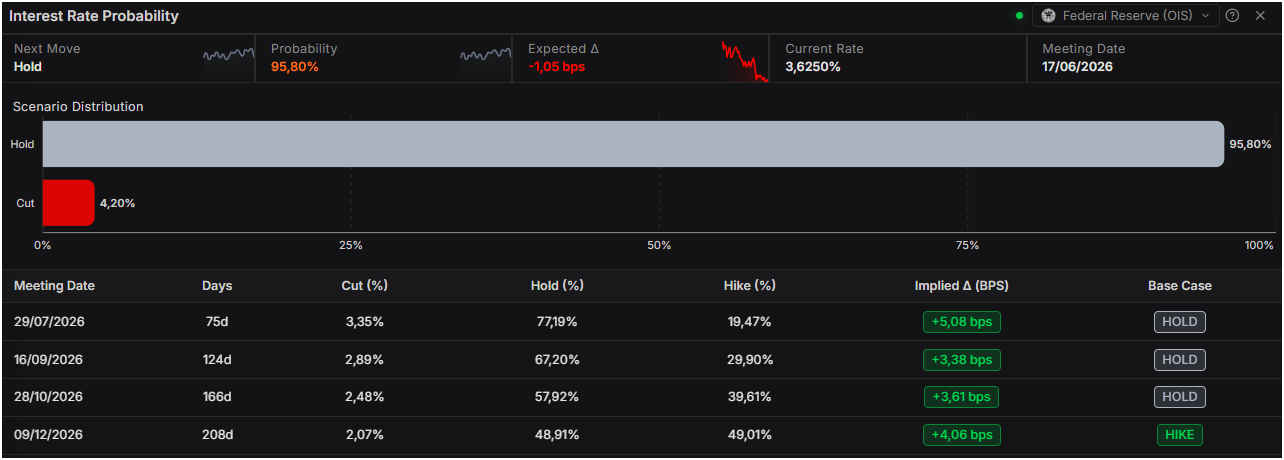
Prime Terminal data shows growing expectations that the Federal Reserve will raise rates in 2026, with the probability of a hike by year-end now at 50%.
Data from the US showed that Industrial Production improved in April, rising 0.7% MoM, exceeding estimates of 0.3% and March’s -0.3% contraction.
In the UK, political turmoil keeps Prime Minister Keir Starmer against the ropes as his health minister, Wes Streeting, resigned, while others are positioning to challenge his leadership.
Reuters revealed that Greater Manchester Mayor Andy Burnham “has been offered a path for a possible leadership challenge after another Labour lawmaker said he would resign his parliamentary seat.”
Next week, the UK economic schedule will feature jobs, inflation, flash PMIs and Retail Sales data, along with speeches by members of the Bank of England (BoE). In the US, traders are awaiting housing and jobs data, as well as Federal Reserve speakers.
Pound Sterling Price This week
The table below shows the percentage change of British Pound (GBP) against listed major currencies this week. British Pound was the strongest against the New Zealand Dollar.
| USD | EUR | GBP | JPY | CAD | AUD | NZD | CHF | |
|---|---|---|---|---|---|---|---|---|
| USD | 1.08% | 1.77% | 1.35% | 0.56% | 1.05% | 1.72% | 1.21% | |
| EUR | -1.08% | 0.66% | 0.31% | -0.54% | -0.04% | 0.61% | 0.11% | |
| GBP | -1.77% | -0.66% | -0.85% | -1.21% | -0.73% | -0.05% | -0.55% | |
| JPY | -1.35% | -0.31% | 0.85% | -0.84% | -0.31% | 0.36% | -0.11% | |
| CAD | -0.56% | 0.54% | 1.21% | 0.84% | 0.57% | 1.20% | 0.64% | |
| AUD | -1.05% | 0.04% | 0.73% | 0.31% | -0.57% | 0.66% | 0.16% | |
| NZD | -1.72% | -0.61% | 0.05% | -0.36% | -1.20% | -0.66% | -0.51% | |
| CHF | -1.21% | -0.11% | 0.55% | 0.11% | -0.64% | -0.16% | 0.51% |
The heat map shows percentage changes of major currencies against each other. The base currency is picked from the left column, while the quote currency is picked from the top row. For example, if you pick the British Pound from the left column and move along the horizontal line to the US Dollar, the percentage change displayed in the box will represent GBP (base)/USD (quote).
GBP/USD Price Forecast: Technical outlook
In the daily chart, GBP/USD trades at 1.3320, keeping a bearish near-term tone as spot holds beneath a dense cluster of the 50-, 100- and 200-day Simple Moving Averages (SMAs) grouped around 1.3430. The pair has slipped away from the prior break zone of the downward resistance trend line near 1.3616, while the Relative Strength Index (14) at about 37 points to building downside momentum rather than a completed oversold condition, suggesting sellers still retain control.
On the topside, initial resistance is defined by the converging 50-, 100- and 200-day SMAs around 1.3430, and a sustained recovery above this cluster would be needed to ease immediate downside pressure, exposing the former break area of the descending trend line near 1.3616. Absent a daily close back over these barriers, any rebounds are likely to be treated as corrective within the broader decline from recent highs.
(The technical analysis of this story was written with the help of an AI tool.)
Pound Sterling FAQs
The Pound Sterling (GBP) is the oldest currency in the world (886 AD) and the official currency of the United Kingdom. It is the fourth most traded unit for foreign exchange (FX) in the world, accounting for 12% of all transactions, averaging $630 billion a day, according to 2022 data. Its key trading pairs are GBP/USD, also known as ‘Cable’, which accounts for 11% of FX, GBP/JPY, or the ‘Dragon’ as it is known by traders (3%), and EUR/GBP (2%). The Pound Sterling is issued by the Bank of England (BoE).
The single most important factor influencing the value of the Pound Sterling is monetary policy decided by the Bank of England. The BoE bases its decisions on whether it has achieved its primary goal of “price stability” – a steady inflation rate of around 2%. Its primary tool for achieving this is the adjustment of interest rates. When inflation is too high, the BoE will try to rein it in by raising interest rates, making it more expensive for people and businesses to access credit. This is generally positive for GBP, as higher interest rates make the UK a more attractive place for global investors to park their money. When inflation falls too low it is a sign economic growth is slowing. In this scenario, the BoE will consider lowering interest rates to cheapen credit so businesses will borrow more to invest in growth-generating projects.
Data releases gauge the health of the economy and can impact the value of the Pound Sterling. Indicators such as GDP, Manufacturing and Services PMIs, and employment can all influence the direction of the GBP. A strong economy is good for Sterling. Not only does it attract more foreign investment but it may encourage the BoE to put up interest rates, which will directly strengthen GBP. Otherwise, if economic data is weak, the Pound Sterling is likely to fall.
Another significant data release for the Pound Sterling is the Trade Balance. This indicator measures the difference between what a country earns from its exports and what it spends on imports over a given period. If a country produces highly sought-after exports, its currency will benefit purely from the extra demand created from foreign buyers seeking to purchase these goods. Therefore, a positive net Trade Balance strengthens a currency and vice versa for a negative balance.
Nothing in this material constitutes investment advice, personal recommendation, investment research, an offer, or a solicitation to buy or sell any financial instrument. The content has been prepared without consideration of your individual investment objectives, financial situation, or needs, and should not be treated as such.
Past performance is not a reliable indicator of future performance and/or results. Forward-looking scenarios or forecasts are not a guarantee of future performance. Actual results may differ materially from those anticipated.
Mitrade makes no representation or warranty as to the accuracy or completeness of the information provided and accepts no liability for any loss arising from reliance on such information.
Recommended Articles


