



USD/INR opens flat as Fed’s policy comes under the spotlight
- The Indian Rupee trades flat in the opening session against the US Dollar at around 92.80 ahead of the Fed’s monetary policy.
- Investors expect the Fed to maintain the status quo amid higher oil prices.
- Consistent foreign outflows and higher oil prices are expected to keep the Indian Rupee on the back foot.
The Indian Rupee (INR) opens almost flat against the US Dollar (USD) on Wednesday. The USD/INR pair wobbles around 92.80 as investors shift to the sidelines ahead of the Federal Reserve’s (Fed) monetary policy announcement at 23:30 IST (18:00 GMT).
During the press time, the US Dollar Index (DXY), which gauges the Greenback’s value against six major currencies, trades flat around 99.50 after a steep correction in the last two trading days.
The USD Index faced selling pressure in the last two trading days as its safe-haven demand diminished amid a recovery in riskier assets. Investors’ risk appetite improved after Iran allowed tankers from some nations, which are one of the largest oil importers in the world, to ship energy products through the Strait of Hormuz.
Fed’s policy comes into the spotlight
The major highlight of the day is expected to be the Fed’s monetary policy announcement in which it is anticipated to leave interest rates unchanged in the range of 3.50%-3.75%, according to the CME FedWatch tool. This would be the second straight meeting when the Fed will hold interest rates steady.
As the Fed will likely maintain the status quo, investors will pay more attention to the Fed’s dot plot, a tool that shows where officials see interest rates heading in the near-to-longer term, and comments from Chairman Jerome Powell in his press conference regarding the monetary policy outlook.
The CME FedWatch tool also shows that traders are confident about the Fed keeping interest rates at their current levels till the July policy meeting. For the September meeting, traders see an almost 53% chance of an interest rate cut.
The speculation of the Fed holding interest rates steady in the near term has intensified due to de-anchored inflation expectations across the world amid surging oil prices in the wake of the war in the Middle East, which involves the United States (US), Israel, and Iran.
Outlook of Indian Rupee remains uncertain
The outlook for the Indian currency remains grim, partly due to higher oil prices and the consistent foreign outflows from the Indian equity market.
Currencies from nations like India, which are heavily dependent on oil imports to fulfill their energy needs, face higher outflows in high oil price conditions. Although Iran has allowed Indian-flagged tankers to ship oil and Liquefied Petroleum Gas (LPG) through the Strait of Hormuz, this has eased concerns about India's domestic energy supply, but higher oil prices could widen India's fiscal deficit.
So far in March, Foreign Institutional Investors (FIIs) have remained net sellers on all trading days and have offloaded their stake worth Rs. 70,989.96 crore, according to NSE data. There has been a significant outflow of foreign funds from the Indian stock market in March as higher oil prices have forced market experts to trim their earnings projections for the fourth quarter of FY 2025-26.
Technical Analysis: USD/INR stays firm above 20-day EMA
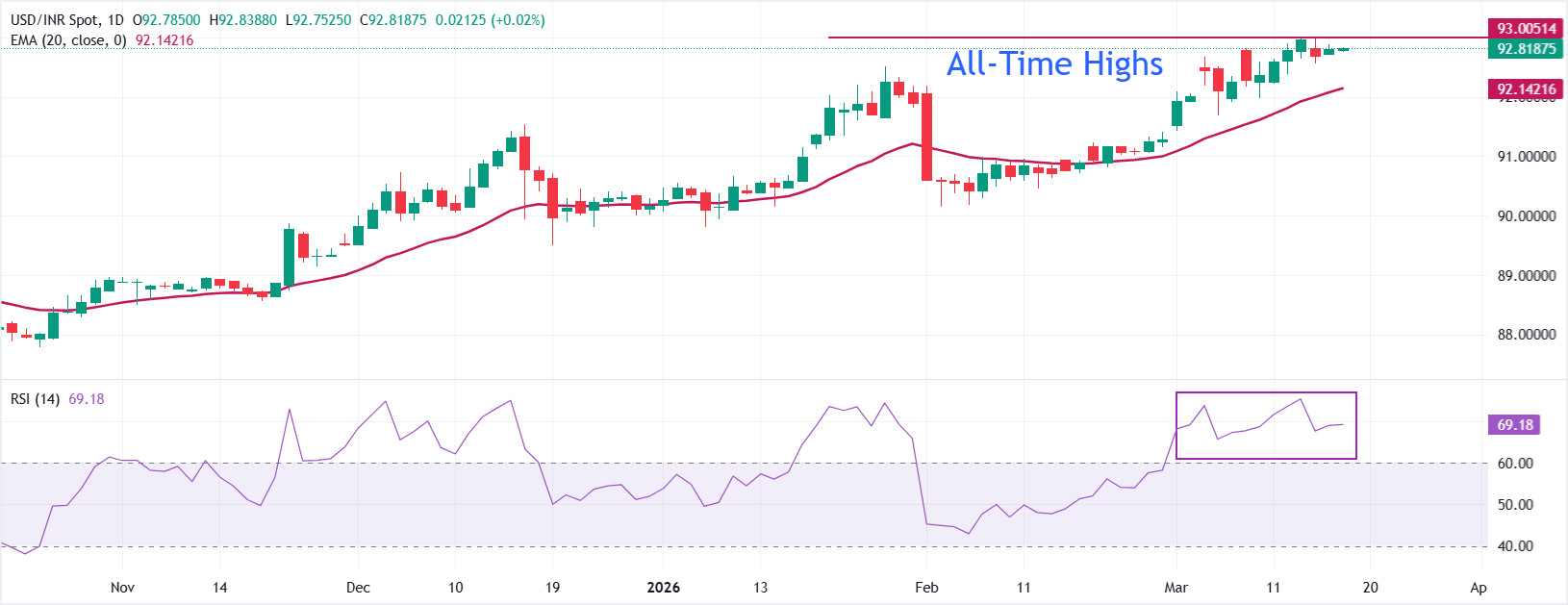
USD/INR consolidates around 92.80 as of writing. The near-term bias is bullish as price holds above the rising 20-day Exponential Moving Average (EMA), which has trailed the advance from the mid-90.50s and continues to provide dynamic support. The sequence of higher closes remains intact despite a brief pause, while the 14-day Relative Strength Index (RSI) in the 60.00-80.00 zone signals strong upside momentum.
Initial support emerges at the 20-day EMA around 92.15, followed by a deeper cushion at 91.70 that aligns with the prior breakout area. A daily close below the latter would weaken the bullish structure and expose 91.30 next. On the upside, immediate resistance is at 92.95, the all-time high posted on March 13, with a break above this level opening the path toward the 93.50 region as the next upside objective.
(The technical analysis of this story was written with the help of an AI tool.)
Indian Rupee FAQs
The Indian Rupee (INR) is one of the most sensitive currencies to external factors. The price of Crude Oil (the country is highly dependent on imported Oil), the value of the US Dollar – most trade is conducted in USD – and the level of foreign investment, are all influential. Direct intervention by the Reserve Bank of India (RBI) in FX markets to keep the exchange rate stable, as well as the level of interest rates set by the RBI, are further major influencing factors on the Rupee.
The Reserve Bank of India (RBI) actively intervenes in forex markets to maintain a stable exchange rate, to help facilitate trade. In addition, the RBI tries to maintain the inflation rate at its 4% target by adjusting interest rates. Higher interest rates usually strengthen the Rupee. This is due to the role of the ‘carry trade’ in which investors borrow in countries with lower interest rates so as to place their money in countries’ offering relatively higher interest rates and profit from the difference.
Macroeconomic factors that influence the value of the Rupee include inflation, interest rates, the economic growth rate (GDP), the balance of trade, and inflows from foreign investment. A higher growth rate can lead to more overseas investment, pushing up demand for the Rupee. A less negative balance of trade will eventually lead to a stronger Rupee. Higher interest rates, especially real rates (interest rates less inflation) are also positive for the Rupee. A risk-on environment can lead to greater inflows of Foreign Direct and Indirect Investment (FDI and FII), which also benefit the Rupee.
Higher inflation, particularly, if it is comparatively higher than India’s peers, is generally negative for the currency as it reflects devaluation through oversupply. Inflation also increases the cost of exports, leading to more Rupees being sold to purchase foreign imports, which is Rupee-negative. At the same time, higher inflation usually leads to the Reserve Bank of India (RBI) raising interest rates and this can be positive for the Rupee, due to increased demand from international investors. The opposite effect is true of lower inflation.
Nothing in this material constitutes investment advice, personal recommendation, investment research, an offer, or a solicitation to buy or sell any financial instrument. The content has been prepared without consideration of your individual investment objectives, financial situation, or needs, and should not be treated as such.
Past performance is not a reliable indicator of future performance and/or results. Forward-looking scenarios or forecasts are not a guarantee of future performance. Actual results may differ materially from those anticipated.
Mitrade makes no representation or warranty as to the accuracy or completeness of the information provided and accepts no liability for any loss arising from reliance on such information.
Recommended Articles


