



GBP/USD Price Forecast: Looks prepared for fresh rally towards 1.3720
- GBP/USD reflects strength near an over two-month high at around 1.3610.
- BoE’s Bailey has stated that the central bank won’t let second-round effects of inflation emerge.
- Investors await the US ISM Manufacturing PMI data for April.
The GBP/USD pair trades firmly near an over two-month high of around 1.3610 during the European trading session on Friday. The Cable outperforms as the Pound Sterling (GBP) reflects strength, following the Bank of England’s (BoE) monetary policy announcement on Thursday.
In the policy meeting, the BoE decided to leave interest rates unchanged at 3.75%, with an 8-1 majority, as expected, and stressed the need to raise interest rates if there might be second-round effects of higher energy prices-led inflation.
A prolonged spike in energy prices could lead to a higher bank rate, BoE Governor Andrew Bailey said in the press conference, adding, “It would be a mistake to wait to see the second-round effects before acting because then it would be too late,” Reuters reported.
Meanwhile, the continued underperformance of the US Dollar (USD) is also supporting the Cable. As of writing, the US Dollar Index (DXY), which tracks the Greenback’s value against six major currencies, trades slightly higher to near 98.20, but is close to its 10-day low of 98.00.
In Friday’s session, investors will focus on the US ISM Manufacturing PMI data for April, which will be published at 14:00 GMT. The US ISM Manufacturing PMI will likely come in at 53.0, higher than 52.7 in March.
GBP/USD technical analysis
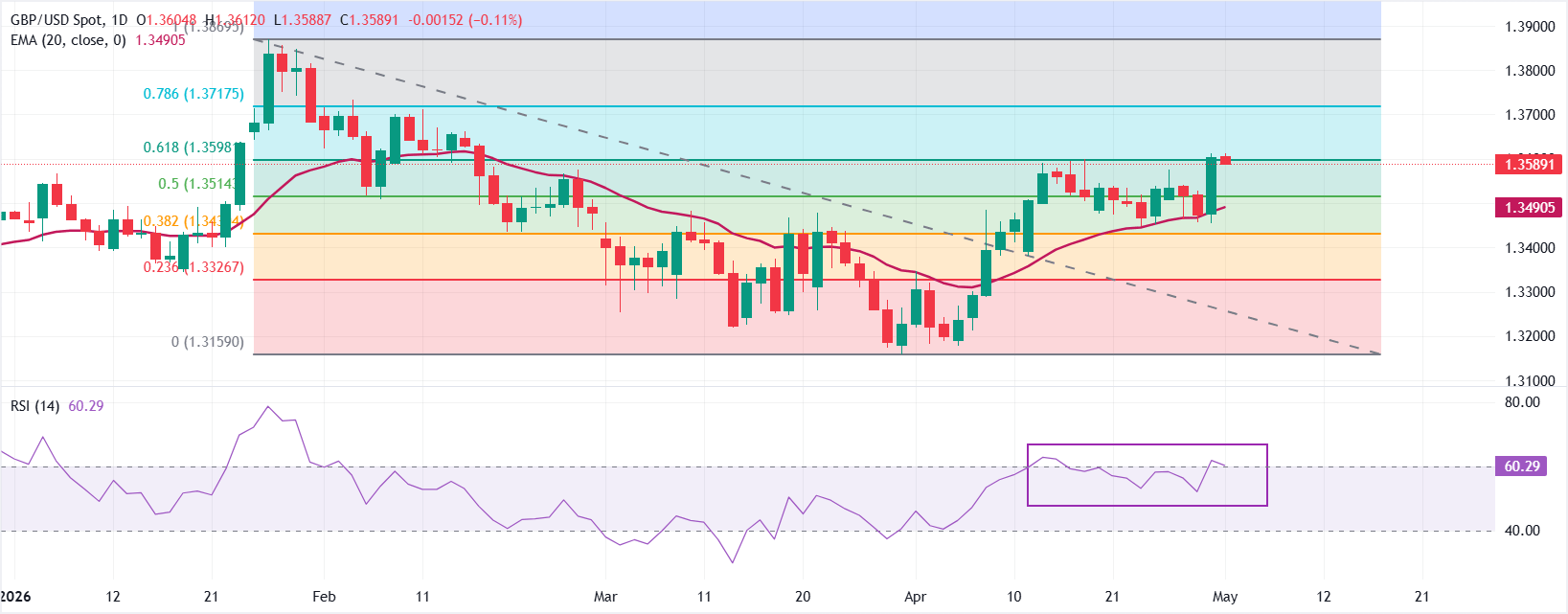
GBP/USD holds onto gains near 1.3610, retaining a constructive bullish bias as it holds above the 20-day Exponential Moving Average (EMA) at 1.3491 and the 50% Fibonacci retracement at 1.3514 of the 1.3159–1.3870 leg.
The Relative Strength Index (14) at 60.3 sits in positive territory without yet signaling overbought conditions, suggesting buyers still have room to press the advance.
On the topside, the price could advance towards the 78.6% retracement level at 1.3717 and the cycle high zone near the 100% retracement at 1.3870 if it manages to sustain above 61.8% retracement at 1.3600.
Looking down, initial support is seen at the 50% Fibonacci level at 1.3514 and the 20-day EMA at 1.3491, ahead of a deeper support band at the 38.2% retracement at 1.3430, with additional Fibonacci floors at 1.3327 and 1.3159 expected to underpin the broader uptrend if a corrective pullback unfolds.
(The technical analysis of this story was written with the help of an AI tool.)
BoE FAQs
The Bank of England (BoE) decides monetary policy for the United Kingdom. Its primary goal is to achieve ‘price stability’, or a steady inflation rate of 2%. Its tool for achieving this is via the adjustment of base lending rates. The BoE sets the rate at which it lends to commercial banks and banks lend to each other, determining the level of interest rates in the economy overall. This also impacts the value of the Pound Sterling (GBP).
When inflation is above the Bank of England’s target it responds by raising interest rates, making it more expensive for people and businesses to access credit. This is positive for the Pound Sterling because higher interest rates make the UK a more attractive place for global investors to park their money. When inflation falls below target, it is a sign economic growth is slowing, and the BoE will consider lowering interest rates to cheapen credit in the hope businesses will borrow to invest in growth-generating projects – a negative for the Pound Sterling.
In extreme situations, the Bank of England can enact a policy called Quantitative Easing (QE). QE is the process by which the BoE substantially increases the flow of credit in a stuck financial system. QE is a last resort policy when lowering interest rates will not achieve the necessary result. The process of QE involves the BoE printing money to buy assets – usually government or AAA-rated corporate bonds – from banks and other financial institutions. QE usually results in a weaker Pound Sterling.
Quantitative tightening (QT) is the reverse of QE, enacted when the economy is strengthening and inflation starts rising. Whilst in QE the Bank of England (BoE) purchases government and corporate bonds from financial institutions to encourage them to lend; in QT, the BoE stops buying more bonds, and stops reinvesting the principal maturing on the bonds it already holds. It is usually positive for the Pound Sterling.
Nothing in this material constitutes investment advice, personal recommendation, investment research, an offer, or a solicitation to buy or sell any financial instrument. The content has been prepared without consideration of your individual investment objectives, financial situation, or needs, and should not be treated as such.
Past performance is not a reliable indicator of future performance and/or results. Forward-looking scenarios or forecasts are not a guarantee of future performance. Actual results may differ materially from those anticipated.
Mitrade makes no representation or warranty as to the accuracy or completeness of the information provided and accepts no liability for any loss arising from reliance on such information.
Recommended Articles


