



Gold soars past $4,700 as geopolitical and trade tensions escalate
- Gold surges to another record above $4,700 as geopolitical and trade tensions fuel demand for defensive assets.
- Trump’s tariff threats and Greenland remarks revive transatlantic trade war fears and weaken the US Dollar.
- Bulls remain firmly in control, with technicals pointing toward a potential extension toward $4,800.
Gold (XAU/USD) hits yet another record high on Tuesday, climbing above the $4,700 psychological mark as rising geopolitical tensions drive strong safe-haven demand. At the time of writing, XAU/USD trades around $4,730, up nearly 1.25% for the day.
Market sentiment remains fragile as renewed US-EU trade tensions dominate headlines. Over the weekend, US President Donald Trump threatened fresh tariffs on eight European nations over the Greenland issue.
European leaders sharply criticized the move and warned that countermeasures are being prepared if the tariffs are implemented.
The developments have revived fears of a broader transatlantic trade war. The risk-off mood is weighing on global equities and strengthening demand for defensive assets.
Trump’s increasingly protectionist stance is also eroding confidence in US assets, putting pressure on the US dollar (USD) and prompting investors to shift into alternative G10 currencies and traditional safe havens such as Gold.
Beyond trade concerns, the ongoing Russia-Ukraine war and persistent tensions in the Middle East continue to keep geopolitical risk elevated. At the same time, robust institutional and investment demand alongside dovish Federal Reserve (Fed) expectations remain key drivers underpinning the metal’s broader uptrend.
Market movers: Trade tensions, court rulings and Fed leadership risks loom
- The US Dollar Index (DXY), which tracks the Greenback's value against a basket of six major currencies, extends its decline for a second straight day, trading around 98.45, near a two-week low.
- US President Donald Trump declined to rule out the use of military force to take control of Greenland in an interview with NBC News, responding, “No comment.” Separately, Trump wrote on Truth Social that Greenland is “imperative for National and World Security. There can be no going back — On that, everyone agrees!” after speaking with NATO Secretary General Mark Rutte, adding that the issue would also be discussed at the World Economic Forum in Davos.
- EU Foreign Policy Chief Kaja Kallas said Europe has “no interest in picking a fight” with the United States but will “hold our ground” and has “a slate of tools to protect its interests”. Analysts say the Eurozone could, in theory, use its large holdings of US assets, including Treasuries, as leverage if trade tensions with Washington escalate. The Eurozone is the largest foreign holder of US long-term Treasuries, accounting for around 21% of total foreign holdings.
- Markets are also bracing for major risk events this week, including a US Supreme Court ruling on the legality of President Trump’s tariffs, court arguments on Wednesday over Trump’s attempt to remove Fed Governor Lisa Cook over mortgage-fraud allegations, and a potential announcement of a new Fed Chair.
- Focus also turns to upcoming US economic data, with the ADP Employment Change 4-week average due later Tuesday, followed by the delayed Personal Consumption Expenditures (PCE) inflation data and third-quarter Gross Domestic Product (GDP) figures on Thursday. On Friday, attention turns to the preliminary S&P Global PMI surveys and the University of Michigan consumer sentiment data.
Technical analysis: XAU/USD eyes $4,800 as support builds near $4,700
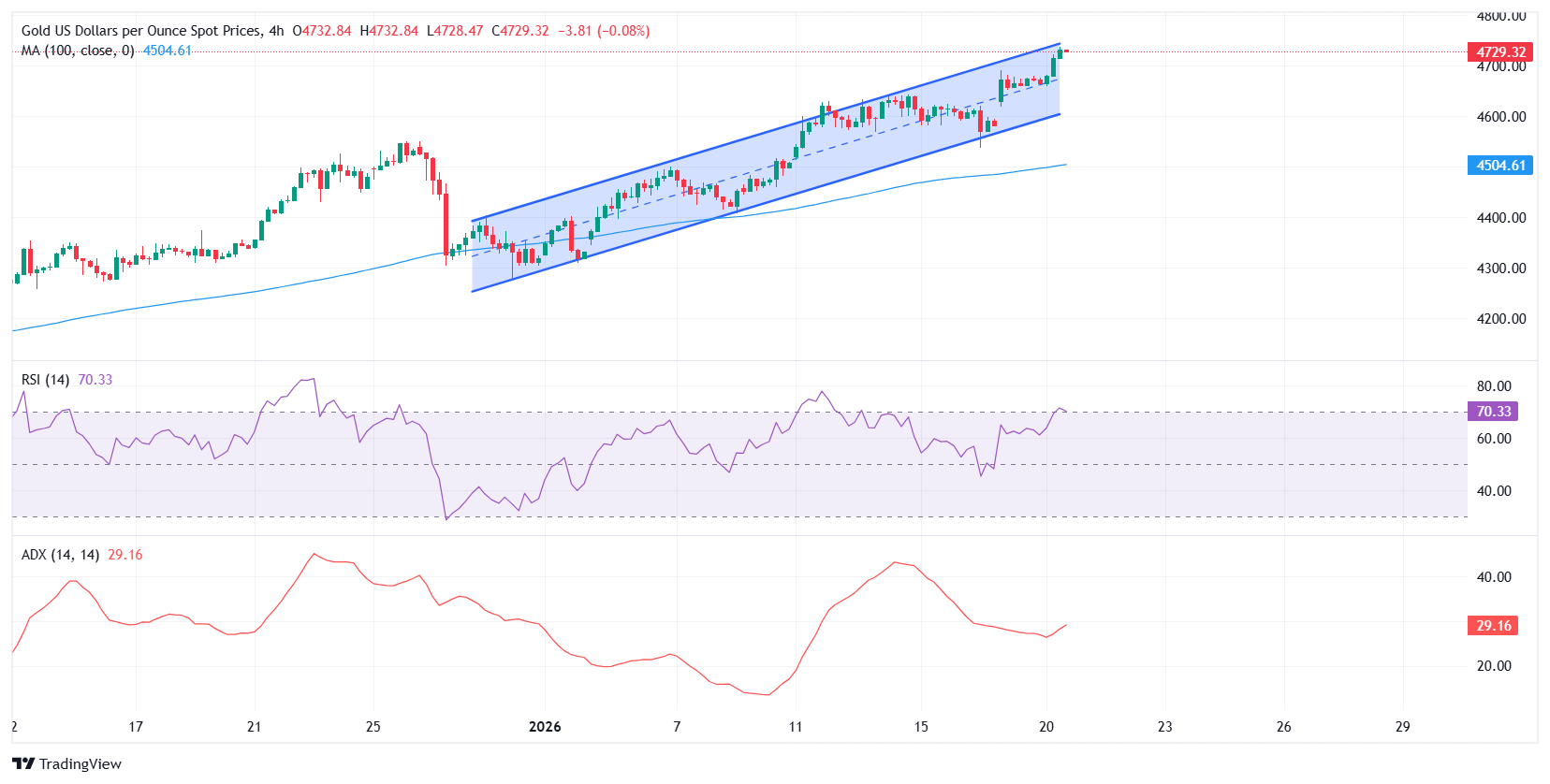
From a technical perspective, XAU/USD continues to push deeper into uncharted territory, with bullish momentum firmly in place. On the 4-hour chart, Gold is trading within a well-defined ascending parallel channel and is holding comfortably above its key moving averages, reinforcing the broader bullish bias.
On the downside, the $4,700 area now acts as the first important near-term pivot. A failure to sustain above this zone could open the door for a corrective pullback toward $4,650, followed by $4,600. Deeper support is seen near the 100-period SMA around $4,505.
On the upside, bulls may look to extend the rally toward the $4,750 region, with the next psychological objective emerging near $4,800.
Momentum indicators remain supportive. The Relative Strength Index (RSI) is holding in overbought territory near 70, reflecting strong upside pressure. Meanwhile, the Average Directional Index (ADX) near 29 suggests the broader uptrend remains firmly intact.
Gold FAQs
Gold has played a key role in human’s history as it has been widely used as a store of value and medium of exchange. Currently, apart from its shine and usage for jewelry, the precious metal is widely seen as a safe-haven asset, meaning that it is considered a good investment during turbulent times. Gold is also widely seen as a hedge against inflation and against depreciating currencies as it doesn’t rely on any specific issuer or government.
Central banks are the biggest Gold holders. In their aim to support their currencies in turbulent times, central banks tend to diversify their reserves and buy Gold to improve the perceived strength of the economy and the currency. High Gold reserves can be a source of trust for a country’s solvency. Central banks added 1,136 tonnes of Gold worth around $70 billion to their reserves in 2022, according to data from the World Gold Council. This is the highest yearly purchase since records began. Central banks from emerging economies such as China, India and Turkey are quickly increasing their Gold reserves.
Gold has an inverse correlation with the US Dollar and US Treasuries, which are both major reserve and safe-haven assets. When the Dollar depreciates, Gold tends to rise, enabling investors and central banks to diversify their assets in turbulent times. Gold is also inversely correlated with risk assets. A rally in the stock market tends to weaken Gold price, while sell-offs in riskier markets tend to favor the precious metal.
The price can move due to a wide range of factors. Geopolitical instability or fears of a deep recession can quickly make Gold price escalate due to its safe-haven status. As a yield-less asset, Gold tends to rise with lower interest rates, while higher cost of money usually weighs down on the yellow metal. Still, most moves depend on how the US Dollar (USD) behaves as the asset is priced in dollars (XAU/USD). A strong Dollar tends to keep the price of Gold controlled, whereas a weaker Dollar is likely to push Gold prices up.
Nothing in this material constitutes investment advice, personal recommendation, investment research, an offer, or a solicitation to buy or sell any financial instrument. The content has been prepared without consideration of your individual investment objectives, financial situation, or needs, and should not be treated as such.
Past performance is not a reliable indicator of future performance and/or results. Forward-looking scenarios or forecasts are not a guarantee of future performance. Actual results may differ materially from those anticipated.
Mitrade makes no representation or warranty as to the accuracy or completeness of the information provided and accepts no liability for any loss arising from reliance on such information.
Recommended Articles


