



Gold slides nearly 2% as US Dollar strength triggers fresh liquidation
- Gold slides to $4,880 as broad US Dollar strength and profit-taking weigh on precious metals.
- Weak US labor data clashes with Bostic’s hawkish tone, limiting the Dollar's downside.
- Policy divergence persists as the ECB holds rates while the BoE signals easing ahead.
Gold price (XAU/USD) tumbles during the North American session on Thursday as precious metals continue their liquidation mode, while the Greenback recovers some ground amid worse-than-expected economic data in the US. Two major central banks held rates unchanged, yet the Bank of England (BoE) signals that further easing is coming. At the time of writing, XAU/USD trades at $4,880, down 1.75%.
XAU/USD extends losses despite weak US labor data as profit-taking and central bank signals favor the Greenback
Broad US Dollar strength and traders booking profits sent the precious metals diving for the second consecutive day day. The European Central Bank (ECB) and the BoE maintained the status quo, with the former set to remain on hold, while the latter is poised to reduce rates twice in 2026.
Data in the United States (US) revealed weakness in the labor market. The Job Openings and Labor Turnover Survey (JOLTS) report for December revealed a low hiring environment. Jobless Claims for the previous week exceeded estimates, while the Challenger Job Cuts for January rose sharply, indicating companies are reducing their workforce.
Given the backdrop, Bullion prices should be higher, but the Greenback remains strong for the second straight day.
Recently, Atlanta Federal Reserve (Fed) President Raphael Bostic said that inflation is too high for too long, and that the Fed is going to do its job well, as it has to think about issues over the long run.
Aside from this, the US Treasury Secretary Scott Bessent said that whether to sue Kevin Warsh over Fed rates policy is up to US President Trump, and added that he does not favor 0% tariffs on Canada, following their deal with China.
Daily market movers: US Dollar advances amid soft US jobs data
- The US Challenger, Gray & Christmas report showed that companies announced 108.435K layoffs in January, marking a 118% increase from a year earlier, while hiring intentions fell by 13%.
- Initial Jobless Claims released by the Department of Labor rose sharply to 231K in the week ending January 31, missing expectations of 212K.
- The Job Openings and Labor Turnover Survey (JOLTS) for December underscored growing caution among employers, with job openings dropping to 6.542 million from 6.928 million in November, well below forecasts of 7.2 million.
- Despite this, the US Dollar Index (DXY), which measures the buck’s performance against six currencies, is up 0.11% at 97.75, a headwind for Gold and Silver prices.
- Contrarily, US Treasury bond yields are plunging. The US 10-year Treasury note yield is dropping six basis points to 4.183% as investors grow confident that the Federal Reserve will ease at least twice in 2025.
- Money markets ramped up expectations from 50 to 56 basis points of Fed easing towards the year-end, according to Prime Market Terminal data.
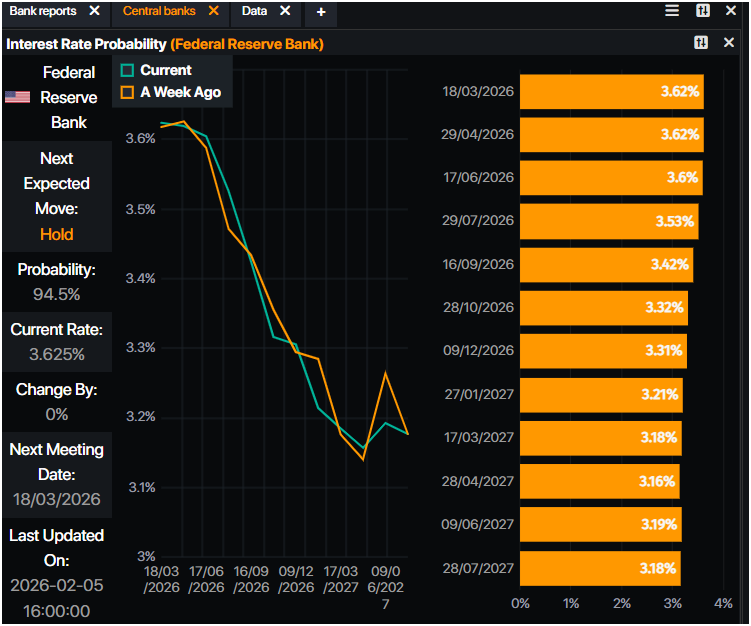
- Easing geopolitical tensions weighed on Gold prices. Russia and Ukraine agreed to a major prisoner swap after sustaining talks between both countries and the US. On Wednesday, US President Donald Trump revealed that he had a good call with the Chinese President Xi Jinping.
- Eyes are also on the resumption of US-Iran talks in Oman, on Friday.
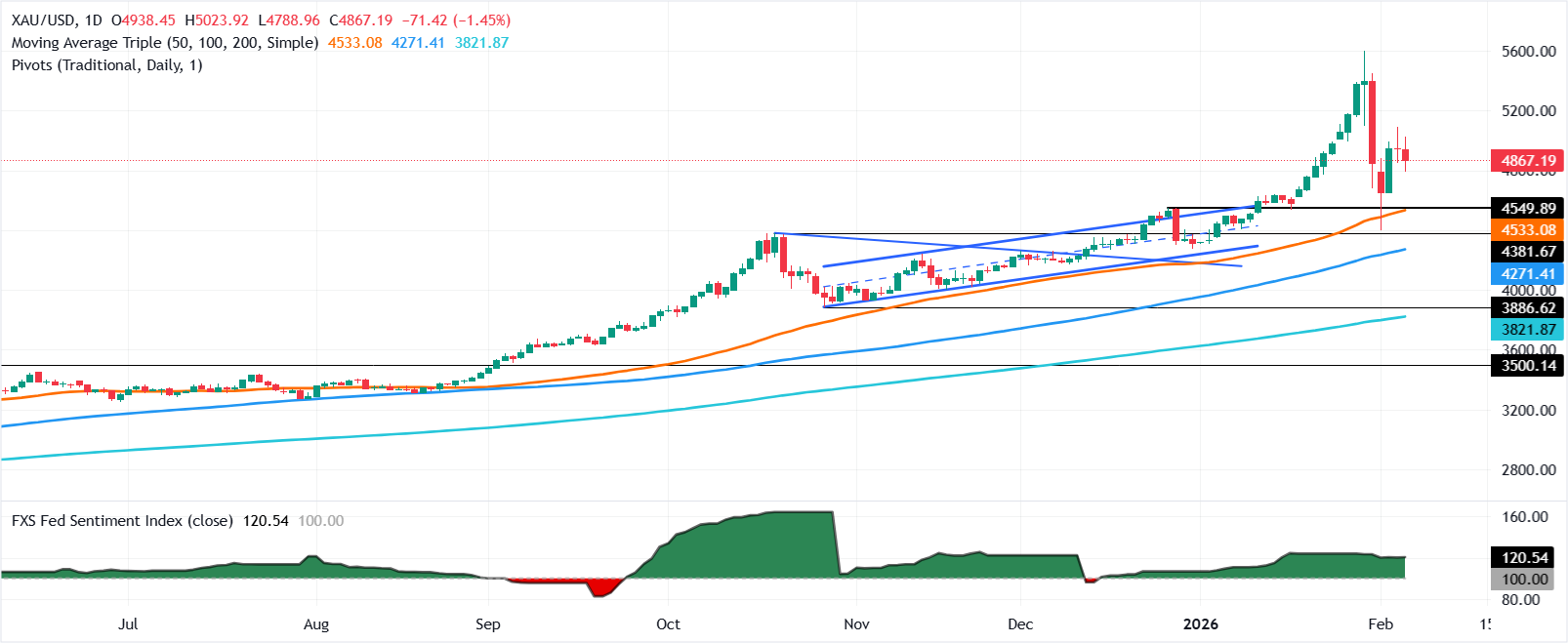
Technical outlook: Gold retreats towards $4,800 as buyers take a breather
Gold’s uptrend continues on the daily chart, but recent volatility calls for caution in the short term. Bulls seem to have lost momentum as depicted by the Relative Strength Index (RSI), which exited from extreme overbought territory, plummeting below its neutral level. However, during the last four days, it turned bullish.
For a bullish continuation, buyers must reclaim $4,900. A breach of the latter will expose the $4,950, followed by $5,000. Conversely, if Gold closes on a daily basis below the 20-day Simple Moving Average (SMA) of $4,842, it could exacerbate a drop towards $4,800. Once cleared, the next stop is $4,666, the February 3 daily low.
Gold FAQs
Gold has played a key role in human’s history as it has been widely used as a store of value and medium of exchange. Currently, apart from its shine and usage for jewelry, the precious metal is widely seen as a safe-haven asset, meaning that it is considered a good investment during turbulent times. Gold is also widely seen as a hedge against inflation and against depreciating currencies as it doesn’t rely on any specific issuer or government.
Central banks are the biggest Gold holders. In their aim to support their currencies in turbulent times, central banks tend to diversify their reserves and buy Gold to improve the perceived strength of the economy and the currency. High Gold reserves can be a source of trust for a country’s solvency. Central banks added 1,136 tonnes of Gold worth around $70 billion to their reserves in 2022, according to data from the World Gold Council. This is the highest yearly purchase since records began. Central banks from emerging economies such as China, India and Turkey are quickly increasing their Gold reserves.
Gold has an inverse correlation with the US Dollar and US Treasuries, which are both major reserve and safe-haven assets. When the Dollar depreciates, Gold tends to rise, enabling investors and central banks to diversify their assets in turbulent times. Gold is also inversely correlated with risk assets. A rally in the stock market tends to weaken Gold price, while sell-offs in riskier markets tend to favor the precious metal.
The price can move due to a wide range of factors. Geopolitical instability or fears of a deep recession can quickly make Gold price escalate due to its safe-haven status. As a yield-less asset, Gold tends to rise with lower interest rates, while higher cost of money usually weighs down on the yellow metal. Still, most moves depend on how the US Dollar (USD) behaves as the asset is priced in dollars (XAU/USD). A strong Dollar tends to keep the price of Gold controlled, whereas a weaker Dollar is likely to push Gold prices up.
Nothing in this material constitutes investment advice, personal recommendation, investment research, an offer, or a solicitation to buy or sell any financial instrument. The content has been prepared without consideration of your individual investment objectives, financial situation, or needs, and should not be treated as such.
Past performance is not a reliable indicator of future performance and/or results. Forward-looking scenarios or forecasts are not a guarantee of future performance. Actual results may differ materially from those anticipated.
Mitrade makes no representation or warranty as to the accuracy or completeness of the information provided and accepts no liability for any loss arising from reliance on such information.
Recommended Articles


