



USD/MXN (USDMXN) Is down 0.53% on Jun 25: Why It Happened
USD/MXN (USDMXN) is down 0.53% at Jun 25 13:30(ET), now at $17.50204, with a 7-day up of 0.83%.
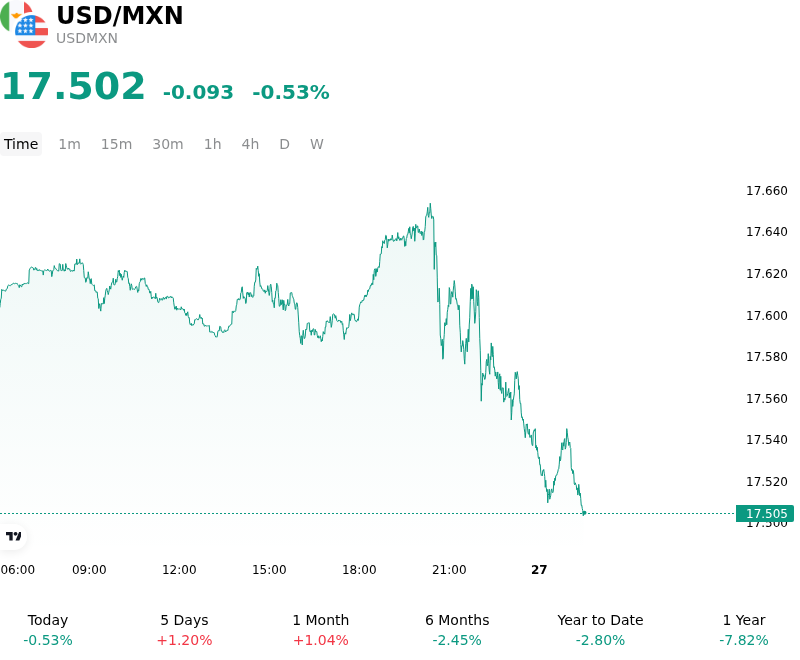
What is driving USD/MXN (USDMXN)’s stock price down today?
The US dollar lost ground against the Mexican peso as investors digested key macroeconomic data from the United States and positioned themselves ahead of the Bank of Mexico’s monetary policy announcement. The decline in the currency pair reflects a combination of easing hawkish expectations for the Federal Reserve and a reinforced interest-rate support story for the high-yielding peso.
In the United States, the release of the highly anticipated May Personal Consumption Expenditures price index provided relief to financial markets. While core PCE inflation grew in line with estimates, the headline monthly figure rose slightly below the consensus forecast. This moderation in monthly price pressures tempered fears of an even more aggressive tightening cycle from the Federal Reserve, prompting a pullback in the US Dollar Index from its recent thirteen-month highs. Although first-quarter US GDP growth was revised upward to a solid annualized rate of 2.1 percent, the underlying consumer spending details were marked down. This combination of stable inflation and mixed economic details led to a downward drift in US Treasury yields, reducing the greenback’s immediate upward momentum.
On the other side of the currency pair, the Mexican peso was bolstered by expectations of a prolonged policy hold from its central bank. Market participants overwhelmingly expected the Bank of Mexico to maintain its benchmark interest rate at its restrictive level of 6.50 percent, in line with prior signals that the domestic easing cycle had concluded. By keeping interest rates steady, policymakers preserve Mexico’s substantial carry-trade advantage and policy buffer against the Federal Reserve. Although recent bi-weekly domestic inflation data showed headline prices easing more than expected to a multi-month low of 3.55 percent, persistent core services inflation keeps the central bank in a cautious, data-dependent stance, assuring investors that a near-term pivot back to rate cuts is unlikely.
Furthermore, a broader shift in global risk sentiment supported the emerging market currency. A sharp drop in international crude oil prices, fueled by easing geopolitical tensions and potential ceasefire progress in the Middle East, alleviated global energy-cost concerns. This reduction in commodity-price volatility benefited global risk assets and fueled demand for high-beta, high-yielding currencies like the peso, allowing it to claw back its recent technical losses against the dollar.
Overall, the intraday pullback in the currency pair appears to be an event-driven consolidation of the dollar's recent rally, rather than a full reversal of the broader macro trend. Investors continue to monitor upcoming US labor market reports and potential trade policy risks related to the upcoming trade agreement reviews, which remain key structural hurdles for the Mexican peso.
Technical Analysis of USD/MXN (USDMXN)
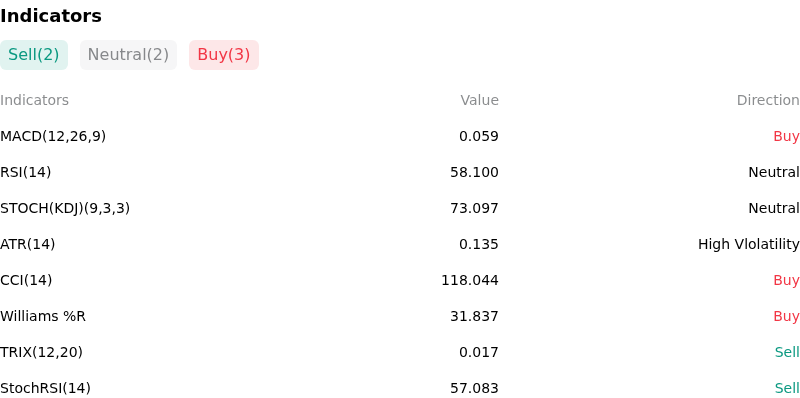
Technically, USD/MXN (USDMXN) shows a MACD (12,26,9) value of 0.059, indicating a buy signal. The RSI at 58.100 suggests neutral condition and the Williams %R at 31.837 suggests buy condition. Please monitor closely.
More details about USD/MXN (USDMXN)
Recent Events and Risks:
- Monetary Policy and Carry-Trade Compression: The yield spread between Banxico and the Federal Reserve has compressed to a decade-narrow 275 basis points, severely eroding the Peso's carry-trade appeal. With Banxico expected to hold its policy rate at 6.50% on June 25, 2026, any dovish-leaning communication responding to the sharper-than-expected decline in early June inflation to 3.55% could challenge market pricing of future tightening and spark a sharp upward repricing in USD/MXN.
- Impending USMCA Review Deadline: With the critical July 1, 2026, USMCA treaty review deadline less than a week away, intense friction in negotiations and political uncertainty regarding a potential 16-year extension versus a shift to highly volatile annual reviews are weighing heavily on the Mexican currency. This structural trade risk has already prompted local exporters to halt capital expenditures.
- Severe Economic Stagnation and Growth Downgrades: Mexico's deteriorating domestic growth outlook continues to trigger growth-related capital outflows. Banxico's regional report released on June 22, 2026, highlighted a 1.0% economic contraction in the crucial northern border states during Q1, compounding a broader national GDP contraction of 0.6% q/q and leading the central bank to slash Mexico's 2026 GDP growth forecast to just 1.1%.
- Technical Breakout Fueled by Safe-Haven USD Demand: Hawkish Federal Reserve rate projections and global risk-off sentiment have triggered a strong US Dollar rally, pushing USD/MXN above the key 17.50 psychological resistance hurdle for the first time in nearly three months. This technical breakout exposes the pair to rapid intraday volatility, bringing the 200-day moving average near 17.78 into play.
Nothing in this material constitutes investment advice, personal recommendation, investment research, an offer, or a solicitation to buy or sell any financial instrument. The content has been prepared without consideration of your individual investment objectives, financial situation, or needs, and should not be treated as such.
Past performance is not a reliable indicator of future performance and/or results. Forward-looking scenarios or forecasts are not a guarantee of future performance. Actual results may differ materially from those anticipated.
Mitrade makes no representation or warranty as to the accuracy or completeness of the information provided and accepts no liability for any loss arising from reliance on such information.
Recommended Articles


