



The Trumponomics Ebook: Oil Price Volatility in the Iran War

DOWNLOAD EBOOK HERE
Global markets went into 2026 caught in a vice. Trumponomics — the mix of aggressive import tariffs, tax cuts and deregulation that defined Donald Trump's second term — did not merely reset US economic policy. It rewired how prices move across equities, currencies and commodities.
For anyone learning how to trade CFDs, the starting point is often the force driving price movements: volatility itself. What follows is the shape of the regime, the pressures behind it, and an examination of why oil price volatility in 2026 did not behave like any recent historical patterns. This is a short read drawn from Mitrade’s new eBook, “Decoding Trumponomics: Trading Volatility in 2026”, now available for free download at the bottom of this page.
The New Market Volatility Regime
When the Cboe Volatility Index (VIX) — Wall Street's so-called fear gauge — surged past 31 in March 2026, it did not simply register a number. It reflected what traders across asset classes had already been observing: market conditions were shifting.
Three forces are converging behind this:
Trumponomics caused by tariff escalation
Central banks gridlocked between inflation and slowing growth
Widening Middle East war disrupting global supply chains
Taken together, these forces have created a market environment in which understanding what drives price movement is no longer a background exercise, but is becoming increasingly important.
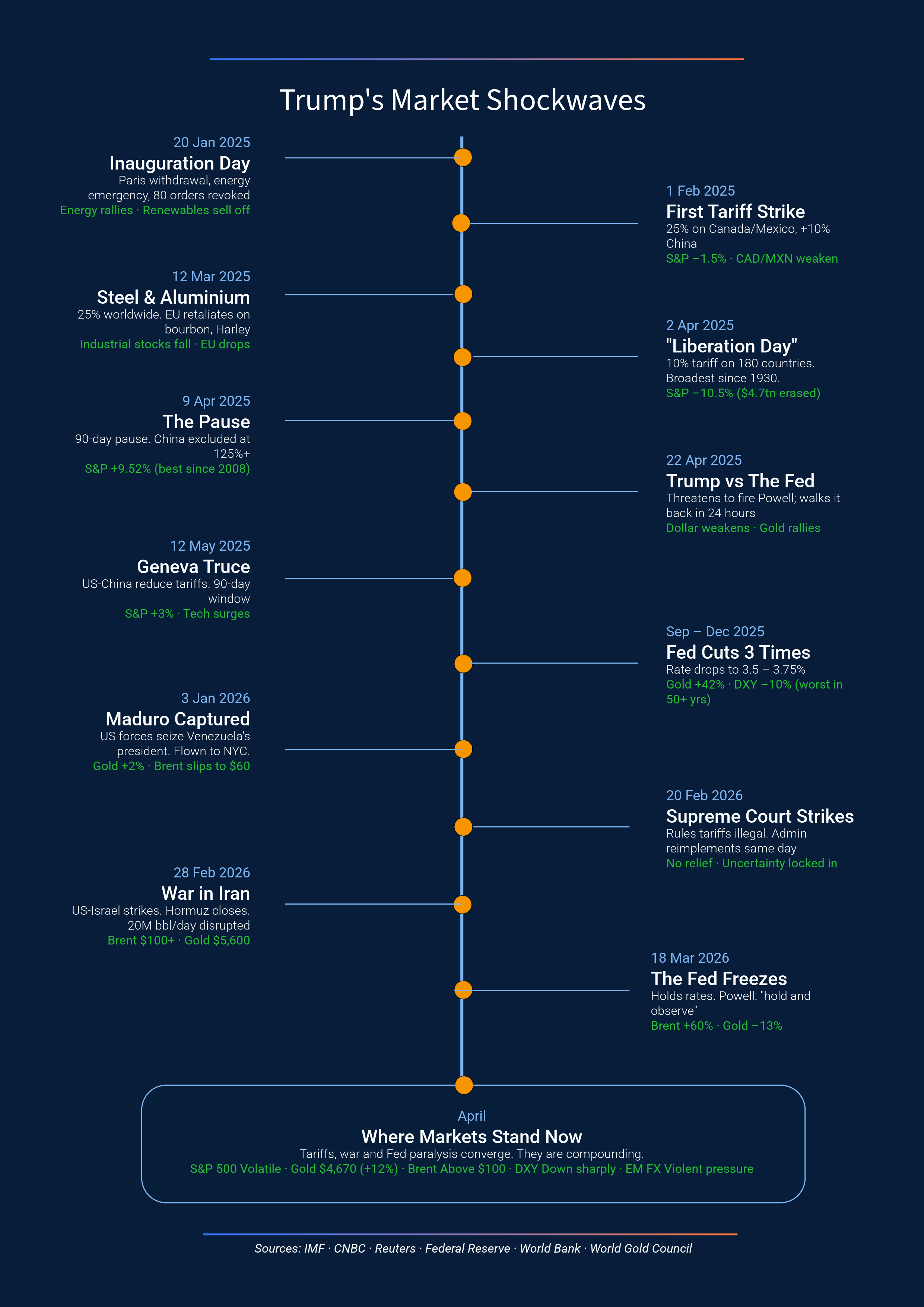
The Volatility Regime: Why Trumponomics 2026 Changed the Rules for Traders
How Tariff Reshaped Global Stock Markets
The first concrete shockwave of Trump's second term arrived in April 2025, when the administration imposed a universal 10% tariff on imports from 180 countries — the broadest US escalation since the Smoot-Hawley Tariff Act of 1930, according to the International Monetary Fund. Tariffs change the cost of doing business across entire supply chains, and modern supply chains are global:
Germany's DAX Index plunged roughly 10% at market opening on 7 April 2025
Australia's ASX 200 lost more than 7% across three sessions
The Indian rupee tumbled against the dollar, driven by tariffs, capital outflows and weak trade momentum.
The Turkish lira lost 17% of its value against the US dollar across 2025
A single policy decision in Washington reshaped how money moves around the world. That reflects the interconnected nature of a globalised economy.
How US Interest Rates Affect Global Markets
Through the second half of 2025, the Fed cut its benchmark rate three times, bringing it down to a target range of 3.5%–3.75%. Inflation had cooled. Unemployment sat between 4.3% and 4.4%.
The Fed's reach extends far beyond America. When it raises rates, global investors may shift capital into US assets seeking potentially higher returns, which can draw capital away from other markets. When it cuts, those flows may reverse. A single rate decision in Washington directly affects how much capital is available in global financial centres.
How the US-Led War in Iran Disrupted the Strait of Hormuz
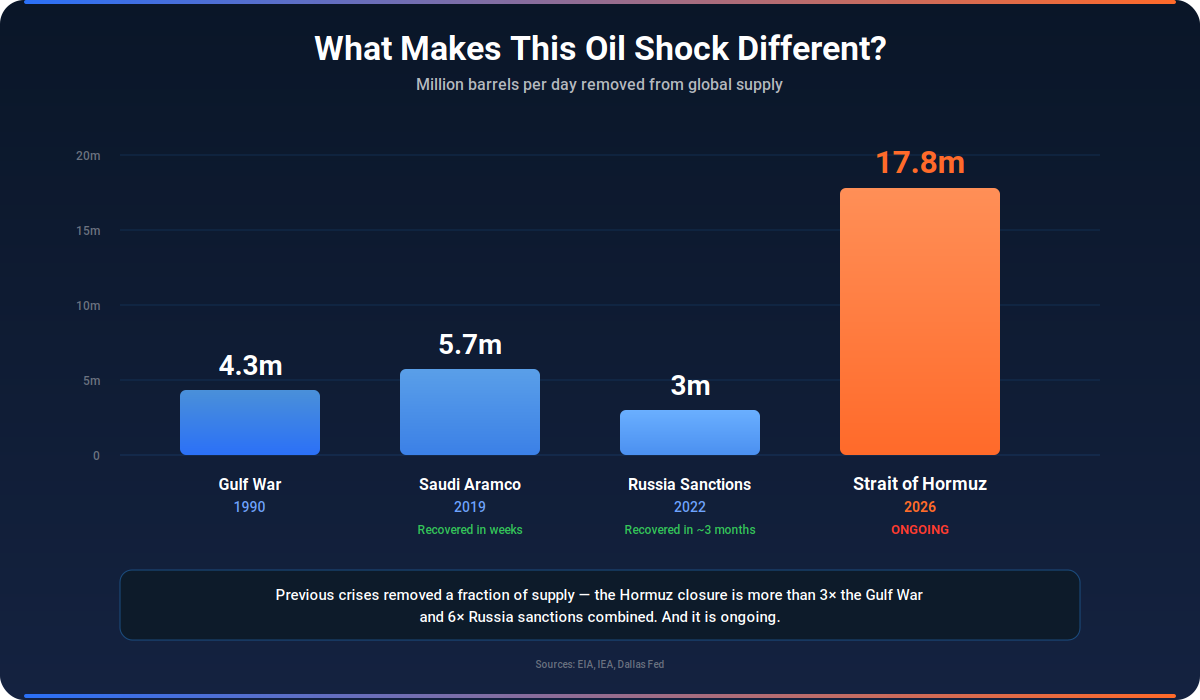
In late February 2026, conflict erupted in the Middle East. Within days, the Strait of Hormuz became the centre of a global energy crisis. About 20 million barrels of oil pass through it every day, along with roughly one-fifth of the world's liquefied natural gas trade, according to the US Energy Information Administration. In early March 2026, the strait was effectively closed.
The closure turned it into a case study: oil prices surged, energy supply chains fractured, and the cost of everything connected to fuel — shipping, manufacturing, farming, fertiliser — began climbing simultaneously.
Why US Policies Influence Global Markets
The thread running through those three forces is the same: it is possible to avoid US markets, but not the ripple effect of US policies on global markets. Three structural links tie every market back to Washington. The dollar is the world's reserve currency. Commodities, cross-border trade and emerging-market debt are priced in it — so any position on gold, oil or an emerging-market currency carries dollar exposure by default.
The Federal Reserve sets borrowing costs for the world's largest economy, and other central banks follow — one Fed decision can influence capital flows across global markets
US trade policy can reshape rules for dozens of economies with a single signature, making Washington announcements a fkey factor influencing global market conditions.
With this landscape laid out, we explore how oil prices affect the global economy.
A single policy decision in Washington reshaped how money moves around the world. That reflects the interconnected nature of a globalised economy.
Oil Price Volatility: Why the Hormuz Shock Had No Cushion
The March 2026 oil shock had two causes, the first one made the second one worse.
Cause one: Venezuala was already blocked. In February 2025, the Trump administration revoked Chevron's licence to export Venezuelan crude. Further enforcement through 2025 shut Venezuela out of global markets. At the time, this just meant tighter supply. Its real significance came later.
Cause two: The Gulf was cut off. On 28 February 2026, joint US–Israeli strikes on Iran shut down shipping through the Strait of Hormuz. Gulf oil — the world's largest supply — was suddenly stuck.
Why it mattered that both happened: Under normal circumstances, a disruption in the Gulf is cushioned by two key backup sources. The first is non-Gulf supply, such as Venezuela. The second is OPEC+ spare capacity, largely held by Saudi Arabia and the UAE. This time, both failed at once. Sanctions had already pushed Venezuela out of the market. Saudi and UAE spare capacity sat inside the Gulf, behind the same chokepoint. When the Strait of Hormuz closed, neither could compensate. Because the shortage was physical — not just fear or speculation — prices did not reverse. The oil was not just more expensive. It was also physically stuck.
In 2025 and early 2026, oil markets demonstrated how headline-driven volatility can temporarily overshadow traditional fundamental analysis. As the chart illustrates, prices frequently reacted rapidly to news events: such as tariff announcements, military escalations, and sanction shifts-often before physical supply and demand data could be fully assessed. This period highlights how geopolitical developments can trigger sudden and unpredictable price movements in either direction.
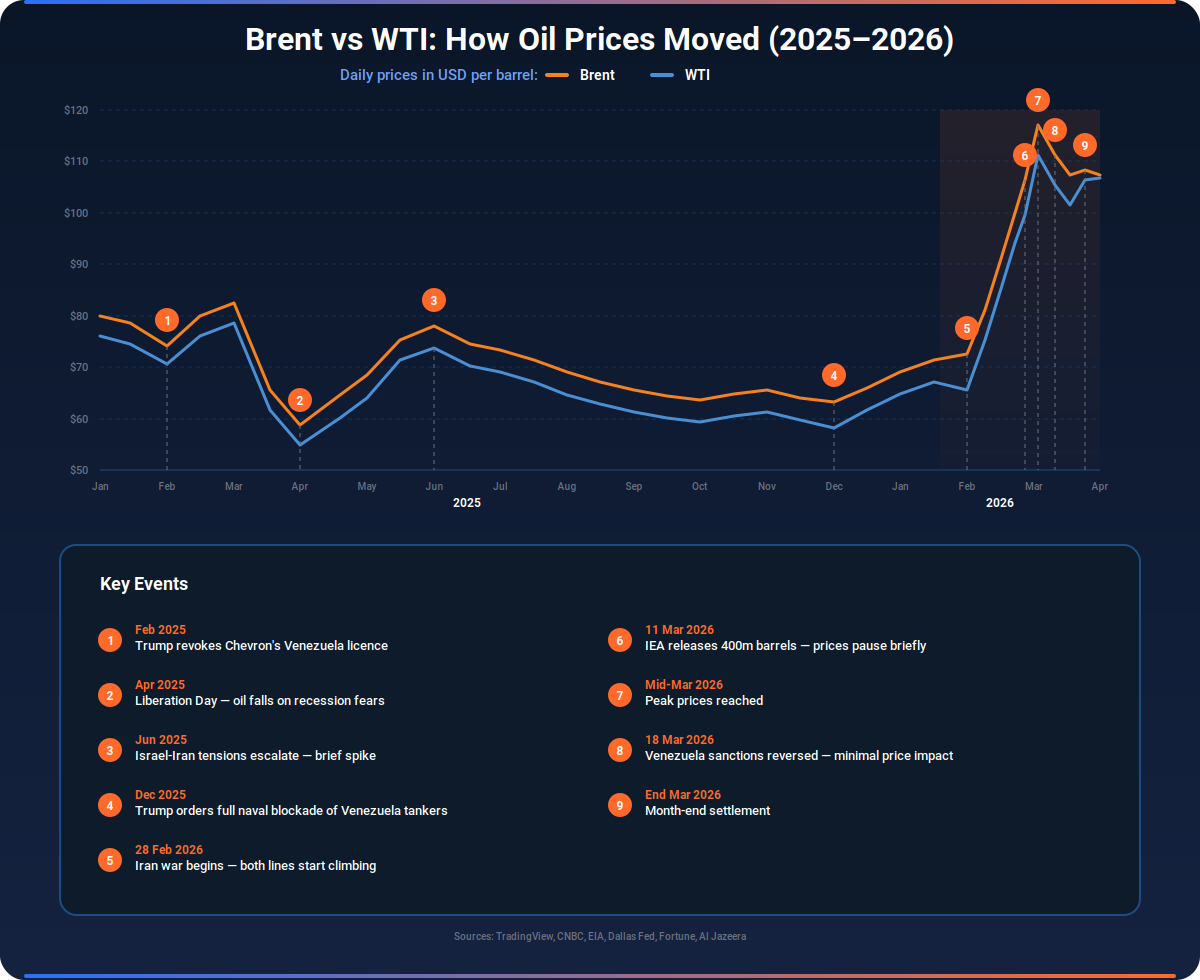
When news is driving the market, prices move on headlines before they move on supply and demand. Watching the news matters as much as watching the numbers. Here's how the shock hit different parts of the world.
The Oil Price Volatility that Hit Everywhere at Once
Most Asian oil imports from the Middle East price against Dubai crude, so when Dubai hit a record high in mid-March — well above Brent's peak — the cost flowed into the real economy, and some Asian refiners switched to pricing US imports against Brent. The impact was observed through four channels: import bills, manufacturing costs, inflation fears and currency pressure.
South Korea imports almost all its energy, and with recession fears landing at the same time, the KOSPI fell 12% on 4 March — its biggest single-day drop ever, triggering an automatic trading halt.
Japan took the sharpest cross-asset hit. The Nikkei 225 fell 13% in March — its worst month since October 2008 — the yen weakened past USD/JPY 160, and on 11 March Japan tapped 80 million barrels from its emergency reserves. and on 11 March Japan tapped 80 million barrels from its emergency reserves.
Thailand's SET fell 8% the same morning, triggering a twelve-minute halt. Power companies led the fall as fuel costs rose faster than electricity prices. The baht weakened too: higher jet fuel forced airlines to cut flights, thinning tourist dollar inflows, and Bank of America cut its baht forecast to 33 per dollar.
India imports about 88% of its oil, and sold rupees for dollars to pay the larger bill — pushing the rupee to a record low of 93.94 on 23 March and past 94 by month-end.
What this means for CFD traders:
During an oil shock, Asian stocks and currencies often move on oil — not earnings or economic data. The most oil-dependent countries show the biggest moves.
Multiple pressures hit at once — import bills, manufacturing costs, inflation fears and currency weakness all land together.
Observing the oil prices, the currency pairs (USD/KRW, USD/JPY, USD/INR, USD/THB) and the stock indexes together may provide broader context for market movements.
Latin America: A late fix and a slow-building pressure
By early 2026, a year of tightening US sanctions had effectively locked Venezuelan crude out of global markets, with measures escalating from financial restrictions to tanker seizures and a broader naval blockade that sharply reduced exports. When the Hormuz closure created a global shortage, the Treasury reversed course on 18 March — but years of decay in Venezuela's oilfields meant no meaningful supply reached the market. Prices continued to rise based on actual supply reaching the market, not what the headlines promised.
Brazil showed a different pass-through. Because mills can turn sugarcane into either sugar or ethanol, high oil prices made ethanol the better bet, cane shifted away from sugar, and food and drink manufacturers faced rising input costs. A single oil shock ended up on grocery shelves, and in the share prices of food and beverage companies.
What this means for CFD traders:
A policy change is not always a price change. The US reversed Venezuela sanctions to bring more oil to market, but no physical supply actually arrived — and prices kept rising.
Cross-commodity links can move prices in places you don't expect. An oil shock can reach sugar prices through Brazilian mill economics, then flow into food and beverage share prices.
Infrastructure decay sets the real speed of a supply response. Venezuela had the legal right to sell after 18 March but couldn't deliver at scale — production capacity and shipping take years to rebuild, not days.
Closing Perspectives
The 2026 regime highlights the importance of a broader, multi-market perspective. When US policy, geopolitical risk and central-bank constraint compound in the same week, reading them as one picture is what separates traders who react to headlines from traders who read them. Understanding how oil markets respond in this environment may require monitoring multiple factors at once rather than focusing on a single indicator in isolation.
The full Mitrade eBook, Decoding Trumponomics: Trading Volatility in 2026, expands on the themes discussed in this article, broadening the analysis across other key commodities and markets.
Download Trumpnomics Ebook

Get the FREE Trumponomics Ebook
What's inside:
Two additional commodity cascades, region by region
Markets carrying the highest levels of exposure
Understanding price movements beyond the charts
The role of traders' psychology in price movements
A practical introduction to how CFD markets operate
Disclaimer: The content available on Mitrade Insights is provided for informational and marketing purposes only. It has not been prepared in accordance with legal requirements designed to promote the independence of investment research and is not subject to any prohibition on dealing ahead of the dissemination of investment research.
Nothing in this material constitutes investment advice, personal recommendation, investment research, an offer, or a solicitation to buy or sell any financial instrument. The content has been prepared without consideration of your individual investment objectives, financial situation, or needs, and should not be treated as such.
Past performance is not a reliable indicator of future performance and/or results. Forward-looking scenarios or forecasts are not a guarantee of future performance. Actual results may differ materially from those anticipated.
Mitrade makes no representation or warranty as to the accuracy or completeness of the information provided and accepts no liability for any loss arising from reliance on such information.


