



Japanese Yen edges higher amid intervention fears; upside potential seems limited
- The Japanese Yen stalls the overnight downfall amid intervention fears.
- Fiscal concerns and BoJ uncertainty could limit any JPY recovery move.
- Reviving Fed rate cut bets undermines the USD and weighs on USD/JPY.
The Japanese Yen (JPY) gains some positive traction during the Asian session on Tuesday as bears turn cautious amid speculations that authorities would step in to stem further weakness in the domestic currency. The US Dollar (USD), on the other hand, extends its consolidative price move on the back of mixed signals from Federal Reserve (Fed) officials and turns out to be another factor that contributes to capping the USD/JPY pair.
Any meaningful JPY appreciation, however, seems elusive in the wake of concerns about Japan's ailing fiscal position and the uncertainty over the Bank of Japan's (BoJ) policy tightening path. Moreover, a positive risk tone could act as a headwind for the safe-haven JPY. Traders might also opt to wait for this week's key US macro releases, starting with the Producer Price Index (PPI) and Retail Sales later today, before placing fresh directional bets.
Japanese Yen bears turn cautious amid speculations about possible government intervention
- Japan's Finance Minister Satsuki Katayama, in the strongest warning to date, said on Friday that we will take appropriate action as needed against excess volatility and disorderly market moves, and also signaled chances of intervention. Furthermore, Takuji Aida, a member of a key government panel, said on Sunday that Japan can actively intervene in the currency market to mitigate the negative economic impact of a weak JPY.
- Japan's cabinet approved a lavish ¥21.3 trillion economic stimulus package last week – the biggest since COVID-19 - and further amplified concerns about the nation's worsening fiscal position. The cabinet plans to approve a supplementary budget to fund the package as early as November 28. This fuels worries about the supply of new government debt and lifted the yield on super-long Japanese government bonds to a record high.
- Moreover, data released last week showed that Japan's economy contracted in Q3 for the first time in six quarters, which could put pressure on the Bank of Japan to delay raising interest rates. However, BoJ Governor Kazuo Ueda left the door open for a December rate hike and told the parliament that a weak JPY could push up broader prices. Inflation in Japan has remained above the BoJ's 2% target for well over three years.
- In contrast, US Federal Reserve Governor Christopher Waller said on Monday that available data showed the US job market remains weak enough to warrant another quarter-point rate cut at the December policy meeting. This follows New York Fed President John Williams' remarks last Friday, describing the current policy as modestly restrictive and saying that the central bank can still cut interest rates in the near term.
- Traders were quick to react and are now pricing in around 80% chances that the Fed will lower borrowing costs at the end of a two-day meeting on December 10. This, in turn, keeps a lid on the recent US Dollar rally to its highest level since late May and acts as a headwind for the USD/JPY pair. The fundamental backdrop, however, seems tilted in favor of the JPY bears and backs the case for further upside for the currency pair.
- Investors now look forward to the delayed release of the US Producer Price Index (PPI) and monthly Retail Sales figures, due later during the North American session. Tuesday's US economic docket also features the release of Pending Home Sales and Richmond Manufacturing Index. This, in turn, will play a key role in influencing the USD price dynamics and producing short-term trading opportunities around the USD/JPY pair.
USD/JPY could aim to retest the multi-month high above the 157.00 mark
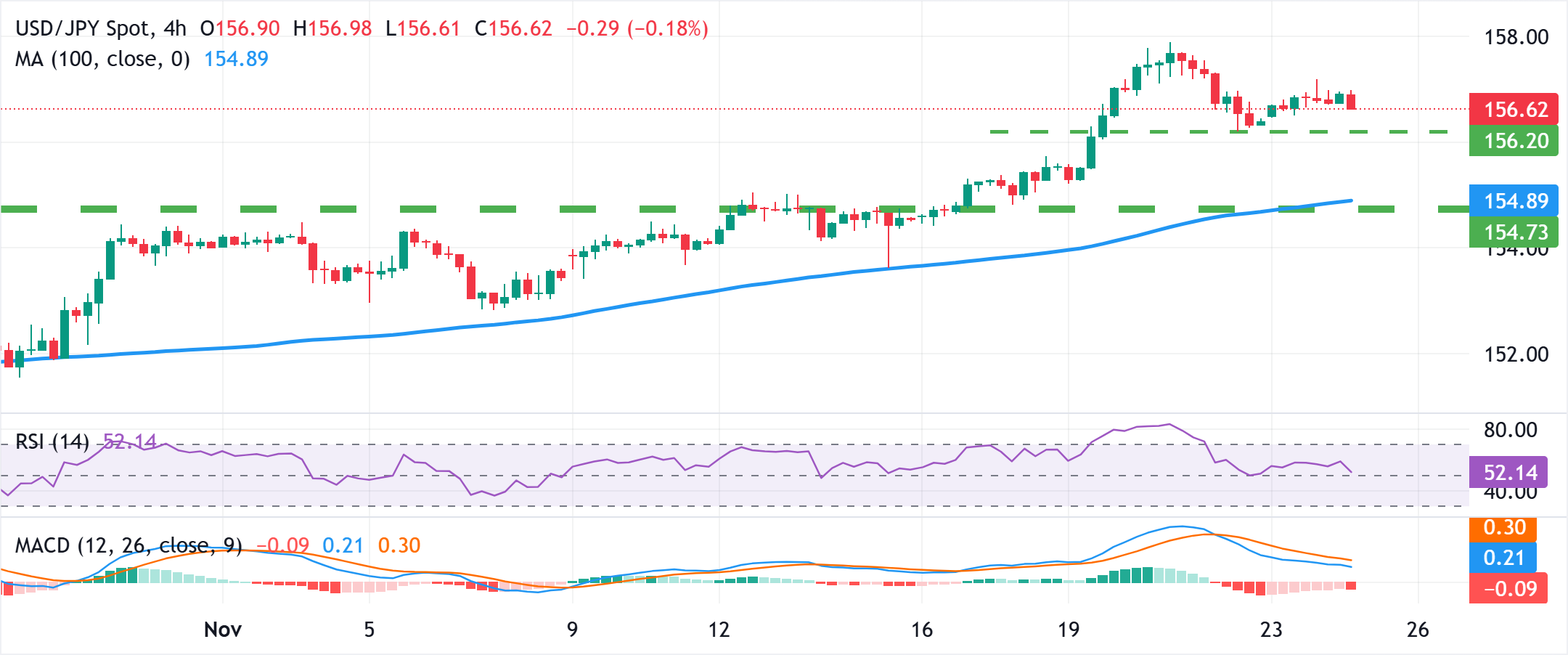
From a technical perspective, traders might now wait for acceptance above the 157.00 mark before placing fresh bullish bets around the USD/JPY pair. The subsequent move up could lift spot prices to the 157.45-157.50 intermediate hurdle en route to the 157.85-157.90 region, or a ten-month peak touched last week. Some follow-through buying beyond the 158.00 round figure will mark a fresh breakout and pave the way for a further near-term appreciating move.
On the flip side, any meaningful corrective slide might now find some support near the 156.25-156.20 zone. This is followed by the 156.00 mark, below which the USD/JPY pair could fall to the 155.45-155.40 intermediate support before dropping to the 155.00 psychological mark. Any further decline is more likely to find decent support and attract buyers near the 154.50-154.45 horizontal resistance breakpoint, which could act as a key pivotal point and a strong near-term base.
Japanese Yen FAQs
The Japanese Yen (JPY) is one of the world’s most traded currencies. Its value is broadly determined by the performance of the Japanese economy, but more specifically by the Bank of Japan’s policy, the differential between Japanese and US bond yields, or risk sentiment among traders, among other factors.
One of the Bank of Japan’s mandates is currency control, so its moves are key for the Yen. The BoJ has directly intervened in currency markets sometimes, generally to lower the value of the Yen, although it refrains from doing it often due to political concerns of its main trading partners. The BoJ ultra-loose monetary policy between 2013 and 2024 caused the Yen to depreciate against its main currency peers due to an increasing policy divergence between the Bank of Japan and other main central banks. More recently, the gradually unwinding of this ultra-loose policy has given some support to the Yen.
Over the last decade, the BoJ’s stance of sticking to ultra-loose monetary policy has led to a widening policy divergence with other central banks, particularly with the US Federal Reserve. This supported a widening of the differential between the 10-year US and Japanese bonds, which favored the US Dollar against the Japanese Yen. The BoJ decision in 2024 to gradually abandon the ultra-loose policy, coupled with interest-rate cuts in other major central banks, is narrowing this differential.
The Japanese Yen is often seen as a safe-haven investment. This means that in times of market stress, investors are more likely to put their money in the Japanese currency due to its supposed reliability and stability. Turbulent times are likely to strengthen the Yen’s value against other currencies seen as more risky to invest in.
Nothing in this material constitutes investment advice, personal recommendation, investment research, an offer, or a solicitation to buy or sell any financial instrument. The content has been prepared without consideration of your individual investment objectives, financial situation, or needs, and should not be treated as such.
Past performance is not a reliable indicator of future performance and/or results. Forward-looking scenarios or forecasts are not a guarantee of future performance. Actual results may differ materially from those anticipated.
Mitrade makes no representation or warranty as to the accuracy or completeness of the information provided and accepts no liability for any loss arising from reliance on such information.
Recommended Articles


