



Indian Rupee opens cautiously against US Dollar despite Fed dovish bets swell
- The Indian Rupee opens on a cautious note against the US Dollar despite intensifying Fed dovish expectations.
- FIIs turn out to be net sellers so far in November.
- Fed’s Williams warns of economic growth slowdown and cooling job market.
The Indian Rupee (INR) ticks lower at open against the US Dollar (USD) on Wednesday. The USD/INR pair edges up to near 89.35 as the Indian Rupee continues to underperform, with persistent US Dollar’s demand from Indian importers and in the offshore market.
Bankers said that dollar demand, largely from importers and in the offshore market, kicked in and blunted the rally, Reuters reported.
Another reason behind consistent weakness in the Indian Rupee is the continuous outflow of foreign funds from the Indian equity market. So far in November, Foreign Institutional Investors (FIIs) have been net sellers, and have pared stake worth Rs. 17,227.42 crores.
Meanwhile, the US Dollar has turned fragile amid accelerating bets supporting more interest rate cuts by the Federal Reserve (Fed) this year. So far in 2025, the Fed has reduced interest rates by 50 basis points (bps) to 3.50%-3.75%, and is expected to cut them again in the December policy meeting amid weak job market conditions.
On Friday, New York Fed Bank President John Williams warned of slowing economic growth and gradually cooling job market, while supporting the need of further monetary policy adjustments. His dovish comments led to a significant rise in market expectations of an interest rate cut in December.
According to the CME FedWatch tool, the probability of the Fed to cut interest rates by 25 basis points (bps) to 3.50%-3.75% in the December meeting has increased to 85.3% from 50.1% seen a week ago.
USD/INR Price Forecast
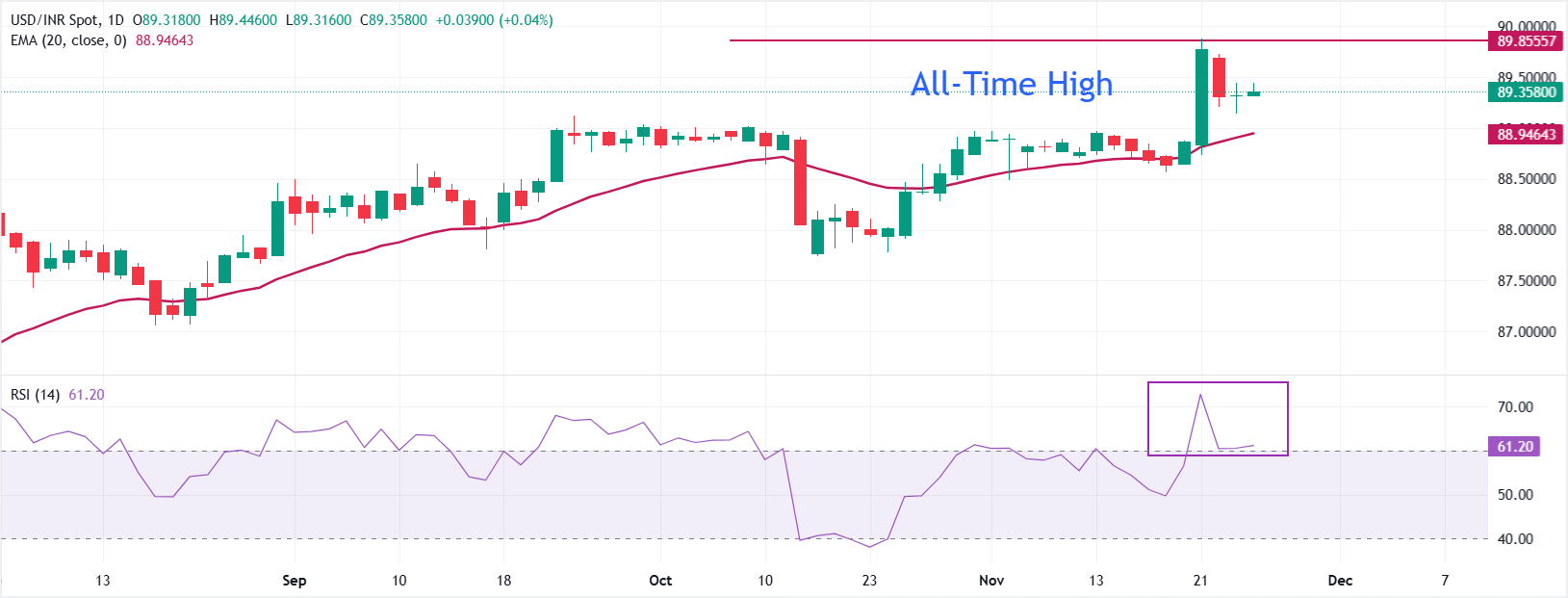
In the daily chart, USD/INR trades at 89.3600. The 20-day EMA at 88.9466 rises and price holds above it, keeping a bullish bias. The average has advanced steadily through the latest consolidation, underpinning the uptrend. RSI at 61.23 is positive and not overbought, supporting trend-following appetite. As long as the pair remains above the rising average, dips could stay contained and the advance could extend.
The moving average slope has firmed over recent sessions, and consecutive closes above it maintain upward pressure. RSI stabilizes around the low 60s, indicating healthy momentum without stretch. A daily close back beneath the 20-day EMA would soften the setup and could usher in a broader pause, while sustained strength above the average would keep buyers in control.
Looking down, the August 21 low of 87.07 will act as key support for the pair. On the upside, the all-time high near 89.85 will be a key barrier.
(The technical analysis of this story was written with the help of an AI tool)
Indian Rupee FAQs
The Indian Rupee (INR) is one of the most sensitive currencies to external factors. The price of Crude Oil (the country is highly dependent on imported Oil), the value of the US Dollar – most trade is conducted in USD – and the level of foreign investment, are all influential. Direct intervention by the Reserve Bank of India (RBI) in FX markets to keep the exchange rate stable, as well as the level of interest rates set by the RBI, are further major influencing factors on the Rupee.
The Reserve Bank of India (RBI) actively intervenes in forex markets to maintain a stable exchange rate, to help facilitate trade. In addition, the RBI tries to maintain the inflation rate at its 4% target by adjusting interest rates. Higher interest rates usually strengthen the Rupee. This is due to the role of the ‘carry trade’ in which investors borrow in countries with lower interest rates so as to place their money in countries’ offering relatively higher interest rates and profit from the difference.
Macroeconomic factors that influence the value of the Rupee include inflation, interest rates, the economic growth rate (GDP), the balance of trade, and inflows from foreign investment. A higher growth rate can lead to more overseas investment, pushing up demand for the Rupee. A less negative balance of trade will eventually lead to a stronger Rupee. Higher interest rates, especially real rates (interest rates less inflation) are also positive for the Rupee. A risk-on environment can lead to greater inflows of Foreign Direct and Indirect Investment (FDI and FII), which also benefit the Rupee.
Higher inflation, particularly, if it is comparatively higher than India’s peers, is generally negative for the currency as it reflects devaluation through oversupply. Inflation also increases the cost of exports, leading to more Rupees being sold to purchase foreign imports, which is Rupee-negative. At the same time, higher inflation usually leads to the Reserve Bank of India (RBI) raising interest rates and this can be positive for the Rupee, due to increased demand from international investors. The opposite effect is true of lower inflation.
Nothing in this material constitutes investment advice, personal recommendation, investment research, an offer, or a solicitation to buy or sell any financial instrument. The content has been prepared without consideration of your individual investment objectives, financial situation, or needs, and should not be treated as such.
Past performance is not a reliable indicator of future performance and/or results. Forward-looking scenarios or forecasts are not a guarantee of future performance. Actual results may differ materially from those anticipated.
Mitrade makes no representation or warranty as to the accuracy or completeness of the information provided and accepts no liability for any loss arising from reliance on such information.
Recommended Articles


