



BoE expected to keep interest rate steady amid sticky inflation, cooling job market
- The Bank of England is expected to keep its policy rate at 3.75%.
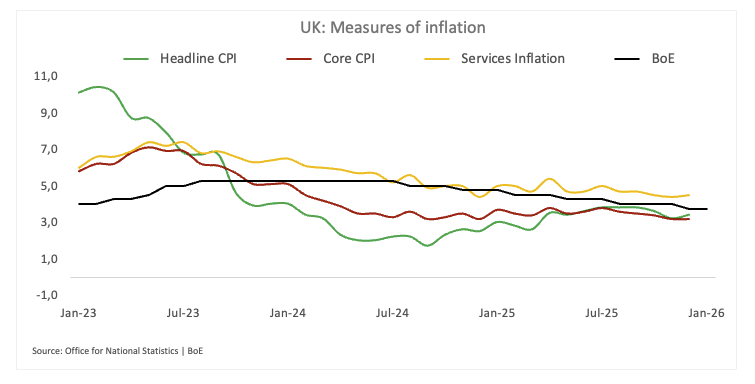
- UK inflation figures remain well above the BoE’s target.
- GBP/USD regains part of last week’s losses, hovering around 1.3700.
The Bank of England (BoE) will deliver its first monetary policy decision of 2026 on Thursday.
Most analysts think the ‘Old Lady’ will sit tight, keeping the base rate at 3.75% after the cut delivered back on December 18. Alongside the decision, the bank will also release the Minutes, which should shed a bit more light on how policymakers weighed the arguments around the table.
Markets are firmly priced for no move this time. However, the case for further easing hasn’t gone away, even if the BoE chooses to stay patient for now, as the UK economy struggles to gain any real traction and the fiscal backdrop continues to darken.
Inflation keeps running hot
The BoE’s December rate cut was a close-run thing. The 25 basis point move, which took the bank rate down to 3.75%, was carried by a narrow 5–4 vote. Indeed, members Breeden, Dhingra, Ramsden and Taylor all backed a cut, but it was Governor Bailey’s switch that proved decisive, underlining just how finely balanced the debate around further easing has become.
The message from the guidance was still cautiously dovish but noticeably more conditional. Policymakers stuck with the idea that rates are likely to move lower over time, describing a “gradual downward path”, while making it clear that each additional cut will be harder to justify. As policy drifts closer to neutral, the room for manoeuvre is shrinking, and the judgement calls are getting tougher.
The macro backdrop allows for further easing, but not with haste. Growth momentum has faded, with the economy expected to flatline in Q4, and inflation is projected to fall back more quickly in the near term, moving closer to the target by mid-2026. At the same time, lingering inflation bumps and a labour market that is only cooling slowly argue against flagging an aggressive cut cycle.
All told, December looks less like the start of a rush to ease and more like a careful recalibration. The Bank is still edging in an easier direction, but with rising caution as rates approach neutral and decisions become ever more dependent on incoming data.
According to the BoE’s Decision Maker Panel (DMP) published on January 8, businesses are growing a touch less punchy on pay, as firms now expect wages to rise by 3.7% over the 12 months from the final quarter of 2025, a shade lower than the pace they were expecting just a month earlier.
Additionally, companies are reducing their expectations for price increases in the upcoming year, which resulted in a 0.1 percentage point decrease to 3.6% in the three months to December.
And it’s not just wages and prices. Firms have also become slightly more cautious on hiring, with expectations for employment growth over the next year softening a little, according to the survey.
How will the BoE interest rate decision impact GBP/USD?
Many people expect the BoE will keep the reference rate at 3.75% when it makes its announcement on Thursday at 12:00 GMT.
The real focus will be on how the MPC votes, since a hold is already fully priced in. If the British Pound (GBP) moves in a way that isn't expected, it could be because it suggests a change in how policymakers are getting ready for future decisions.
Pablo Piovano, Senior Analyst at FXStreet, notes that GBP/USD has come under fresh downside pressure soon after hitting yearly peaks near 1.3870 in late January, an area last traded in September 2021.
“Once Cable clears this level, it could then attempt a move to the September 2021 high at 1.3913 (September 14) ahead of the July 2021 peak at 1.3983 (July 30)”, Piovano adds.
On the other hand, Piovano says that “the critical 200-day SMA at 1.3421 emerges as the immediate contention in case sellers regain the upper hand prior to the 2026 floor at 1.3338 (January 19).”
“Meanwhile, the Relative Strength Index (RSI) near 61 suggests further gains remain in the pipeline in the near term, while the Average Directional Index (ADX) near 30 indicates a pretty strong trend,” he concludes.
Central banks FAQs
Central Banks have a key mandate which is making sure that there is price stability in a country or region. Economies are constantly facing inflation or deflation when prices for certain goods and services are fluctuating. Constant rising prices for the same goods means inflation, constant lowered prices for the same goods means deflation. It is the task of the central bank to keep the demand in line by tweaking its policy rate. For the biggest central banks like the US Federal Reserve (Fed), the European Central Bank (ECB) or the Bank of England (BoE), the mandate is to keep inflation close to 2%.
A central bank has one important tool at its disposal to get inflation higher or lower, and that is by tweaking its benchmark policy rate, commonly known as interest rate. On pre-communicated moments, the central bank will issue a statement with its policy rate and provide additional reasoning on why it is either remaining or changing (cutting or hiking) it. Local banks will adjust their savings and lending rates accordingly, which in turn will make it either harder or easier for people to earn on their savings or for companies to take out loans and make investments in their businesses. When the central bank hikes interest rates substantially, this is called monetary tightening. When it is cutting its benchmark rate, it is called monetary easing.
A central bank is often politically independent. Members of the central bank policy board are passing through a series of panels and hearings before being appointed to a policy board seat. Each member in that board often has a certain conviction on how the central bank should control inflation and the subsequent monetary policy. Members that want a very loose monetary policy, with low rates and cheap lending, to boost the economy substantially while being content to see inflation slightly above 2%, are called ‘doves’. Members that rather want to see higher rates to reward savings and want to keep a lit on inflation at all time are called ‘hawks’ and will not rest until inflation is at or just below 2%.
Normally, there is a chairman or president who leads each meeting, needs to create a consensus between the hawks or doves and has his or her final say when it would come down to a vote split to avoid a 50-50 tie on whether the current policy should be adjusted. The chairman will deliver speeches which often can be followed live, where the current monetary stance and outlook is being communicated. A central bank will try to push forward its monetary policy without triggering violent swings in rates, equities, or its currency. All members of the central bank will channel their stance toward the markets in advance of a policy meeting event. A few days before a policy meeting takes place until the new policy has been communicated, members are forbidden to talk publicly. This is called the blackout period.
Economic Indicator
BoE Interest Rate Decision
The Bank of England (BoE) announces its interest rate decision at the end of its eight scheduled meetings per year. If the BoE is hawkish about the inflationary outlook of the economy and raises interest rates it is usually bullish for the Pound Sterling (GBP). Likewise, if the BoE adopts a dovish view on the UK economy and keeps interest rates unchanged, or cuts them, it is seen as bearish for GBP.
Read more.Last release: Thu Dec 18, 2025 12:00
Frequency: Irregular
Actual: 3.75%
Consensus: 3.75%
Previous: 4%
Source: Bank of England
Nothing in this material constitutes investment advice, personal recommendation, investment research, an offer, or a solicitation to buy or sell any financial instrument. The content has been prepared without consideration of your individual investment objectives, financial situation, or needs, and should not be treated as such.
Past performance is not a reliable indicator of future performance and/or results. Forward-looking scenarios or forecasts are not a guarantee of future performance. Actual results may differ materially from those anticipated.
Mitrade makes no representation or warranty as to the accuracy or completeness of the information provided and accepts no liability for any loss arising from reliance on such information.
Recommended Articles


