



EUR/USD Price Forecast: Remains sideways near 200-day EMA, ECB warns of high inflation
- EUR/USD trades sideways around 1.1600 as investors await Iran’s reply to Trump’s 15-point proposal.
- Trump’s 15-point proposal restricts Iran from building nuclear weapons.
- ECB’s Lane said market dynamic suggests a price-level jump.
The EUR/USD pair trades broadly sideways around 1.1600 during the European trading session on Wednesday. The major currency pair consolidates as investors await Iran’s response to United States (US) President Donald Trump’s proposals of a month-long ceasefire and 15-point settlement plan.
US President Trump’s attempts of ceasefire have improved investors’ risk appetite. As of writing, S&P 500 futures are up almost 1%, reflecting strong demand for riskier assets. Meanwhile, the US Dollar (USD) trades calmly, with the US Dollar Index (DXY) trading in a confined range above 93.00.
On late Tuesday, US President Trump sent a 15-point proposal to Iran, which restricts the nation from pursuing nuclear ambitions and nuclear weapons, and disallows uranium enrichment on Iranian territory.
In the Eurozone, European Central Bank (ECB) officials have warned of upside inflation risks amid surging energy prices due to the war in the Middle East. “The market dynamic suggests a price-level jump,” ECB Chief Economist Philip Lane said.
EUR/USD technical analysis
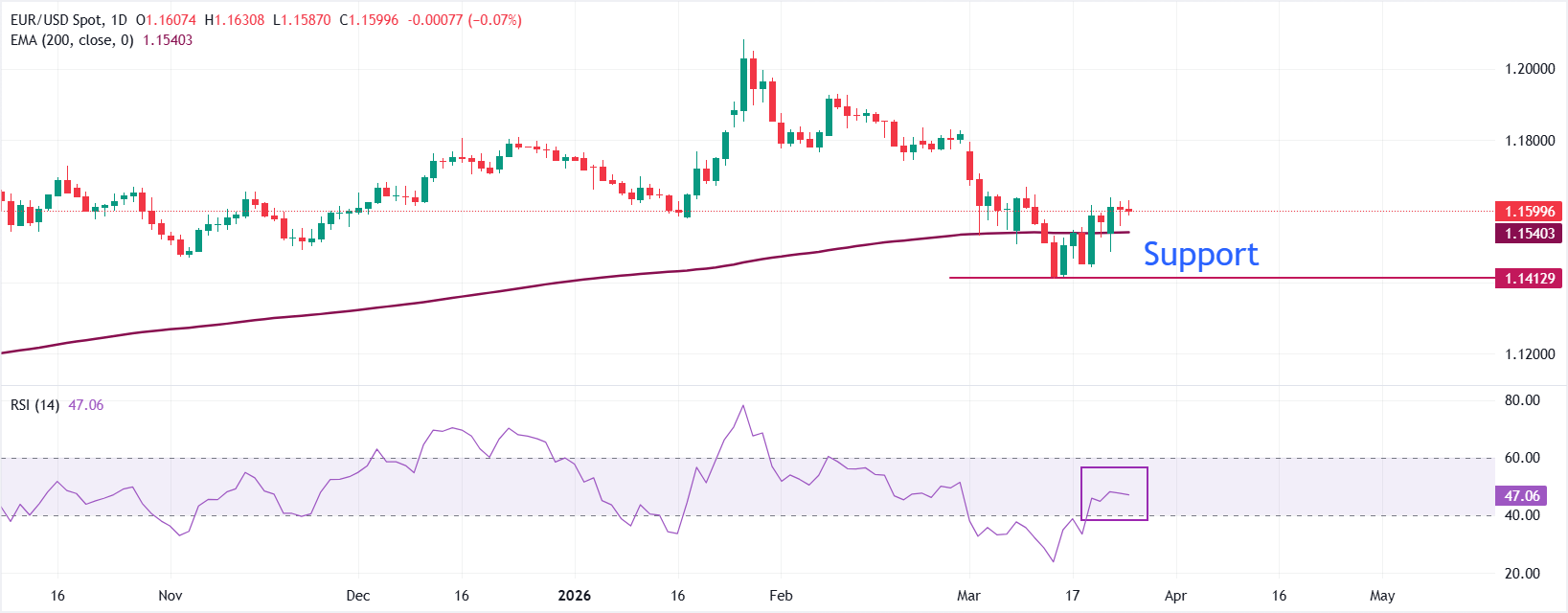
EUR/USD trades flat at around 1.1600 as of writing. The near-term bias is neutral with a mild downside tone as spot hovers just above the flattening 200-day Exponential Moving Average near 1.1540, which has lost upside inclination and now acts more as a directional pivot than a trending guide.
The 14-day Relative Strength Index (RSI) at 47 stays below the 50 line and confirms softening demand rather than outright bearish pressure, keeping the pair in a consolidative phase around its medium-term mean.
Immediate support emerges at 1.1540, where the 200-day EMA converges with recent reaction lows, and a daily close below this level would open the way toward 1.1510 and then the March 13 low of 1.1411. As long as 1.1540 holds on a closing basis, downside probes remain corrective within a broader range. On the topside, initial resistance stands at 1.1640, the last minor recovery high, followed by 1.1760 ahead of the 1.1835 barrier that has repeatedly capped advances.
(The technical analysis of this story was written with the help of an AI tool.)
ECB FAQs
The European Central Bank (ECB) in Frankfurt, Germany, is the reserve bank for the Eurozone. The ECB sets interest rates and manages monetary policy for the region. The ECB primary mandate is to maintain price stability, which means keeping inflation at around 2%. Its primary tool for achieving this is by raising or lowering interest rates. Relatively high interest rates will usually result in a stronger Euro and vice versa. The ECB Governing Council makes monetary policy decisions at meetings held eight times a year. Decisions are made by heads of the Eurozone national banks and six permanent members, including the President of the ECB, Christine Lagarde.
In extreme situations, the European Central Bank can enact a policy tool called Quantitative Easing. QE is the process by which the ECB prints Euros and uses them to buy assets – usually government or corporate bonds – from banks and other financial institutions. QE usually results in a weaker Euro. QE is a last resort when simply lowering interest rates is unlikely to achieve the objective of price stability. The ECB used it during the Great Financial Crisis in 2009-11, in 2015 when inflation remained stubbornly low, as well as during the covid pandemic.
Quantitative tightening (QT) is the reverse of QE. It is undertaken after QE when an economic recovery is underway and inflation starts rising. Whilst in QE the European Central Bank (ECB) purchases government and corporate bonds from financial institutions to provide them with liquidity, in QT the ECB stops buying more bonds, and stops reinvesting the principal maturing on the bonds it already holds. It is usually positive (or bullish) for the Euro.
Nothing in this material constitutes investment advice, personal recommendation, investment research, an offer, or a solicitation to buy or sell any financial instrument. The content has been prepared without consideration of your individual investment objectives, financial situation, or needs, and should not be treated as such.
Past performance is not a reliable indicator of future performance and/or results. Forward-looking scenarios or forecasts are not a guarantee of future performance. Actual results may differ materially from those anticipated.
Mitrade makes no representation or warranty as to the accuracy or completeness of the information provided and accepts no liability for any loss arising from reliance on such information.
Recommended Articles


