



SpaceX IPO Nears: What Are SpaceX Concept Stocks? A Full Review of Taiwan and U.S. Starlink Supply Chains
TradingKey - As the countdown to SpaceX's listing process begins, the attention of global capital markets is once again fixed on this tech giant disrupting the aerospace industry. According to the latest reports, Tesla ( TSLA) founder Elon Musk's SpaceX plans to submit an IPO prospectus to regulators later this week or next week, seeking to raise over $75 billion with a valuation of $1.25 trillion, targeting an official listing on the Nasdaq in June.
This news not only signals the largest IPO in commercial aerospace history but also puts SpaceX concept stocks throughout the supply chain into the market spotlight.
As the dominant leader in global commercial aerospace, SpaceX has not only rewritten the cost rules of space transportation with reusable rocket technology but has also built a global communication network through the Starlink project, fundamentally breaking traditional aerospace boundaries.
As SpaceX advances toward its listing, investors are looking beyond the company's own growth prospects toward its massive industrial ecosystem—from core satellite components to ground terminals, and from launch services to space data centers, every link offers investment opportunities.
Investing in SpaceX concept stocks is essentially a move to capture the certain growth of the commercial aerospace wave and share in the industrial dividends of disruptive technological innovation.
This article will explore the definition, market opportunities, and potential risks of SpaceX concept stocks to help investors better understand this high-profile investment option.
What are SpaceX concept stocks?
Concept stocks generally refer to listed companies that gain market attention by relying on specific business concepts, cutting-edge technologies, or emerging trends. These enterprises are often positioned at the forefront of industrial innovation, carrying market expectations for future development directions. Inve
SpaceX concept stocks refer to listed companies associated with Space Exploration Technologies Corp. (SpaceX) and its core business. These targets include direct participants in the aerospace industry, such as rocket launch service providers, satellite manufacturers, and aerospace R&D firms, as well as upstream and downstream supply chain enterprises that provide support, such as specialty aerospace material suppliers and precision component manufacturers.
As SpaceX continues to achieve breakthroughs in fields such as reusable rockets, Starlink satellite internet, space tourism, and Mars colonization plans, market attention on related concept stocks has risen significantly.
Investing in SpaceX concept stocks is essentially a strategic move to capture the future growth potential of the aerospace industry while sharing in the dividends of disruptive technological innovation—as SpaceX continues to reshape the aerospace sector, companies throughout the upstream and downstream supply chain are also expected to see value revaluations; therefore, these targets hold a unique appeal for investors seeking high-growth returns.
What are the SpaceX concept stocks?
Taiwan Stock Market: SpaceX Supply Chain
Leveraging mature precision manufacturing capabilities, Taiwan's electronics industry has deeply integrated into the SpaceX Starlink satellite and ground station supply chain, becoming a critical link in its global footprint. The following is an overview of Taiwan-based companies with high market recognition:
- Satellite Core Components and PCB Sector
The demand from satellite systems for high-precision circuit boards and communication components aligns perfectly with the technological advantages and production capacity of Taiwanese manufacturers.
Compeq (2313): As a leader in LEO satellite PCBs, it is a core supplier for SpaceX satellite bodies and ground stations.
Universal Microwave Technology (3491): Focusing on satellite communication RF modules, it directly benefits from the explosive demand for LEO satellite communication components.
Tong Hsing Electronic (6271): Its core products include ceramic substrates and RF modules; market rumors suggest it is the exclusive supplier of RF transceiver modules for SpaceX LEO satellites.
Rafael Micro (6568): Engaging in the R&D of satellite communication chips, it has become a technical player in the aerospace communication supply chain.
- Ground Receiving Equipment and Assembly Manufacturing
The large-scale rollout of the Starlink project has driven a surge in demand for ground terminal equipment, where Taiwanese manufacturers hold a significant position due to their supply chain integration advantages.
Wistron NeWeb (6285): As a core supplier of Starlink ground terminals, it provides satellite antenna and array solutions.
Kinpo Electronics (2312): Entering the LEO satellite ground station motherboard OEM field, the company reported a consolidated profit of NT$1.27 billion and an EPS of NT$0.85 for the first three quarters of 2025, further solidifying its diversified business structure.
Auden Techno (3138): Specializing in RF antenna technology, it has established advantages in integrated terrestrial-satellite communications and satellite ground terminals (UT).
APEX (4916): Entering the SpaceX supply chain through indirect support, it handles satellite communication PCB/PCBA production and testing, serving as an invisible participant in aerospace electronics manufacturing.
US-listed SpaceX Partners
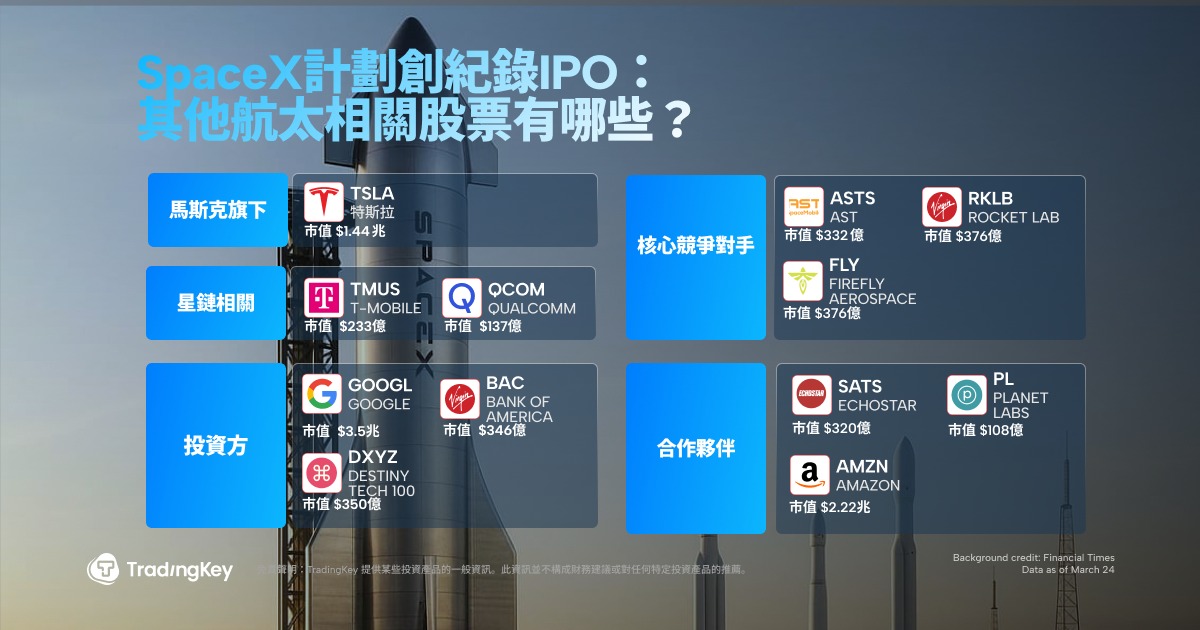
Notably, SpaceX concept stocks are not limited to the Taiwan market. In the US market, business links with SpaceX are more reflected at the strategic level, with spectrum transactions and launch services being the core areas of cooperation.
- Strategic Partner Targets
T-Mobile ( TMUS ): Through the "Direct to Cell" collaboration, it integrates SpaceX's Starlink satellite network into its own mobile service system, enabling mobile devices to connect directly to satellite signals.
EchoStar ( SATS ): SpaceX acquired its AWS-4 and H-block spectrum licenses for $17 billion, providing critical frequency resources for Starlink's direct-to-device services.
- Launch Service Partner Targets
Globalstar ( GSAT ): Signed a launch services agreement with SpaceX to replace its existing satellite network.
AST SpaceMobile ( ASTS ): Collaborating with SpaceX through multiple launch agreements to advance its direct-to-cell satellite service project.
Why invest in SpaceX concept stocks?
The core logic of investing in SpaceX concept stocks is essentially a strategic positioning for certain growth opportunities within the wave of aerospace commercialization. As the global aerospace industry transitions from a "national project" to a "commercial track," SpaceX has become the core engine driving industry transformation through technological innovation and business model reconstruction, providing unique investment value for companies across its supply chain.
Through reusable rocket technology, SpaceX has slashed launch costs to one-third or even less than those of traditional aerospace companies, directly breaking down the high barriers to space resources. This has not only transformed satellite constellations and space travel from concepts into scalable businesses but also spawned entirely new markets like the Starlink satellite internet.
This comprehensive disruption, ranging from the technical foundation to business logic, signals that the aerospace industry is poised for explosive growth. Companies that integrate into its supply chain early will be the first to capture the dividends of industry expansion.
Elon Musk’s success in leading Tesla to disrupt the global automotive industry has provided a powerful endorsement of trust for SpaceX. His long-term vision and execution in space exploration have convinced investors that SpaceX is poised to replicate Tesla's growth trajectory, evolving from a marginal challenger into an industry giant.
This "star effect" has not only raised valuation expectations for SpaceX itself but has also brought a valuation premium to associated companies within the industrial chain.
More importantly, SpaceX has secured numerous government contracts, including NASA’s manned space missions. These stable official orders provide a solid foundation for its business expansion and offer predictability for the performance growth of supply chain companies. Simultaneously, governments worldwide are placing increasing importance on the aerospace industry; the dual drivers of policy dividends and market demand further reinforce the long-term investment value of SpaceX concept stocks.
Notably, SpaceX is not yet public, which provides investors with a window for early strategic positioning. As IPO expectations heat up, the market’s optimistic forecasts for SpaceX's success will continue to drive up the share prices of related companies in the industrial chain, allowing investors to capture long-term returns from SpaceX's growth indirectly by holding these assets.
Although the aerospace industry faces risks in technology R&D and project implementation, for long-term investors seeking high-growth returns, SpaceX concept stocks are undoubtedly a critical choice for capturing the dividends of the next technological revolution.
Risks of Investing in SpaceX Concept Stocks
However, investing in SpaceX concept stocks and supply chain companies still requires vigilance regarding the cumulative impact of multiple risks.
While the long-term prospects of Starlink and Starship are viewed favorably by the market, factors such as valuation bubbles, R&D uncertainty, and regulatory changes could weigh on related stock prices at any time.
First, technical R&D uncertainty remains a factor. SpaceX’s core technology, such as Starship’s reusable design, is at the leading edge of industry exploration. Any failure during the testing process could cause significant delays, triggering doubts about technical feasibility and directly dragging down the valuations of supply chain companies.
Second, speculative sentiment around SpaceX concept stocks is currently high, with some valuations far outstripping actual earnings, leading to a noticeable "sentiment premium." If market enthusiasm cools or SpaceX’s business progress misses expectations, high-valuation targets face sharp correction risks.
Space exploration is a capital-intensive industry. Although SpaceX’s financial position has improved, the global deployment of Starlink continues to require massive capital expenditure, and the maturity of its profit model remains to be seen. If commercialization is hindered or user growth falls short, the resulting cash flow pressure on SpaceX would propagate to its supply chain, affecting order stability and earnings growth.
For investors, SpaceX-related investing should move beyond pure thematic hype to focus on core financial metrics, the contribution of actual orders to total revenue, and the R&D progress and launch success rates of core technologies. Fundamental analysis is essential to determine true value and avoid being misled by short-term, sentiment-driven market trends.
Nothing in this material constitutes investment advice, personal recommendation, investment research, an offer, or a solicitation to buy or sell any financial instrument. The content has been prepared without consideration of your individual investment objectives, financial situation, or needs, and should not be treated as such.
Past performance is not a reliable indicator of future performance and/or results. Forward-looking scenarios or forecasts are not a guarantee of future performance. Actual results may differ materially from those anticipated.
Mitrade makes no representation or warranty as to the accuracy or completeness of the information provided and accepts no liability for any loss arising from reliance on such information.
Recommended Articles


