



GBP/USD falls as Fed holds rates steady, Powell to stay at Fed
- GBP/USD stays negative as Fed holds rates steady amid Iran uncertainty.
- Split FOMC vote highlights divisions over easing bias in policy statement.
- Traders now await Powell’s final presser for fresh Dollar direction.
GBP/USD maintains its negative intraday trend, remaining steady following the Federal Reserve’s decision to keep interest rates unchanged at Jerome Powell’s final meeting as Fed Chair. As of this writing, the currency pair is trading near 1.3480, down 0.30%, as market participants await insights from Powell’s forthcoming press conference.
Summary of the Fed’s statement
At his press conference, Jay Powell congratulated Kevin Warsh as he hurdled the first stage on his path to becoming his successor as Fed Chair and clarified that he will remain as Governor until the criminal investigation against him concludes. He added that, as Governor, he “will keep a low profile” and that he will stay at the Fed after May 15, when his eight-year term as the chief of the US central bank ends.
In the monetary policy statement, the Federal Reserve commented that the economy remains resilient, noting that the unemployment rate “has been little changed in recent months.” The central bank also acknowledged that inflation is elevated, driven by higher energy prices linked to the Iran conflict.
The Fed added that developments in the Middle East are increasing uncertainty around the economic outlook and emphasized that policymakers will continue to balance both sides of their dual mandate.
The decision passed with an 8–4 vote split. Fed Governor Stephen Miran dissented in favor of a rate cut, while Beth Hammack, Neel Kashkari, and Lorie Logan opposed adding an easing bias to the statement.
Traders’ eyes shift towards the Fed Chair Jerome Powell’s monetary policy meeting at 18:30 GMT.
GBP/USD reaction to the Fed’s decision
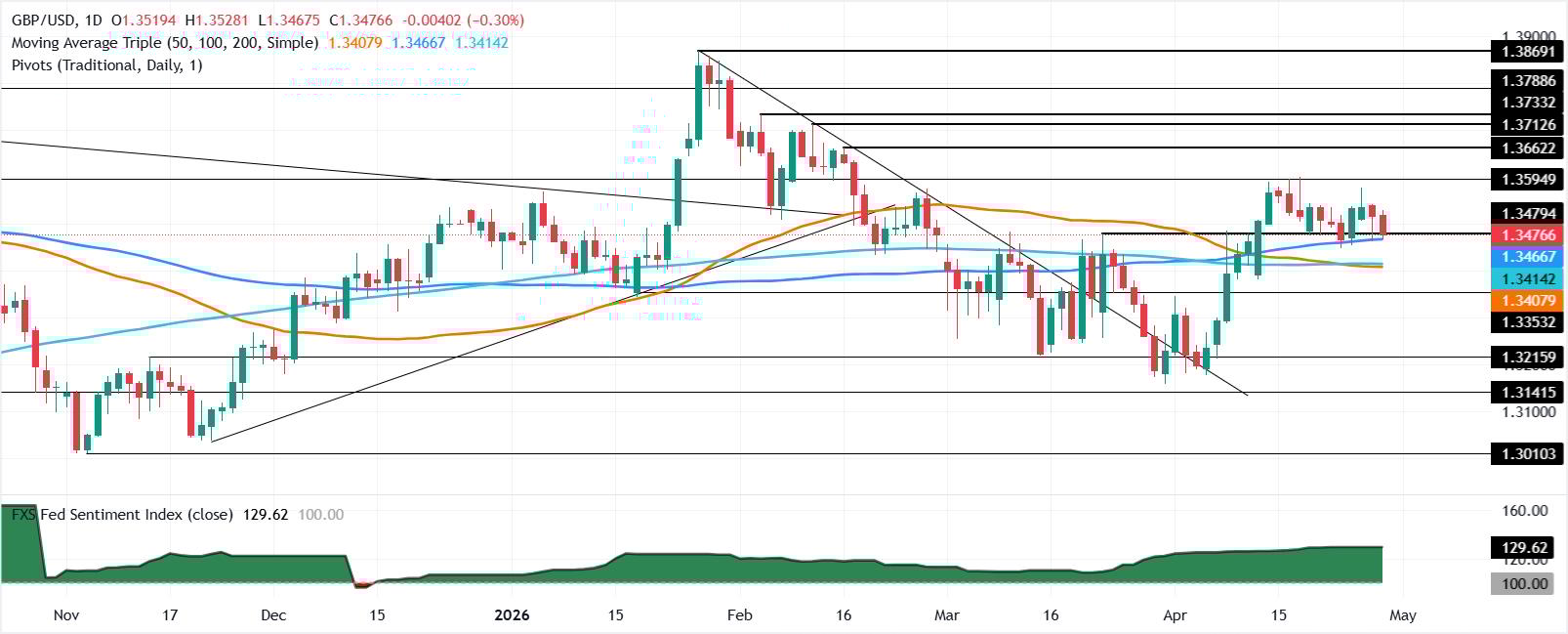
The GBP/USD fell to a daily low of 1.3467, touching the 100-day SMA ahead of Powell’s press conference. A clear breach would open the path to challenge the psychological 1.3400 figure. On the other hand, if Powell turns dovish, the 1.3500 would be up for grabs.
Fed FAQs
Monetary policy in the US is shaped by the Federal Reserve (Fed). The Fed has two mandates: to achieve price stability and foster full employment. Its primary tool to achieve these goals is by adjusting interest rates. When prices are rising too quickly and inflation is above the Fed’s 2% target, it raises interest rates, increasing borrowing costs throughout the economy. This results in a stronger US Dollar (USD) as it makes the US a more attractive place for international investors to park their money. When inflation falls below 2% or the Unemployment Rate is too high, the Fed may lower interest rates to encourage borrowing, which weighs on the Greenback.
The Federal Reserve (Fed) holds eight policy meetings a year, where the Federal Open Market Committee (FOMC) assesses economic conditions and makes monetary policy decisions. The FOMC is attended by twelve Fed officials – the seven members of the Board of Governors, the president of the Federal Reserve Bank of New York, and four of the remaining eleven regional Reserve Bank presidents, who serve one-year terms on a rotating basis.
In extreme situations, the Federal Reserve may resort to a policy named Quantitative Easing (QE). QE is the process by which the Fed substantially increases the flow of credit in a stuck financial system. It is a non-standard policy measure used during crises or when inflation is extremely low. It was the Fed’s weapon of choice during the Great Financial Crisis in 2008. It involves the Fed printing more Dollars and using them to buy high grade bonds from financial institutions. QE usually weakens the US Dollar.
Quantitative tightening (QT) is the reverse process of QE, whereby the Federal Reserve stops buying bonds from financial institutions and does not reinvest the principal from the bonds it holds maturing, to purchase new bonds. It is usually positive for the value of the US Dollar.
Nothing in this material constitutes investment advice, personal recommendation, investment research, an offer, or a solicitation to buy or sell any financial instrument. The content has been prepared without consideration of your individual investment objectives, financial situation, or needs, and should not be treated as such.
Past performance is not a reliable indicator of future performance and/or results. Forward-looking scenarios or forecasts are not a guarantee of future performance. Actual results may differ materially from those anticipated.
Mitrade makes no representation or warranty as to the accuracy or completeness of the information provided and accepts no liability for any loss arising from reliance on such information.
Recommended Articles


