



British Pound Sterling's peace rally round-trips ahead of the Fed
- GBP/USD surged at the week's open on the US-Iran ceasefire and Strait of Hormuz reopening, then gave the entire move back to close flat.
- Soft US Empire State and Industrial Production data gave the Dollar every reason to soften, yet it held firm as traders position into Wednesday's FOMC.
- UK CPI on Wednesday and the BoE on Thursday are the Pound's domestic tests, but the Fed dominates the week.
GBP/USD opened the new week with a sharp risk-on pop toward 1.3450 as a US-Iran ceasefire and the reopening of the Strait of Hormuz sent Crude Oil tumbling and lifted risk-sensitive currencies. The entire move then unwound, leaving the pair back near 1.3400, almost exactly where it started. The relief was genuine but shallow, and a Dollar quietly bidding into Wednesday's Federal Reserve (Fed) meeting did the rest.
A ceasefire the market only half-believed
The deal that sparked the move is, on paper, a breakthrough, but the fine print invites skepticism. It is a preliminary framework: a 60-day ceasefire extension with Iran's nuclear program pushed into later talks and a formal signing not due until Friday. Crude Oil fell close to 5%, yet the broader risk reaction was only moderate, with most of the buying already done last week.
That is the problem for the Pound, which had no catalyst of its own on Monday and rode the global risk impulse higher. Once the relief was priced, the buy-the-rumor trade gave way to the sell-the-fact and Sterling drifted back to its starting point.
The Dollar isn't waiting for permission
Monday's US data gave the Dollar every reason to soften, yet it barely flinched. The New York Empire State Manufacturing Index collapsed to 5.7 in June from 19.6, well short of the 14 consensus, while Industrial Production rose a thin 0.1% in May against a 0.3% call. On most days that pressures the Dollar; two days before a Federal Open Market Committee (FOMC) decision, the market is not trading regional surveys.
The Fed is widely expected to hold its target range at 3.50% to 3.75% on Wednesday, but the tone should lean hawkish. May Nonfarm Payrolls (NFP) beat near 172K with unemployment steady around 4.3%, and rate futures now price the next move as a hike rather than a cut: a December hike sits better than even near 57%, and by January a hold drops to roughly 35%, making a hike the base case. That gives traders reason to trim short-Dollar positions into the event, and the Pound, lacking a domestic driver, gets carried along.
Coiled between the moving averages
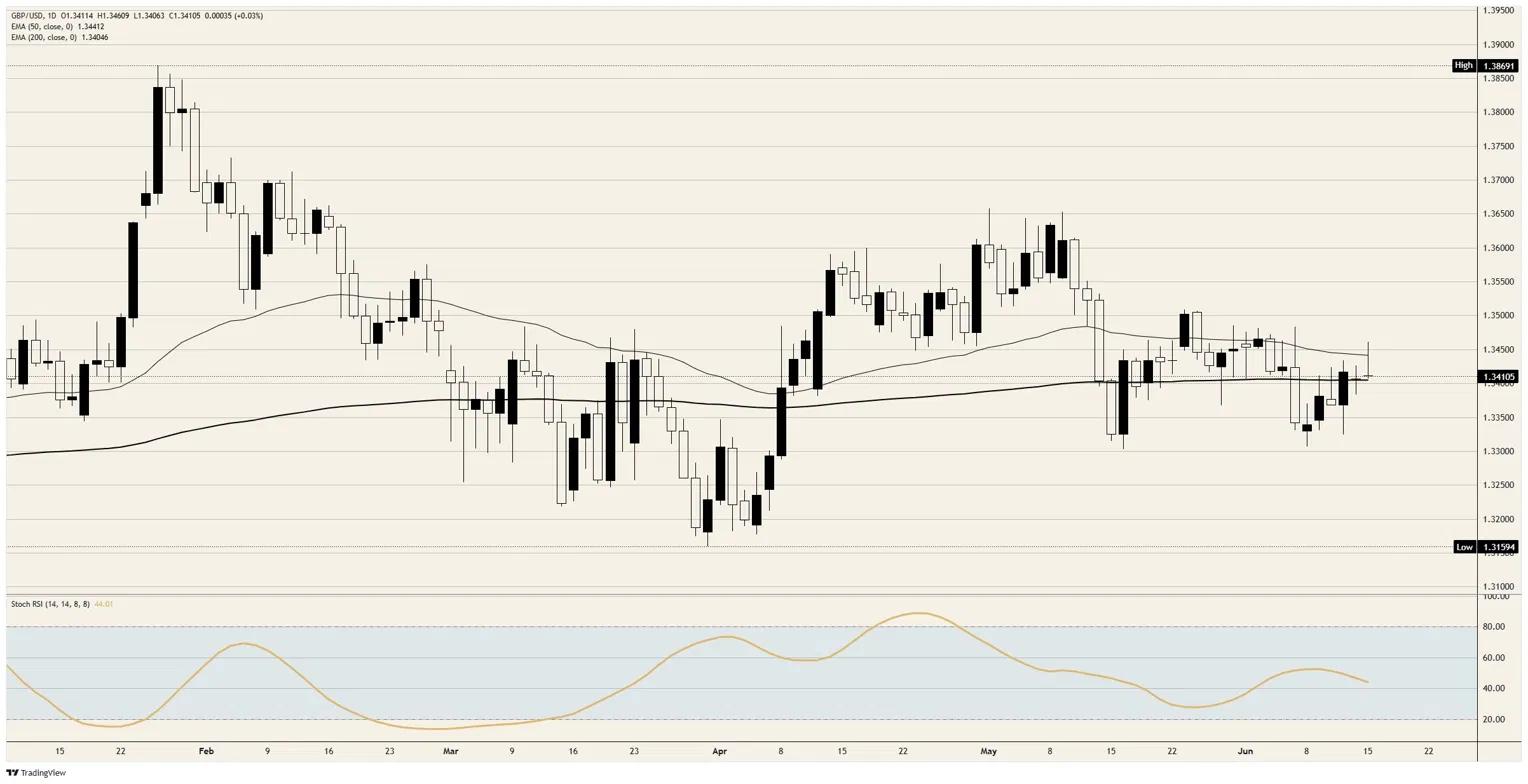
On the daily chart the Pound is pinned in a tightening band, with Monday's close near 1.3400 sitting right on the 200-period Exponential Moving Average (EMA) at the handle and the 50-period EMA capping the tape just under 1.3450. The two have converged to within roughly 40 pips, textbook compression that precedes a volatility expansion, not its direction. The daily Stochastic Relative Strength Index (Stoch RSI) sits mid-range near 44, neutral and consistent with a holding pattern, leaving 1.3400 as the pivot the FOMC will decide.
Where the week is decided
Tuesday brings only US Building Permits and Housing Starts, near 1.42 and 1.43 million; second-tier housing data rarely moves a major pair before the Fed, so expect a quiet, position-squaring session.
Wednesday front-loads the Pound's domestic risk. UK Consumer Price Index (CPI) lands at 06:00 GMT, with headline inflation last at 2.8% YoY and the core rate seen ticking up toward 2.7% from 2.5%. It is the final reading still carrying the war's full energy premium, even as the ceasefire now points to a softer forward path.
US Retail Sales follow at 12:30 GMT, before the main event at 18:00 GMT: the Fed decision, projections and dot plot, with the press conference at 18:30 GMT. A hold is locked in, so the dots and the tone are the entire trade. Any upward drift in the projections extends the Dollar's bid and pressures GBP/USD; a softer message is the Pound's clearest route higher. The Bank of England (BoE) follows Thursday with its own hold expected.
Resistance: Near-term supply sits around 1.3450, the level that capped Monday's surge and aligns with the 50 EMA. A clean break and hold above it opens the 1.3500 handle, with little in the way until 1.3550.
Support: The 1.3400 handle is the immediate pivot, defended by the 200 EMA just beneath the close. A Fed-driven Dollar bid through it exposes 1.3350, then the lower edge of the recent range.
Bias: Mildly bearish into Wednesday. With no UK catalyst before the CPI release and the Dollar holding the upper hand on positioning, the path of least resistance is a grind toward 1.3400. Only a dovish Fed or soft dots flips that and puts 1.3450 and 1.3500 back in play.
GBP/USD daily chart
Pound Sterling FAQs
The Pound Sterling (GBP) is the oldest currency in the world (886 AD) and the official currency of the United Kingdom. It is the fourth most traded unit for foreign exchange (FX) in the world, accounting for 12% of all transactions, averaging $630 billion a day, according to 2022 data. Its key trading pairs are GBP/USD, also known as ‘Cable’, which accounts for 11% of FX, GBP/JPY, or the ‘Dragon’ as it is known by traders (3%), and EUR/GBP (2%). The Pound Sterling is issued by the Bank of England (BoE).
The single most important factor influencing the value of the Pound Sterling is monetary policy decided by the Bank of England. The BoE bases its decisions on whether it has achieved its primary goal of “price stability” – a steady inflation rate of around 2%. Its primary tool for achieving this is the adjustment of interest rates. When inflation is too high, the BoE will try to rein it in by raising interest rates, making it more expensive for people and businesses to access credit. This is generally positive for GBP, as higher interest rates make the UK a more attractive place for global investors to park their money. When inflation falls too low it is a sign economic growth is slowing. In this scenario, the BoE will consider lowering interest rates to cheapen credit so businesses will borrow more to invest in growth-generating projects.
Data releases gauge the health of the economy and can impact the value of the Pound Sterling. Indicators such as GDP, Manufacturing and Services PMIs, and employment can all influence the direction of the GBP. A strong economy is good for Sterling. Not only does it attract more foreign investment but it may encourage the BoE to put up interest rates, which will directly strengthen GBP. Otherwise, if economic data is weak, the Pound Sterling is likely to fall.
Another significant data release for the Pound Sterling is the Trade Balance. This indicator measures the difference between what a country earns from its exports and what it spends on imports over a given period. If a country produces highly sought-after exports, its currency will benefit purely from the extra demand created from foreign buyers seeking to purchase these goods. Therefore, a positive net Trade Balance strengthens a currency and vice versa for a negative balance.
Nothing in this material constitutes investment advice, personal recommendation, investment research, an offer, or a solicitation to buy or sell any financial instrument. The content has been prepared without consideration of your individual investment objectives, financial situation, or needs, and should not be treated as such.
Past performance is not a reliable indicator of future performance and/or results. Forward-looking scenarios or forecasts are not a guarantee of future performance. Actual results may differ materially from those anticipated.
Mitrade makes no representation or warranty as to the accuracy or completeness of the information provided and accepts no liability for any loss arising from reliance on such information.
Recommended Articles


