



Indian Rupee trades firmly amid signs of renewed FIIs’ interest towards Indian stock market
- The Indian Rupee trades firmly against the US Dollar due to multiple tailwinds.
- Lower oil prices and signs of improvement in FIIs sentiment towards the Indian stock market have strengthened the Indian Rupee.
- The Fed is expected to leave interest rates steady on Wednesday.
The Indian Rupee (INR) opens firmly against the US Dollar (USD) on Tuesday. The USD/INR pair trades lower around 94.58 as lower oil prices due to the successive reopening of the Strait of Hormuz, following the signing of a peace deal between the United States (US) and Iran, and signs of improvement in sentiment of overseas investors towards the Indian stock market have strengthened the Indian Rupee.
In the opening session, the MCX Crude Oil contract expiring on June 18 rises slightly to near 7,640, but is close to its over eight-week low of 7,550 posted on Monday.
Currencies from economies, such as India, which rely heavily on oil imports to meet their energy needs, tend to outperform when oil prices remain lower.
US-Iran signs peace deal
On Monday, US President Donald Trump announced that a peace deal with Iran had signed and the Strait of Hormuz had fully reopened. Trump added that details of the deal will be released shortly, but confirmed that Tehran won’t have nuclear weapons.
Investors await details of the deal to get clarification regarding whether Hormuz remains toll-free or not. The resumption of normal traffic will keep oil prices lower, a scenario that will be favorable for the Indian currency.
FIIs turns of net buyers for first time in June
On Monday, Foreign Institutional Investors (FIIs) emerged as net buyers in the Indian stock market for the first time in June after diluting their stake worth Rs. 46,430.42 crore in the first two weeks. The sentiment of foreign investors towards the Indian equity market appears to have improved due to the US-Iran peace deal signing, which has eased the global risk-off impulse. In Monday’s session, FIIs bought shares worth Rs. 200.05 crore.
Investors await two-day Fed policy meeting
This week, the major trigger for the US Dollar will be the Federal Reserve’s (Fed) monetary policy announcement on Wednesday. According to the CME FedWatch tool, the Fed is certain to leave interest rates unchanged in the 3.50%-3.75%.
Investors will pay close attention to the Fed’s monetary policy guidance under the new Chairman Kevin Warsh, and interest and economic projections in the near-to-longer term.
US President Trump has provided significant breathing room to Chairman Warsh by giving him a free hand on decision-making, stating in recent days that he wants him to “do whatever he wants” and “be totally independent”, CNBC reported. While Trump was seen criticizing former Chairman Jerome Powell numerous times for not reducing interest rates quickly, despite inflationary pressures remaining higher.
Technical Analysis: USD/INR stays below 20-day EMA
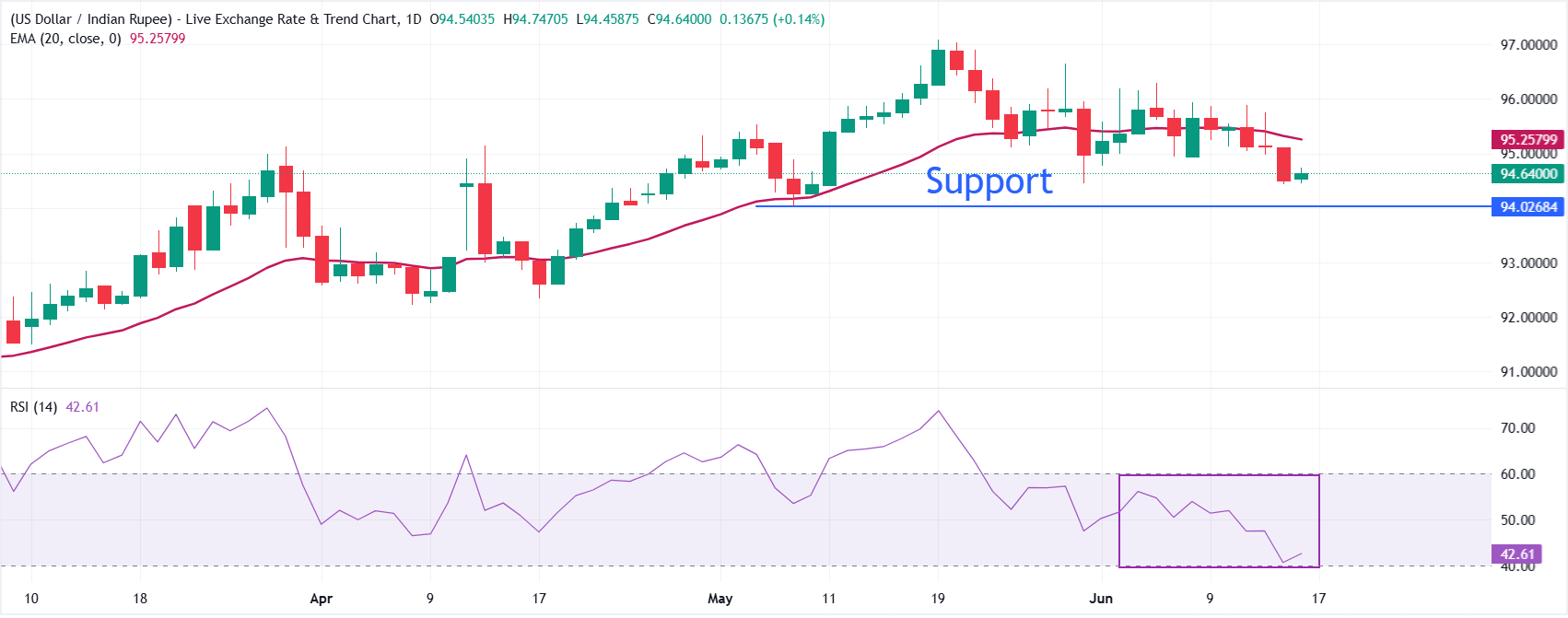
USD/INR trades weakly at around 94.58, extending a corrective phase below its 20-day exponential moving average (EMA) at 95.2580, which now acts as the first topside barrier and keeps the near-term bias tilted lower.
The Relative Strength Index (RSI) at 42.6 remains below the midline, suggesting waning bullish momentum and leaving the pair vulnerable while it holds under the short-term EMA cap.
On the topside, a daily close above the 20-day EMA around 95.26 would be needed to ease immediate downside pressure and open the way for a more sustained rebound towards 96.00. Looking down, the pair could extend the decline to the May 7 low at 94.03 if it fails to hold the June 15 low at 94.43.
(The technical analysis of this story was written with the help of an AI tool.)
Indian Rupee FAQs
The Indian Rupee (INR) is one of the most sensitive currencies to external factors. The price of Crude Oil (the country is highly dependent on imported Oil), the value of the US Dollar – most trade is conducted in USD – and the level of foreign investment, are all influential. Direct intervention by the Reserve Bank of India (RBI) in FX markets to keep the exchange rate stable, as well as the level of interest rates set by the RBI, are further major influencing factors on the Rupee.
The Reserve Bank of India (RBI) actively intervenes in forex markets to maintain a stable exchange rate, to help facilitate trade. In addition, the RBI tries to maintain the inflation rate at its 4% target by adjusting interest rates. Higher interest rates usually strengthen the Rupee. This is due to the role of the ‘carry trade’ in which investors borrow in countries with lower interest rates so as to place their money in countries’ offering relatively higher interest rates and profit from the difference.
Macroeconomic factors that influence the value of the Rupee include inflation, interest rates, the economic growth rate (GDP), the balance of trade, and inflows from foreign investment. A higher growth rate can lead to more overseas investment, pushing up demand for the Rupee. A less negative balance of trade will eventually lead to a stronger Rupee. Higher interest rates, especially real rates (interest rates less inflation) are also positive for the Rupee. A risk-on environment can lead to greater inflows of Foreign Direct and Indirect Investment (FDI and FII), which also benefit the Rupee.
Higher inflation, particularly, if it is comparatively higher than India’s peers, is generally negative for the currency as it reflects devaluation through oversupply. Inflation also increases the cost of exports, leading to more Rupees being sold to purchase foreign imports, which is Rupee-negative. At the same time, higher inflation usually leads to the Reserve Bank of India (RBI) raising interest rates and this can be positive for the Rupee, due to increased demand from international investors. The opposite effect is true of lower inflation.
Nothing in this material constitutes investment advice, personal recommendation, investment research, an offer, or a solicitation to buy or sell any financial instrument. The content has been prepared without consideration of your individual investment objectives, financial situation, or needs, and should not be treated as such.
Past performance is not a reliable indicator of future performance and/or results. Forward-looking scenarios or forecasts are not a guarantee of future performance. Actual results may differ materially from those anticipated.
Mitrade makes no representation or warranty as to the accuracy or completeness of the information provided and accepts no liability for any loss arising from reliance on such information.
Recommended Articles


