



Mexican Peso weakens as Fed repricing lifts USD ahead of Banxico
- Fed dots keep rate-hike risks alive, lifting Dollar demand.
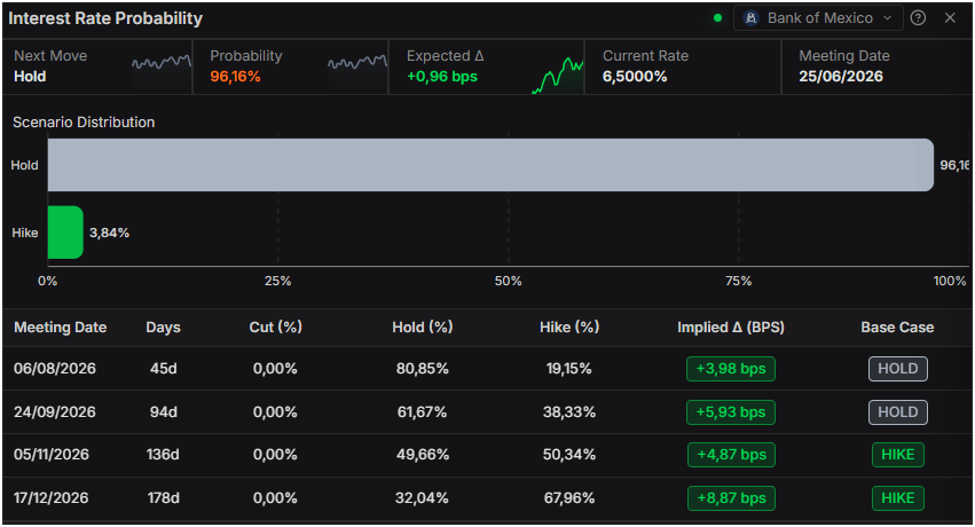
- Banxico is expected to hold rates steady at 6.50%.
- Mexico inflation and US Core PCE guide next move.
The Mexican Peso posted losses of 0.34% on Monday as the Greenback recovered some ground, driven by the Federal Reserve's hawkish tilt, which pushed the US Dollar higher. At the time of writing, the USD/MXN trades at 17.35 after bouncing off daily lows of 17.29.
USD/MXN rises as hawkish Fed bets support Greenback recovery
At the US central bank's last meeting, nine of the 19 members of the Federal Open Market Committee (FOMC) expect one rate hike this year, while eight favour holding rates unchanged. One of the two remaining favours a rate cut, while the new Fed Chair, Kevin Warsh, refrained from expressing his view on monetary policy, as he does not like forward guidance.
The US Dollar Index (DXY), which measures the performance of the buck’s value against a basket of six currencies, is up 0.22% at 100.98, about to test 12-month highs on expectations that the interest rate difference between the US and Mexico could reduce in the near-term.
Banxico, to hold rates unchanged
In Mexico, the economic docket was absent on Monday, yet Retail Sales for April are expected, along with the first-half of the month inflation for June and the Bank of Mexico (Banxico) monetary policy meeting on June 25, with the bank expected to keep rates steady at 6.50%.
A Reuters poll revealed that inflation seems steady in Mexico, despite the rise of prices spurred by the World Cup. The Consumer Price Index (CPI) is seen at 3.77% YoY, while the Core CPI ir projected to ease from 4.15% to 4.14% YoY.
Worth noting that Banxico signalled the end of its easing cycle, a posture confirmed by Deputy Governor Gabriel Cuadra, who commented that the bank needs to keep interest rates stable due to the complex outlook.
In the US, the economic docket is light, with Flash PMIs eyed, followed by housing data, GDP figures for Q1 2026, the Fed’s preferred inflation gauge, the Core Personal Consumption Expenditures (PCE) Price Index, and Initial Jobless Claims data.
USD/MXN Price Forecast: Technical outlook
In the daily chart, USD/MXN trades at 17.3575, holding a mildly constructive tone as it sits above the clustered simple moving averages (SMA) around 17.3298. This positioning suggests the pair has reclaimed a short-term base after prior declines from the broader downtrend marked by the long-standing descending resistance line, while the Relative Strength Index (14) near 51.6 hints at steady but not overstretched upside momentum.
On the downside, initial support emerges at the SMA cluster near 17.33, where a decisive break would expose a deeper retracement toward prior daily lows. With no clear nearby resistance levels derived from the provided metrics, further gains would likely meet selling interest only as the pair approaches historically significant swing highs and the broader descending trend structure, leaving the immediate risk tilted modestly to the upside while price holds above the 17.33 area.
(The technical analysis of this story was written with the help of an AI tool.)
Mexican Peso FAQs
The Mexican Peso (MXN) is the most traded currency among its Latin American peers. Its value is broadly determined by the performance of the Mexican economy, the country’s central bank’s policy, the amount of foreign investment in the country and even the levels of remittances sent by Mexicans who live abroad, particularly in the United States. Geopolitical trends can also move MXN: for example, the process of nearshoring – or the decision by some firms to relocate manufacturing capacity and supply chains closer to their home countries – is also seen as a catalyst for the Mexican currency as the country is considered a key manufacturing hub in the American continent. Another catalyst for MXN is Oil prices as Mexico is a key exporter of the commodity.
The main objective of Mexico’s central bank, also known as Banxico, is to maintain inflation at low and stable levels (at or close to its target of 3%, the midpoint in a tolerance band of between 2% and 4%). To this end, the bank sets an appropriate level of interest rates. When inflation is too high, Banxico will attempt to tame it by raising interest rates, making it more expensive for households and businesses to borrow money, thus cooling demand and the overall economy. Higher interest rates are generally positive for the Mexican Peso (MXN) as they lead to higher yields, making the country a more attractive place for investors. On the contrary, lower interest rates tend to weaken MXN.
Macroeconomic data releases are key to assess the state of the economy and can have an impact on the Mexican Peso (MXN) valuation. A strong Mexican economy, based on high economic growth, low unemployment and high confidence is good for MXN. Not only does it attract more foreign investment but it may encourage the Bank of Mexico (Banxico) to increase interest rates, particularly if this strength comes together with elevated inflation. However, if economic data is weak, MXN is likely to depreciate.
As an emerging-market currency, the Mexican Peso (MXN) tends to strive during risk-on periods, or when investors perceive that broader market risks are low and thus are eager to engage with investments that carry a higher risk. Conversely, MXN tends to weaken at times of market turbulence or economic uncertainty as investors tend to sell higher-risk assets and flee to the more-stable safe havens.
Nothing in this material constitutes investment advice, personal recommendation, investment research, an offer, or a solicitation to buy or sell any financial instrument. The content has been prepared without consideration of your individual investment objectives, financial situation, or needs, and should not be treated as such.
Past performance is not a reliable indicator of future performance and/or results. Forward-looking scenarios or forecasts are not a guarantee of future performance. Actual results may differ materially from those anticipated.
Mitrade makes no representation or warranty as to the accuracy or completeness of the information provided and accepts no liability for any loss arising from reliance on such information.
Recommended Articles


