



Record intervention bought the Japanese Yen three weeks
- USD/JPY trades near 159.00, nearly half the way back to its late-July peak.
- Japanese investors bought over 5 trillion Yen of foreign assets in two weeks.
- Tokyo core inflation is seen easing to 1.8%, thinning the September hike case.
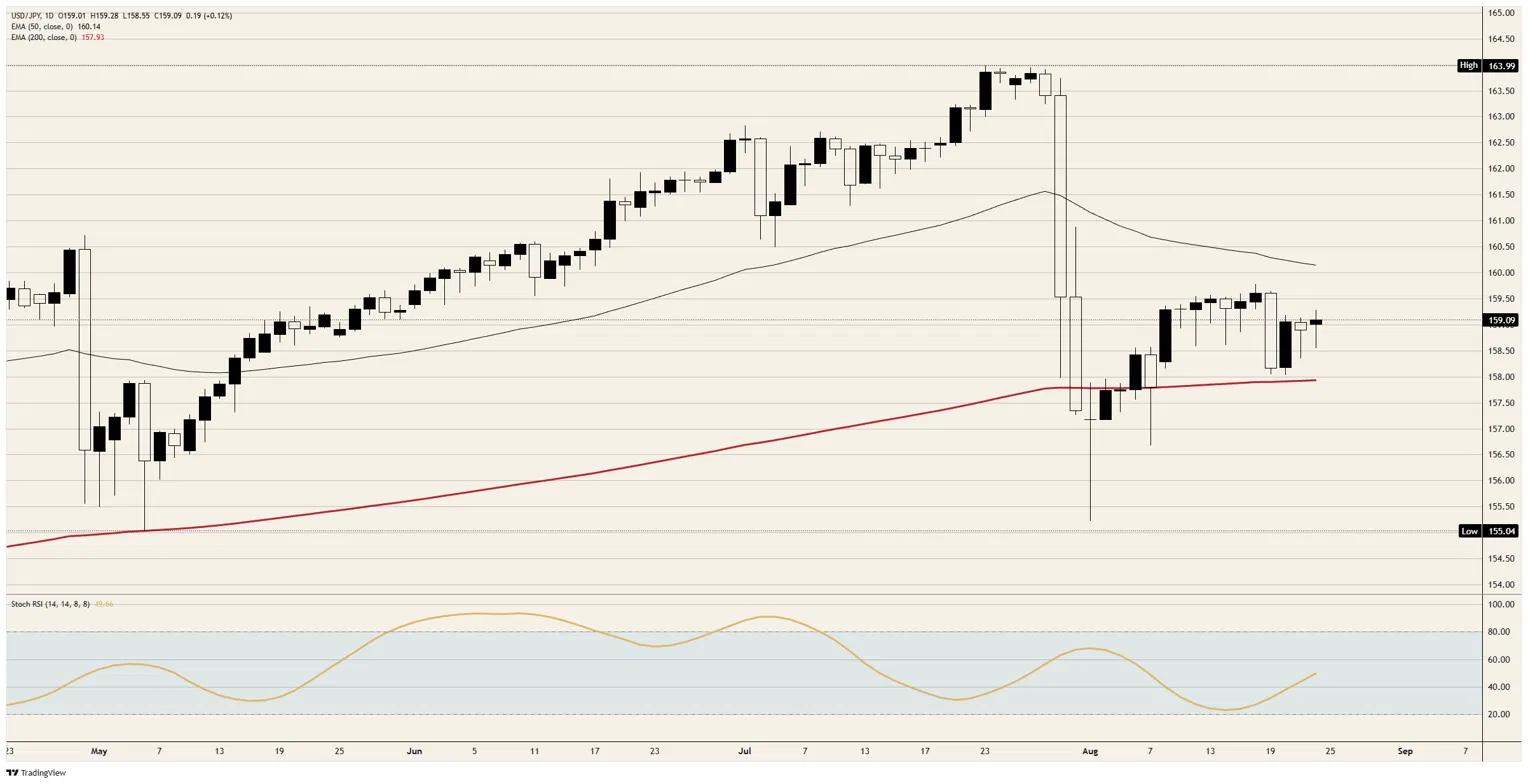
Dollar-Yen holds near 159.00 into the North American afternoon, marginally higher on the day inside a range of roughly three quarters of a Yen between the 158.50 area and a high short of 159.50. Three weeks on from the largest single-session defence of the Yen on record, the pair has recovered close to half of what that operation delivered.
The scale of the effort is worth stating plainly, because the outcome has to be judged against it. A record 8.45 trillion Yen went out in one session, followed by roughly 5.3 trillion more in coordination with the US Treasury, and the pair fell from just under 164.00 to a little above the 155.00 handle. It has spent every week since walking back up.
The defence that funded the trade
The flow data explains why. Japanese investors net bought more than 5 trillion Yen of foreign equities and long-term bonds in the two weeks to August 15, against net selling of more than 300 billion Yen in the fortnight before. A cheaper Dollar was not read as a warning by the domestic institutional base. It was read as an entry.
That is the awkward arithmetic of a defence conducted without a policy change behind it. Official selling supplied a better level to whoever wanted the other side of the trade, and the people who wanted it were the same life insurers and pension funds the operation was nominally protecting. Reserves were converted into a discount on the carry trade.
One detail sharpens the point further. Reporting on the operation indicates the American leg was executed by selling Euros rather than Dollars, which left the Treasury market untouched at the very moment Washington was propping it up by other means. The Yen got its defence, and no American holding was liquidated to provide it.
The gap no ministry can sell its way out of
Nothing about the differential moved. The Bank of Japan (BoJ) holds its policy rate at 1.00% against a Federal Reserve target range of 3.50% to 3.75%, and the ten-year yield gap between the two markets runs near 1.8 percentage points with the American long end at multi-decade highs. Intervention changes the price for a session and leaves the reason for the flow entirely intact.
The energy leg pushes the same way. Japan imports effectively all of its fuel, Brent trades above $92.00, and Washington opened a global secondary-sanctions campaign against Iran's energy revenue on Monday while Tehran advanced plans to charge vessels for transiting the Strait of Hormuz. A country paying for its energy in Dollars has no interest in that argument running into the autumn, and its currency has less.
Which leaves the Yen dependent on a rate rise rather than a bigger cheque. Reporting through August has the Takaichi government supportive of a move in September or October, and that expectation is most of what has kept the pair from a straight retest of the level that triggered the defence.
Thursday is the test
Tokyo Consumer Price Index (CPI) figures for August land Thursday at 23:30 GMT and they point the wrong way. The measure excluding fresh food is seen at 1.8% YoY from 1.9%, with the headline and the series excluding food and energy both running near 2% and the July unemployment rate seen unchanged at 2.5%. Underlying inflation drifting back toward the target thins the case for a September increase rather than building it.
The American calendar supplies the rest. Core Personal Consumption Expenditures (PCE) prices arrive Wednesday at 12:30 GMT, seen at 0.2% MoM for July from 0.1% with the annual rate holding 3.3%, alongside the second look at Q2 Gross Domestic Product (GDP) at 1.5% annualised. The symposium at Jackson Hole runs Thursday through Saturday, and the Fed Chair's keynote on Friday at 14:00 GMT shares its hour with the preliminary benchmark revision to nonfarm payrolls.
Both halves of the week therefore lean the same direction for this pair. A soft Tokyo print and a chair unwilling to disown the December increase still in the curve is the combination that puts the intervention level back on the table, and there is nothing on the calendar between now and Friday capable of stopping it.
Levels to watch
Resistance: The 159.50 handle caps the session, then the 50-day Exponential Moving Average (EMA) near 160.00, which is also where intervention risk re-arms. Above that, the late-July peak just under 164.00.
Support: The 158.50 area is the first floor, then the 200-day EMA near 158.00 and rising into it. Beneath, 157.50 and then the August low just above the 155.00 handle.
Bias: Bullish while the 200-day EMA near 158.00 holds. The daily Stochastic Relative Strength Index (Stoch RSI) near 50 leaves plenty of room in either direction, and the structural case is unchanged as long as one central bank pays 1.00% and the other pays close to four times that. Invalidation on a daily close beneath the 200-day, which would need either a hawkish surprise from Tokyo or a second operation.
USD/JPY daily chart
Japanese Yen FAQs
The Japanese Yen (JPY) is one of the world’s most traded currencies. Its value is broadly determined by the performance of the Japanese economy, but more specifically by the Bank of Japan’s policy, the differential between Japanese and US bond yields, or risk sentiment among traders, among other factors.
One of the Bank of Japan’s mandates is currency control, so its moves are key for the Yen. The BoJ has directly intervened in currency markets sometimes, generally to lower the value of the Yen, although it refrains from doing it often due to political concerns of its main trading partners. The BoJ ultra-loose monetary policy between 2013 and 2024 caused the Yen to depreciate against its main currency peers due to an increasing policy divergence between the Bank of Japan and other main central banks. More recently, the gradually unwinding of this ultra-loose policy has given some support to the Yen.
Over the last decade, the BoJ’s stance of sticking to ultra-loose monetary policy has led to a widening policy divergence with other central banks, particularly with the US Federal Reserve. This supported a widening of the differential between the 10-year US and Japanese bonds, which favored the US Dollar against the Japanese Yen. The BoJ decision in 2024 to gradually abandon the ultra-loose policy, coupled with interest-rate cuts in other major central banks, is narrowing this differential.
The Japanese Yen is often seen as a safe-haven investment. This means that in times of market stress, investors are more likely to put their money in the Japanese currency due to its supposed reliability and stability. Turbulent times are likely to strengthen the Yen’s value against other currencies seen as more risky to invest in.
Nothing in this material constitutes investment advice, personal recommendation, investment research, an offer, or a solicitation to buy or sell any financial instrument. The content has been prepared without consideration of your individual investment objectives, financial situation, or needs, and should not be treated as such.
Past performance is not a reliable indicator of future performance and/or results. Forward-looking scenarios or forecasts are not a guarantee of future performance. Actual results may differ materially from those anticipated.
Mitrade makes no representation or warranty as to the accuracy or completeness of the information provided and accepts no liability for any loss arising from reliance on such information.
Recommended Articles


