



USD/JPY Price Forecast: 20-day EMA continues to act as key barrier
- USD/JPY declines to near 159.00 amid hawkish BoJ expectations.
- Investors keenly await the US PCE Inflation data for July.
- The US core PCE Price Index is expected to have remained steady at 3.3% YoY.
The Japanese Yen (JPY) trades higher against the US Dollar (USD) on Wednesday, with USD/JPY dropping 0.1% to near 159.00. The Asia-Pacific currency gains amid firm expectations that the Bank of Japan (BoJ) will hike policy rates by 25 basis points (bps) to 1.25% in the September meeting.
Strategists at Scotiabank note that domestic data have offered little fresh direction, with “fundamental releases…limited” even as “media are reporting of high-profile adjustments to BoJ forecasts as major banks shift their tightening calls to September.” They add that while markets have begun to reprice the near-term policy path, the “greater risk will center around the central bank’s tone as market participants look beyond the September 18 meeting,” suggesting that guidance on the trajectory of normalization may prove more market-moving than the decision itself.
Earlier in the day, the August 17-24 survey conducted by Reuters showed that 57% of economists expected the BoJ to raise its interest rates by 25 bps to 1.25% in September. This is a sharp turnaround from a July poll when just 5% expected an interest rate hike move
Meanwhile, the US Dollar trades lower ahead of the United States (US) Personal Consumption Expenditure Price Index (PCE) data for July, which will be published at 12:30 GMT.
Inflation outlook steady as Wells Fargo sees only modest easing in PCE
Economists at Wells Fargo do not anticipate any major surprise on the inflation front in the July data. Drawing on the latest CPI and PPI reports, they note that these releases "point to a 0.1% gain in the PCE deflator in July, nudging the year-over-year rate down to 3.6%." At the same time, Wells Fargo expects "core PCE inflation" to "rise 0.2% on the month, leaving the annual rate at 3.3%," reinforcing the view that price pressures are easing only gradually rather than falling sharply.
USD/JPY Technical Analysis
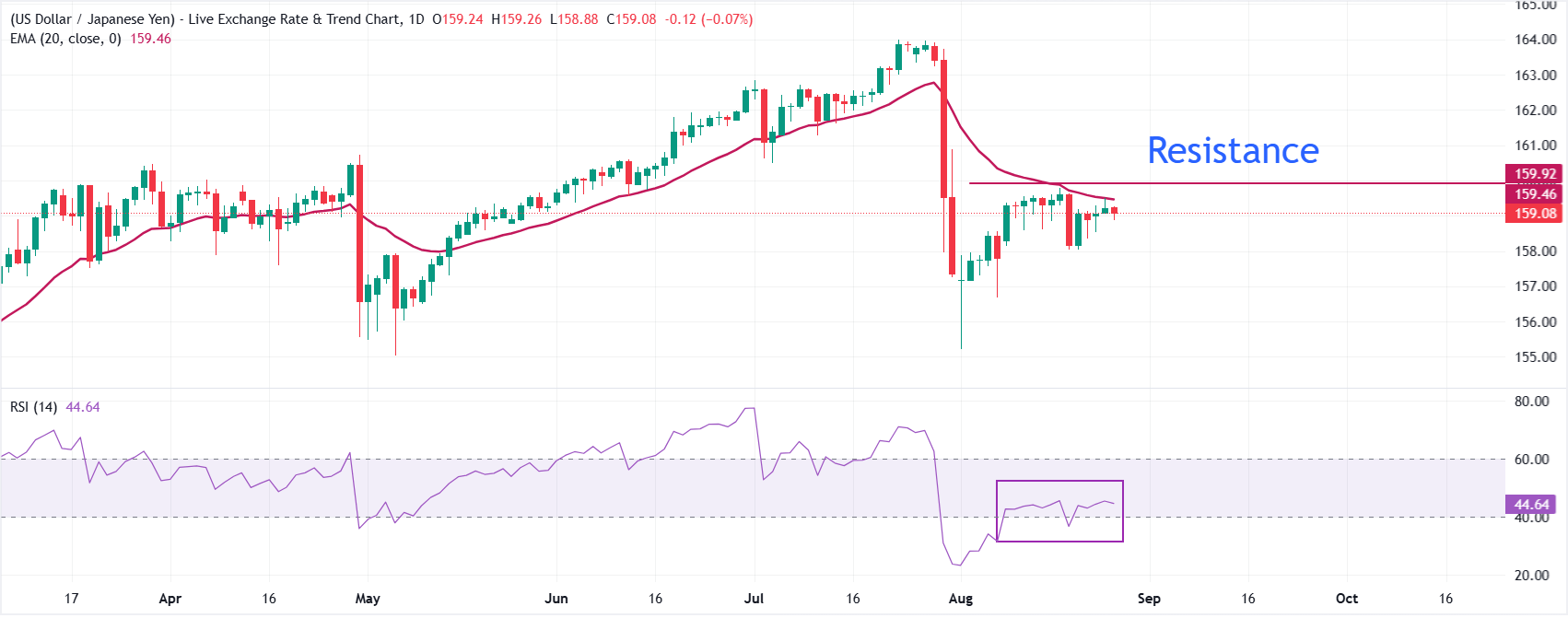
In the daily chart, USD/JPY trades at 159.08, holding a bearish near-term bias as spot remains capped beneath the 20-day exponential moving average (EMA) at 159.46. The pair has retreated from recent highs and now sits under this short-term trend gauge, suggesting topside pressure, while the Relative Strength Index (RSI) around 44 leans slightly negative but is not oversold.
On the topside, immediate resistance is located at the 20-day EMA at 159.46, and a daily close above this level would be needed to ease the current downside bias and allow a recovery toward higher levels. With no nearby technical supports derived from the provided dataset, the pair appears vulnerable as long as it trades below 159.46, leaving price action driven by whether sellers can extend the decline or buyers manage to reclaim the EMA barrier.
(The technical analysis of this story was written with the help of an AI tool. Know more.)
Bank of Japan FAQs
The Bank of Japan (BoJ) is the Japanese central bank, which sets monetary policy in the country. Its mandate is to issue banknotes and carry out currency and monetary control to ensure price stability, which means an inflation target of around 2%.
The Bank of Japan embarked in an ultra-loose monetary policy in 2013 in order to stimulate the economy and fuel inflation amid a low-inflationary environment. The bank’s policy is based on Quantitative and Qualitative Easing (QQE), or printing notes to buy assets such as government or corporate bonds to provide liquidity. In 2016, the bank doubled down on its strategy and further loosened policy by first introducing negative interest rates and then directly controlling the yield of its 10-year government bonds. In March 2024, the BoJ lifted interest rates, effectively retreating from the ultra-loose monetary policy stance.
The Bank’s massive stimulus caused the Yen to depreciate against its main currency peers. This process exacerbated in 2022 and 2023 due to an increasing policy divergence between the Bank of Japan and other main central banks, which opted to increase interest rates sharply to fight decades-high levels of inflation. The BoJ’s policy led to a widening differential with other currencies, dragging down the value of the Yen. This trend partly reversed in 2024, when the BoJ decided to abandon its ultra-loose policy stance.
A weaker Yen and the spike in global energy prices led to an increase in Japanese inflation, which exceeded the BoJ’s 2% target. The prospect of rising salaries in the country – a key element fuelling inflation – also contributed to the move.
Nothing in this material constitutes investment advice, personal recommendation, investment research, an offer, or a solicitation to buy or sell any financial instrument. The content has been prepared without consideration of your individual investment objectives, financial situation, or needs, and should not be treated as such.
Past performance is not a reliable indicator of future performance and/or results. Forward-looking scenarios or forecasts are not a guarantee of future performance. Actual results may differ materially from those anticipated.
Mitrade makes no representation or warranty as to the accuracy or completeness of the information provided and accepts no liability for any loss arising from reliance on such information.
Recommended Articles


