



If the Strait of Hormuz Remains Closed: What Commodity Markets Will Experience?
TradingKey - As of April 3 ET, the Strait of Hormuz has effectively been closed for five consecutive weeks. This situation continues to impact global commodity markets.
Just how critical is the Strait of Hormuz?
The Strait of Hormuz is the only waterway connecting the Persian Gulf to the open ocean, carrying approximately 20 million barrels of crude oil daily, which accounts for about 20% of the global crude oil supply.
More critically, this waterway, which is only 33 kilometers wide at its narrowest point, also handles approximately 20% of global liquefied natural gas (LNG) transport and 34% of global oil exports, with about 11% of the world's total maritime trade volume passing through it.
While Middle Eastern Gulf nations can bypass the strait by exporting some crude oil via overland pipelines, the estimated bypass capacity is only 4 million to 5 million barrels per day. This means that if the strait is blocked, the global market could face a supply gap of up to 15 million barrels per day.
The International Energy Agency (IEA) has described the current situation as the largest crude oil supply disruption in history. In a report dated March 30, Morgan Stanley warned that the intensity of this Middle East crude supply shock is already several times that of the Russian supply losses in 2022.
According to the bank's statistics, approximately 10.2 million barrels per day of crude oil production in the Middle East is currently forced offline, and the market has suffered a cumulative loss of about 300 million barrels of crude oil since the conflict erupted.
Turning point emerges, but uncertainty remains.
On April 3, three Omani vessels took the "southern route" near the Omani coast to cross the strait, bypassing the northern shipping lanes controlled by Iran. Simultaneously, Iran's state news agency reported that Iran is drafting a "joint management agreement" with Oman, intending to implement transit oversight and fees for vessels passing through the strait.
Following the news, international oil prices briefly retreated from their intraday highs. However, the White House has set April 6 as the deadline for Iran and the U.S. to reach an agreement, and the development of the situation remains highly uncertain.
Beyond oil prices, which commodities are most at risk?
Brent crude oil prices have surged to a four-year high of nearly $120 per barrel. A Reuters survey in March showed that analysts raised their annual oil price forecasts by the largest margin on record—the average price for Brent in 2026 is expected to be $82.85 per barrel, about 30% higher than the pre-war forecast of $63.85. Spot Brent crude briefly touched $141.37 per barrel, the highest level since 2008.
Goldman Sachs has raised its average Brent price forecast for March and April to $110 and its 2026 average to $85, warning that if disruptions extend to 10 weeks, oil prices could break the 2008 record of $147 per barrel.
Bank of America (BAC) ..., on the other hand, assumed a more extreme scenario: if disruptions persist into the second half of the year, average Brent crude prices will reach approximately $130.
Liquefied Natural Gas (LNG): Another "Chokehold"
Perhaps even more alarming than oil prices is the natural gas market. Approximately 20% of global LNG supply passes through the Strait of Hormuz, and throughout March, not a single LNG carrier was observed successfully transiting the strait. About four-fifths of Qatar's LNG is sold to Asian buyers, all of which depends on transit through the strait.
For Asia, this is more than just a pricing issue—delays in long-term contract fulfillment have entered a substantive stage. According to OilChem, of the nearly 70 LNG shipments scheduled to arrive in China in March and April 2026, 28 originated from Qatar, accounting for 40%. The 11 Qatari shipments scheduled for departure after February 28 have been unable to ship normally, directly affecting arrival plans for late March through April.
On April 3, Eastern Time, the first LNG carrier, the "Sohar," was attempting to transit the Strait of Hormuz in ballast, injecting a dose of "hope" into the market. However, there remains a massive gap between a single transit in ballast and the normalization of navigation for fully loaded LNG tankers.
Morgan Stanley (MS) has projected three scenarios for the market:
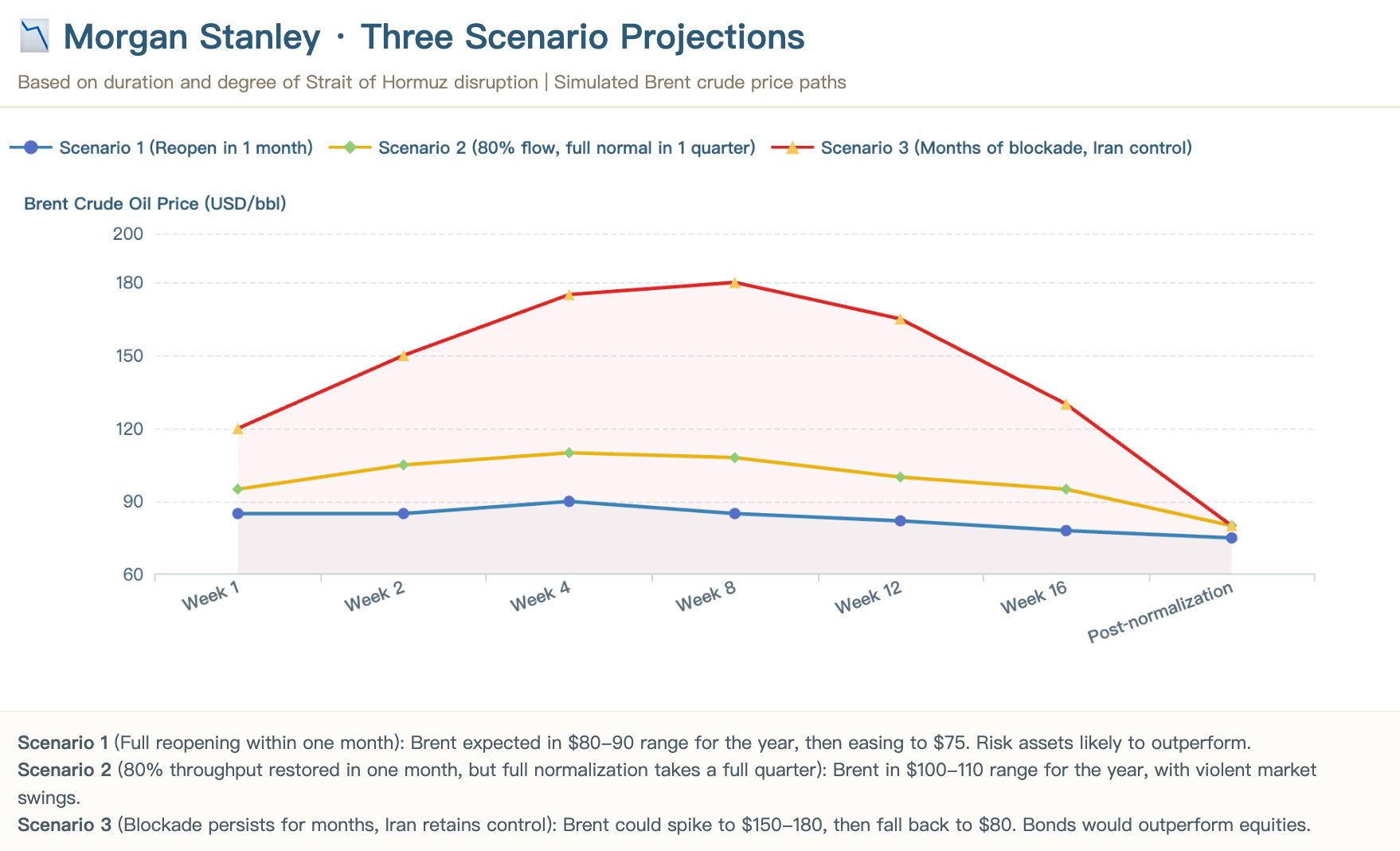
[Morgan Stanley Brent Crude Oil Scenario Analysis, Source: TradingKey | Morgan Stanley]
- Scenario 1 (Normal reopening within one month): Brent is expected to remain in the $80 to $90 range for the year, subsequently pulling back to $75. In this case, risk assets are expected to outperform.
- Scenario 2 (80% of navigation restored within one month, but full normalization takes an entire quarter): Brent stays in the $100 to $110 range for the year, and the market will experience severe volatility.
- Scenario 3 (Blockade lasts several months, with Iran retaining control): Brent could surge to $150 to $180 before falling back to $80. In this scenario, bonds are expected to outperform stocks.
It is worth noting that this crisis is spawning structural changes that could permanently alter the landscape of the global commodities market:
First, geopolitical risk premiums are being permanently repriced. Goldman Sachs (GS) pointed out that the reality of highly concentrated production and spare capacity in the Middle East, combined with vulnerable energy infrastructure, will lead to higher "security premiums" in forward prices. Morgan Stanley also anticipates a potential "new normal" where tolls are charged for every tanker passing through the Strait of Hormuz; recently, an Indian LNG tanker was charged a passage fee of $1 million to $2 million.
At the same time, global trade flows are being completely reshaped. Atlantic Basin crude is being repriced as the "last marginal relief," with Asian buyers scrambling for European supplies, pushing Europe to the very end of the restocking queue. Saudi Arabia's alternative pipelines are nearing full capacity—crude oil exports via the Port of Yanbu have surged to approximately 4.6 million barrels per day, approaching the pipeline's capacity limit.
Furthermore, Gulf nations are re-evaluating their long-term energy infrastructure strategies. According to the Financial Times, the possibility of Iran maintaining indefinite control over the Strait of Hormuz is prompting Gulf states to consider constructing costly new pipelines to bypass this chokepoint for continued oil and gas exports. Saudi Arabia's 1,200-kilometer East-West Pipeline, which diverts an average of 7 million barrels of crude oil per day, has become the benchmark.
During the Iran-Iraq War in the 1980s, Iran repeatedly threatened to blockade the strait and attacked tankers, leading some crew members to label the passage the "Corridor of Death." History shows that the Strait of Hormuz has never been completely or permanently closed, but every strategic maneuver surrounding the region has a direct impact on international oil prices and the global economy. The resolution of this geopolitical conflict will not only determine the short-term direction of oil prices but will also reshape the global commodity trade order for years to come.
Nothing in this material constitutes investment advice, personal recommendation, investment research, an offer, or a solicitation to buy or sell any financial instrument. The content has been prepared without consideration of your individual investment objectives, financial situation, or needs, and should not be treated as such.
Past performance is not a reliable indicator of future performance and/or results. Forward-looking scenarios or forecasts are not a guarantee of future performance. Actual results may differ materially from those anticipated.
Mitrade makes no representation or warranty as to the accuracy or completeness of the information provided and accepts no liability for any loss arising from reliance on such information.
Recommended Articles


