



WTI Price Forecast: Hormuz uncertainty widens scope for further upside towards $113
- The Oil price falls back from its over seven-week high of $107.35; however, its broader outlook remains firm.
- US President Trump warns of a prolonged naval blockade of Iranian sea ports.
- Fed Chair Powell said that the current interest rate stance is appropriate.
West Texas Intermediate (WTI), futures on NYMEX, gives up its early gains after posting a fresh over seven-week high at around $107.35 and flattens to near $104.85 during the European trading session on Thursday.
The Oil price is broadly upbeat as United States (US) President Donald Trump has warned of a prolonged blockade on Iranian sea ports after rejecting Iran’s proposal, which consisted of the reopening of the Strait of Hormuz, a vital passage to almost 20% global energy supply, Bloomberg reported. Trump added that the naval blockade of Iran will continue until Washington secures a deal with Tehran to address the country’s nuclear program.
In response, Iran has warned of "unprecedented military action" against continued US blockading of Iran-linked vessels.
The prolonged Hormuz closure has prompted an energy supply crisis, undermining currencies from economies that rely on oil imports to meet their energy needs.
Meanwhile, comments from the Federal Reserve’s (Fed) policy announcement on Wednesday, pointing to holding interest rates at their current levels for now, have raised concerns over the oil demand outlook. Fed Chair Jerome Powell said in the press conference on Wednesday that the “current policy stance is appropriate,” and risks to both inflation and the economy have increased.
WTI technical analysis
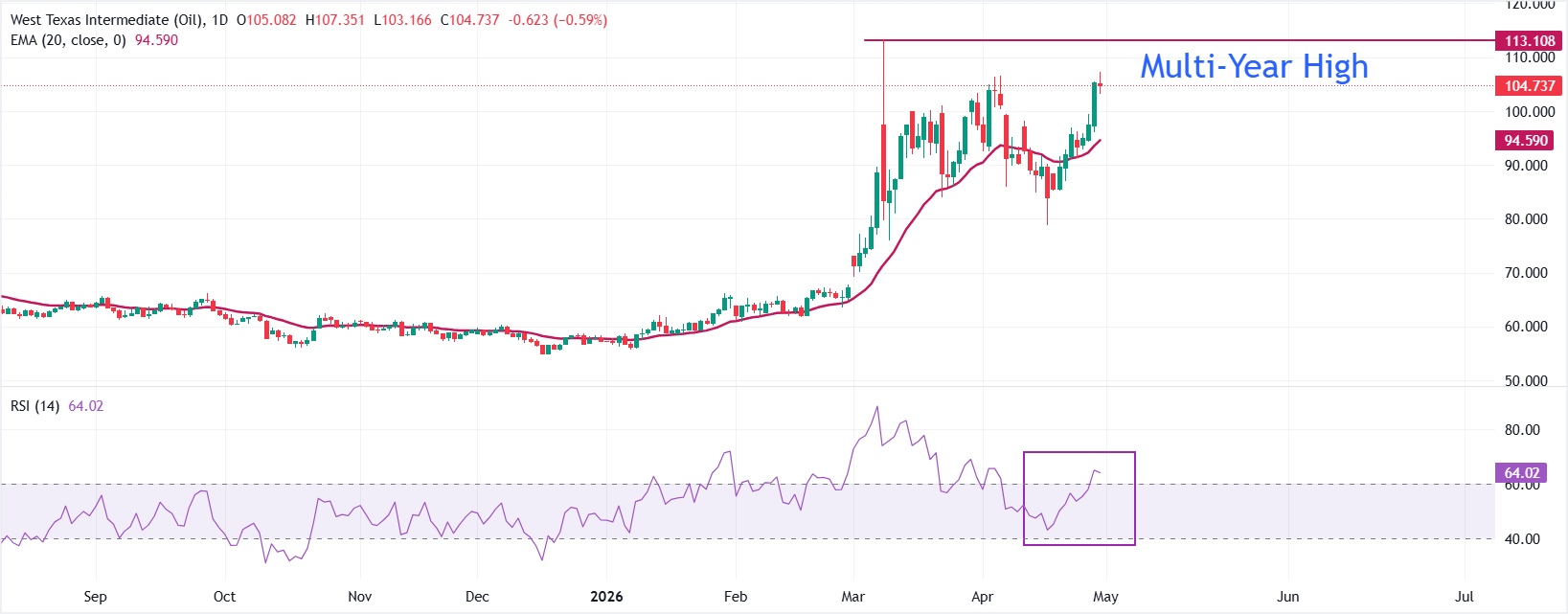
WTI US Oil trades flat at around $104.82 at the press time, maintaining a bullish near-term bias, as price holds well above the 20-day Exponential Moving Average (EMA) at roughly $94.60, which now lies far below spot and underscores the strength of the latest advance.
The Relative Strength Index (RSI) around 64 suggests firm but not yet overbought upside momentum, hinting that buyers retain control despite the market having extended sharply away from its mean.
With no nearby moving-average supports under the current price, the market remains in a stretched phase where any pullback toward the 20-day EMA near $94.60 would be watched as a potential area for dip-buying interest rather than a structural break. On the topside, the oil price will likely extend its advance towards the multi-year high of $113.28 posted on March 9.
(The technical analysis of this story was written with the help of an AI tool.)
WTI Oil FAQs
WTI Oil is a type of Crude Oil sold on international markets. The WTI stands for West Texas Intermediate, one of three major types including Brent and Dubai Crude. WTI is also referred to as “light” and “sweet” because of its relatively low gravity and sulfur content respectively. It is considered a high quality Oil that is easily refined. It is sourced in the United States and distributed via the Cushing hub, which is considered “The Pipeline Crossroads of the World”. It is a benchmark for the Oil market and WTI price is frequently quoted in the media.
Like all assets, supply and demand are the key drivers of WTI Oil price. As such, global growth can be a driver of increased demand and vice versa for weak global growth. Political instability, wars, and sanctions can disrupt supply and impact prices. The decisions of OPEC, a group of major Oil-producing countries, is another key driver of price. The value of the US Dollar influences the price of WTI Crude Oil, since Oil is predominantly traded in US Dollars, thus a weaker US Dollar can make Oil more affordable and vice versa.
The weekly Oil inventory reports published by the American Petroleum Institute (API) and the Energy Information Agency (EIA) impact the price of WTI Oil. Changes in inventories reflect fluctuating supply and demand. If the data shows a drop in inventories it can indicate increased demand, pushing up Oil price. Higher inventories can reflect increased supply, pushing down prices. API’s report is published every Tuesday and EIA’s the day after. Their results are usually similar, falling within 1% of each other 75% of the time. The EIA data is considered more reliable, since it is a government agency.
OPEC (Organization of the Petroleum Exporting Countries) is a group of 12 Oil-producing nations who collectively decide production quotas for member countries at twice-yearly meetings. Their decisions often impact WTI Oil prices. When OPEC decides to lower quotas, it can tighten supply, pushing up Oil prices. When OPEC increases production, it has the opposite effect. OPEC+ refers to an expanded group that includes ten extra non-OPEC members, the most notable of which is Russia.
Nothing in this material constitutes investment advice, personal recommendation, investment research, an offer, or a solicitation to buy or sell any financial instrument. The content has been prepared without consideration of your individual investment objectives, financial situation, or needs, and should not be treated as such.
Past performance is not a reliable indicator of future performance and/or results. Forward-looking scenarios or forecasts are not a guarantee of future performance. Actual results may differ materially from those anticipated.
Mitrade makes no representation or warranty as to the accuracy or completeness of the information provided and accepts no liability for any loss arising from reliance on such information.
Recommended Articles


