



Strait of Hormuz Closure: Bitcoin Falls Into Liquidity Trap, or Heads Toward $100,000 Mark?
TradingKey - The closure of the Strait of Hormuz has led to a liquidity shortage for Bitcoin, but it remains a long-term positive for the asset.
On April 3, Bitcoin ( BTC) saw a weak rebound in price, fluctuating around $66,000, with the current price at $66,735. Recently, signals of a troop withdrawal from the U.S. President boosted Bitcoin prices above $69,000; however, the subsequent announcement of intensified crackdowns on Iran caused Bitcoin to briefly drop below $66,000.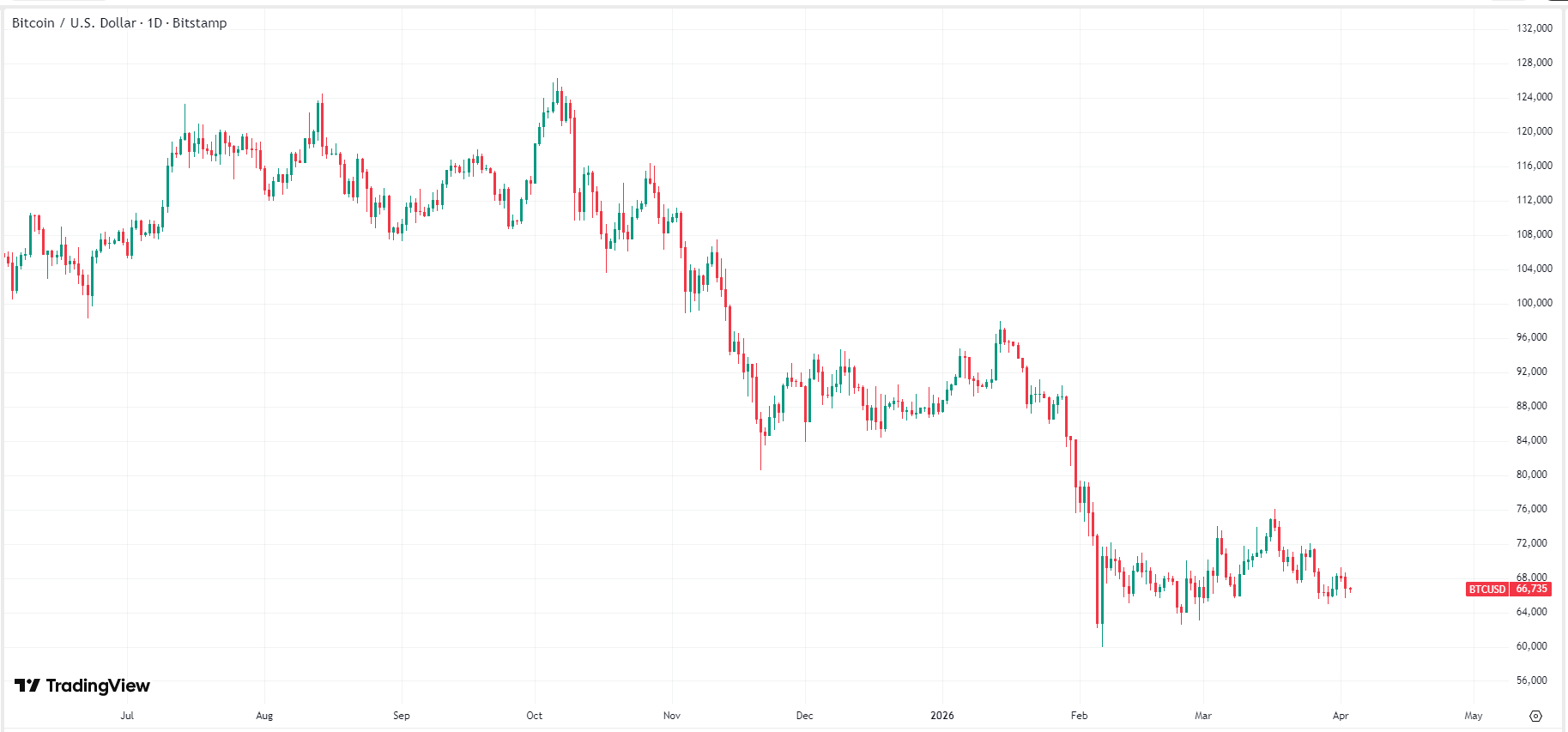 Bitcoin price chart, Source: TradingView
Since the U.S.-Iran conflict began, Iran has maintained firm control over the Strait of Hormuz, and Bitcoin has faced the ongoing threat of a "liquidity trap." During the initial stages of the strait's closure, investors sold Bitcoin—a high-volatility asset—for cash to hedge against uncertainty. Meanwhile, many institutional investors were forced to liquidate Bitcoin, which has relatively high liquidity, to meet margin calls for their equity positions. For instance, when the conflict escalated in early March 2026, Bitcoin plummeted from $74,000 to approximately $65,000.
Currently, the strait remains closed, with crude oil prices holding at $110 per barrel. Rising energy costs will eventually permeate various sectors, triggering global inflation. To combat this secondary inflation driven by oil prices, the Federal Reserve (Fed) may delay its original rate-cut plans or even reconsider raising interest rates. This would lead to a stronger U.S. dollar, typically putting pressure on Bitcoin, a "non-monetary asset," in a high-interest-rate and strong-dollar environment.
However, once the initial liquidity shock subsides, Bitcoin's "decentralized" and "censorship-resistant" attributes will gradually emerge. In other words, a long-term closure of the Strait of Hormuz could actually benefit Bitcoin. Specifically, under threats of war or sanctions, the traditional banking system may face restrictions, making Bitcoin the sole channel for real-time global safe-haven capital and cross-border transfers. Furthermore, if the conflict triggers global financial instability or the devaluation of sovereign currencies, capital will flow into assets with "hard scarcity," potentially pushing Bitcoin back toward the $100,000 milestone.
Another noteworthy development is that the situation in the Strait of Hormuz is bolstering Bitcoin. According to Bloomberg, the Islamic Revolutionary Guard Corps is charging ships passing through the strait in RMB or cryptocurrency. This means shipowners must purchase large quantities of cryptocurrency (including BTC) as "transit fees" to move hundreds of millions of dollars in cargo. In effect, this inelastic demand from the real economy provides Bitcoin with a level of support independent of the financial markets.
Nothing in this material constitutes investment advice, personal recommendation, investment research, an offer, or a solicitation to buy or sell any financial instrument. The content has been prepared without consideration of your individual investment objectives, financial situation, or needs, and should not be treated as such.
Past performance is not a reliable indicator of future performance and/or results. Forward-looking scenarios or forecasts are not a guarantee of future performance. Actual results may differ materially from those anticipated.
Mitrade makes no representation or warranty as to the accuracy or completeness of the information provided and accepts no liability for any loss arising from reliance on such information.
Recommended Articles


