



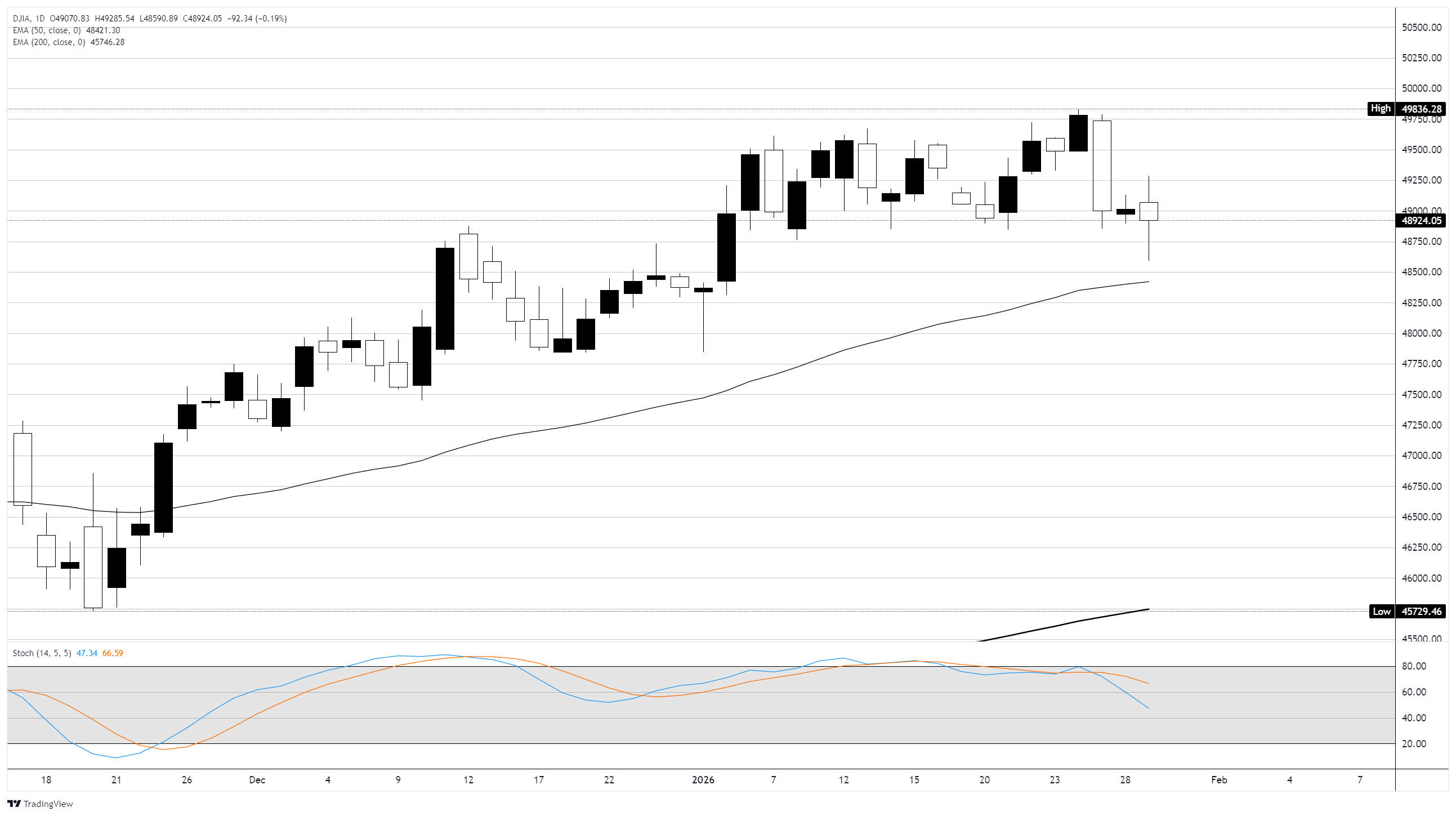
Dow Jones Industrial Average struggles to ward off software downturn
- Megacap tech earnings dragged markets lower, led by Microsoft’s sharp post-earnings drop.
- Software stocks slid as AI optimism faded, pushing the IGV ETF into bear market territory.
- Meta earnings and record-high copper prices stood out as key pockets of strength.
US equities faced renewed pressure on Thursday as megacap technology earnings and the Federal Reserve’s (Fed) tepid showing this week weighed on sentiment. The S&P 500 fell 0.7%, the Nasdaq dropped 1.6%, and the Dow slipped around 0.2%, while cryptocurrencies declined more than 4% to their lowest levels in nearly two months. Microsoft was the primary drag, tumbling 11% after reporting slower cloud growth and issuing weaker operating margin guidance, marking its worst day since early 2020.
Rising tides don't lift all boats forever
Weakness spread across the software sector, reflecting growing investor unease about still-rising artificial intelligence spending and its hypothesized potential to overturn established business models. ServiceNow (NOW) fell sharply despite beating earnings expectations, while Oracle (ORCL) and Salesforce (CRM) also declined. The software-focused IGV ETF dropped into bear market territory, now more than 20% below its recent high, highlighting how quickly sentiment has shifted in a segment that had previously benefited from AI optimism. While AI remains a long-term growth driver, it is no longer delivering consistently positive surprises, making earnings quality and diversification increasingly important as valuation expansion becomes harder to sustain.
There were notable bright spots on Thursday: Meta (META) shares surged after the company delivered strong earnings. Meta posted 24% revenue growth driven by advertising and issued an upbeat sales forecast. Investors appeared comfortable with Meta’s aggressive AI investment plans, even as capital expenditures are set to nearly double from last year, signaling confidence in its ability to fund growth while maintaining profitability. Caterpillar (CAT) also added to the positive side of earnings season with a solid quarterly beat.
"Doctor Copper" signals everything's okay
Outside equities, copper prices reached an all-time high, tangentially reaffirming expectations for resilient global economic activity. Futures climbed more than 8% to $6.45 a pound, extending a strong multi-month rally. Copper mining stocks and related ETFs posted outsized gains, with several major producers up 35-50% in January alone, marking one of the strongest periods for the sector in more than a decade.
Dow Jones daily chart
Dow Jones FAQs
The Dow Jones Industrial Average, one of the oldest stock market indices in the world, is compiled of the 30 most traded stocks in the US. The index is price-weighted rather than weighted by capitalization. It is calculated by summing the prices of the constituent stocks and dividing them by a factor, currently 0.152. The index was founded by Charles Dow, who also founded the Wall Street Journal. In later years it has been criticized for not being broadly representative enough because it only tracks 30 conglomerates, unlike broader indices such as the S&P 500.
Many different factors drive the Dow Jones Industrial Average (DJIA). The aggregate performance of the component companies revealed in quarterly company earnings reports is the main one. US and global macroeconomic data also contributes as it impacts on investor sentiment. The level of interest rates, set by the Federal Reserve (Fed), also influences the DJIA as it affects the cost of credit, on which many corporations are heavily reliant. Therefore, inflation can be a major driver as well as other metrics which impact the Fed decisions.
Dow Theory is a method for identifying the primary trend of the stock market developed by Charles Dow. A key step is to compare the direction of the Dow Jones Industrial Average (DJIA) and the Dow Jones Transportation Average (DJTA) and only follow trends where both are moving in the same direction. Volume is a confirmatory criteria. The theory uses elements of peak and trough analysis. Dow’s theory posits three trend phases: accumulation, when smart money starts buying or selling; public participation, when the wider public joins in; and distribution, when the smart money exits.
There are a number of ways to trade the DJIA. One is to use ETFs which allow investors to trade the DJIA as a single security, rather than having to buy shares in all 30 constituent companies. A leading example is the SPDR Dow Jones Industrial Average ETF (DIA). DJIA futures contracts enable traders to speculate on the future value of the index and Options provide the right, but not the obligation, to buy or sell the index at a predetermined price in the future. Mutual funds enable investors to buy a share of a diversified portfolio of DJIA stocks thus providing exposure to the overall index.
Nothing in this material constitutes investment advice, personal recommendation, investment research, an offer, or a solicitation to buy or sell any financial instrument. The content has been prepared without consideration of your individual investment objectives, financial situation, or needs, and should not be treated as such.
Past performance is not a reliable indicator of future performance and/or results. Forward-looking scenarios or forecasts are not a guarantee of future performance. Actual results may differ materially from those anticipated.
Mitrade makes no representation or warranty as to the accuracy or completeness of the information provided and accepts no liability for any loss arising from reliance on such information.
Recommended Articles


