



Dow Jones Industrial Average futures flat as Iran diplomacy wobbles, UoM sentiment beats
- DJIA futures churn in a wide range as fresh headlines on Iran talks in Pakistan pull traders in both directions.
- Hopes for a quick resolution faded after Iran framed Araghchi's trip as a bilateral tour rather than direct negotiations with the US.
- University of Michigan Consumer Sentiment jumps to 49.8 from 47.6 expected, though April still prints a record low.
- Year-ahead inflation expectations ease to 4.7%, while the five-year gauge ticks up to 3.5%.
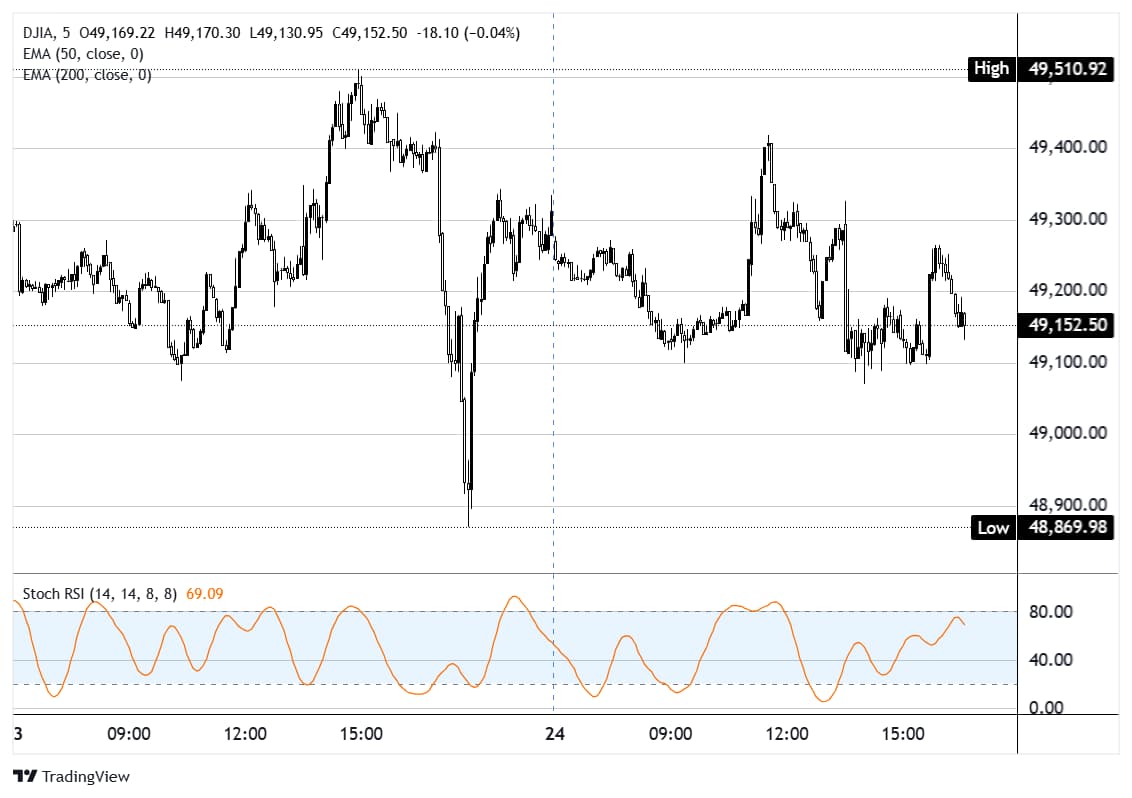
Dow Jones Industrial Average (DJIA) futures are trading broadly flat in the early afternoon GMT on Friday, holding above 49,100 after a choppy session that saw prices swing between 48,900 and 49,500. Risk sentiment is being pulled in opposing directions by renewed US-Iran diplomacy headlines out of Islamabad and a stronger-than-expected University of Michigan (UoM) Consumer Sentiment print that nonetheless left April at its weakest reading on record. The prior session closed lower, with the cash index shedding around 0.36% as tech earnings weighed.
Witkoff and Kushner head to Pakistan as Araghchi arrives
US special envoy Steve Witkoff and senior adviser Jared Kushner are set to land in Islamabad this weekend to take part in talks alongside Iranian Foreign Minister Abbas Araghchi, who flew into Pakistan on Friday evening local time. The news triggered a brief risk-on burst during European hours, with DJIA futures pushing back above 49,400 and Oil prices easing as traders leaned into the possibility of a restart of the stalled second round of negotiations. Vice President JD Vance is not currently joining the trip, given that Iran's lead negotiator from the first round, parliamentary speaker Mohammad Bagher Ghalibaf, is also absent, which the White House reads as a signal that Tehran is not yet ready to commit to a full second round.
Iran's bilateral framing dims resolution odds
The enthusiasm proved short-lived. Iranian state media IRNA explicitly framed Araghchi's trip as a bilateral visit to Pakistani officials rather than a direct engagement with the US delegation, with onward stops in Muscat and Moscow. Araghchi himself posted on X that the purpose was to coordinate with partners on bilateral matters and consult on regional developments, making no mention of Washington. Combined with Ghalibaf's absence, the odds of a substantive breakthrough on this particular trip look slim, and DJIA futures faded their earlier gains as traders registered the gap between the optics and the substance.
UoM sentiment beats but remains at record lows
The final April UoM Consumer Sentiment Index printed at 49.8, well ahead of the 47.6 consensus but still the weakest on record and down 6.6% from March. The Consumer Expectations subindex came in at 48.1 versus 46.1 expected. On the inflation side, one-year ahead expectations eased to 4.7% from 4.8%, while the five-year gauge ticked up to 3.5% from 3.4%, nudging the stickier end of the inflation picture higher just as the Federal Reserve (Fed) weighs the passthrough from elevated Oil prices into upcoming Consumer Price Index (CPI) readings. The mix is an awkward one for equities, as it pushes back against any near-term dovish Fed pivot without meaningfully improving the growth picture.
Strait of Hormuz standoff continues to cap upside
Beyond the diplomacy headlines, the underlying Iran backdrop remains tense. The US naval blockade of the Strait of Hormuz is still in place, with President Donald Trump refusing to lift it before a deal is struck, while Iran continues to assert operational control of the waterway. Reports of sanctioned vessels still transiting the strait underscore the standoff, and so long as Oil supply risk premia stay elevated, DJIA futures look unlikely to cleanly reclaim the 49,500 zone brushed earlier in the week without a genuine, confirmed restart of direct US-Iran talks.
Dow Jones 5-minute chart
Dow Jones FAQs
The Dow Jones Industrial Average, one of the oldest stock market indices in the world, is compiled of the 30 most traded stocks in the US. The index is price-weighted rather than weighted by capitalization. It is calculated by summing the prices of the constituent stocks and dividing them by a factor, currently 0.152. The index was founded by Charles Dow, who also founded the Wall Street Journal. In later years it has been criticized for not being broadly representative enough because it only tracks 30 conglomerates, unlike broader indices such as the S&P 500.
Many different factors drive the Dow Jones Industrial Average (DJIA). The aggregate performance of the component companies revealed in quarterly company earnings reports is the main one. US and global macroeconomic data also contributes as it impacts on investor sentiment. The level of interest rates, set by the Federal Reserve (Fed), also influences the DJIA as it affects the cost of credit, on which many corporations are heavily reliant. Therefore, inflation can be a major driver as well as other metrics which impact the Fed decisions.
Dow Theory is a method for identifying the primary trend of the stock market developed by Charles Dow. A key step is to compare the direction of the Dow Jones Industrial Average (DJIA) and the Dow Jones Transportation Average (DJTA) and only follow trends where both are moving in the same direction. Volume is a confirmatory criteria. The theory uses elements of peak and trough analysis. Dow’s theory posits three trend phases: accumulation, when smart money starts buying or selling; public participation, when the wider public joins in; and distribution, when the smart money exits.
There are a number of ways to trade the DJIA. One is to use ETFs which allow investors to trade the DJIA as a single security, rather than having to buy shares in all 30 constituent companies. A leading example is the SPDR Dow Jones Industrial Average ETF (DIA). DJIA futures contracts enable traders to speculate on the future value of the index and Options provide the right, but not the obligation, to buy or sell the index at a predetermined price in the future. Mutual funds enable investors to buy a share of a diversified portfolio of DJIA stocks thus providing exposure to the overall index.
Nothing in this material constitutes investment advice, personal recommendation, investment research, an offer, or a solicitation to buy or sell any financial instrument. The content has been prepared without consideration of your individual investment objectives, financial situation, or needs, and should not be treated as such.
Past performance is not a reliable indicator of future performance and/or results. Forward-looking scenarios or forecasts are not a guarantee of future performance. Actual results may differ materially from those anticipated.
Mitrade makes no representation or warranty as to the accuracy or completeness of the information provided and accepts no liability for any loss arising from reliance on such information.
Recommended Articles


