



Dow Jones Industrial Average slips below 49K ahead of Powell's final Fed rate call
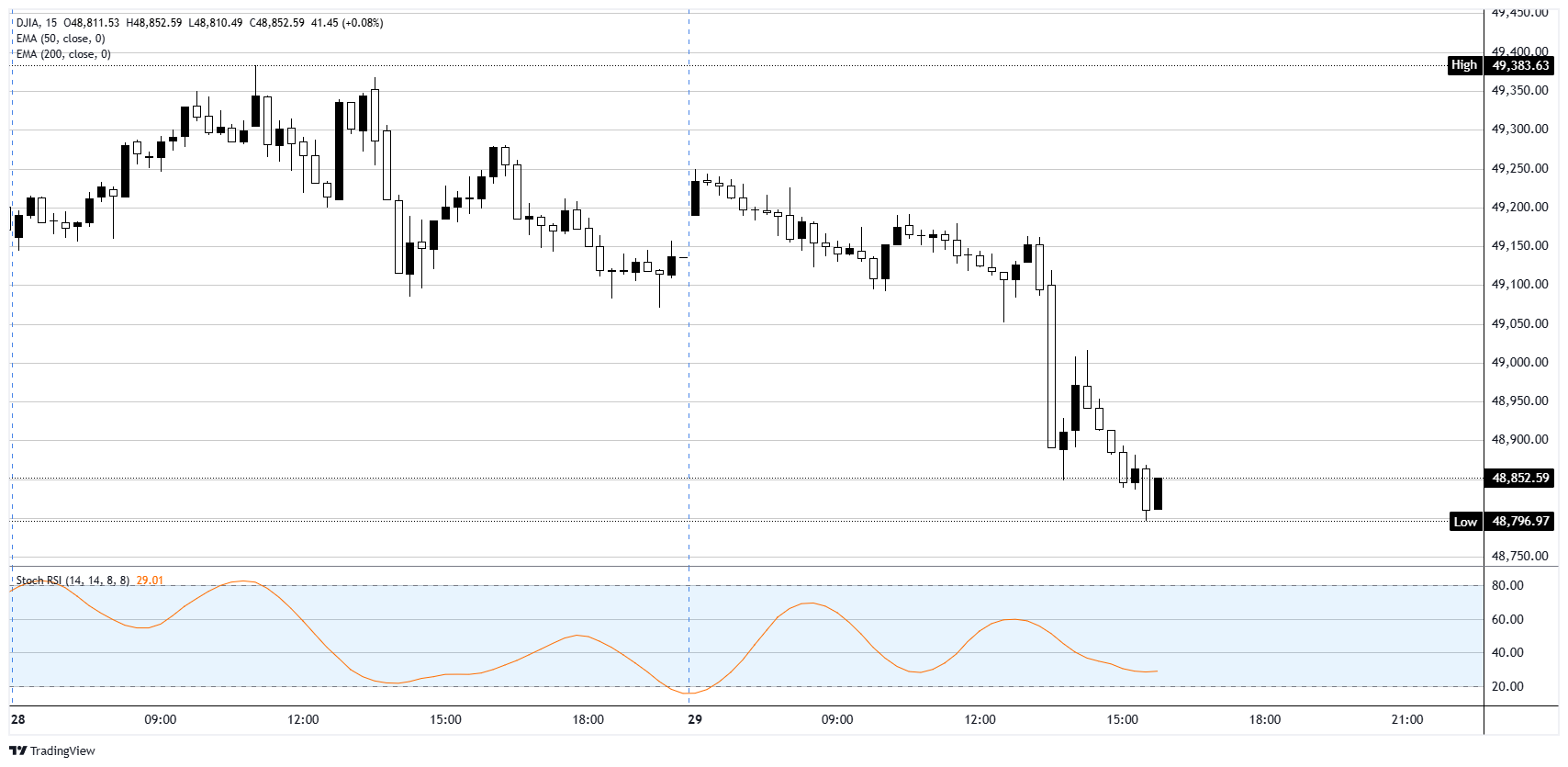
- DJIA futures traded near 48.8K at the time of writing, slipping below 49K as risk appetite faded into the Federal Reserve decision.
- Stronger than expected March Durable Goods Orders complicated the inflation picture as Oil extended gains on US-Iran tensions.
- Federal Open Market Committee (FOMC) is widely expected to hold rates steady at 3.75% at what is likely Jerome Powell's final meeting as Fed Chair.
- Kevin Warsh cleared the Senate Banking Committee, with his Fed Chair nomination heading to a full Senate vote.
Dow Jones Industrial Average futures drifted lower through Wednesday's session, trading close to 48.8K at the time of writing after rejecting levels above 49.3K during the prior day. The S&P 500 hovered around the flatline alongside the Nasdaq Composite, with traders holding back ahead of the Federal Reserve (Fed) decision later in the session and a heavy slate of mega-cap technology earnings due after the closing bell.
Durable Goods beat keeps inflation watch live
March Durable Goods Orders rose 0.8% MoM, ahead of the 0.5% consensus and a sharp turnaround from the prior month's 1.2% contraction. The core reading, Nondefense Capital Goods Orders excluding Aircraft, jumped 3.3% MoM against expectations of 0.6%, pointing to firm business investment heading into the second quarter. Sticky capex demand reinforces the view that activity has not buckled despite higher input costs, which keeps inflation risks alive just as Oil prices grind higher. Defense-related orders also continue to run hot, with elevated military procurement tied to the ongoing Strait of Hormuz situation feeding into the headline series.
Oil rally adds pressure to risk assets
US West Texas Intermediate (WTI) crude extended its rally for another session after reports that the White House has instructed officials to prepare for an extended US blockade of Iranian ports. WTI advanced around 5% to trade above $105 per barrel at the time of writing, while Brent crude pushed past $117. Higher Oil prices feed directly into goods inflation and consumer sentiment, leaving the Fed with the kind of stagflation overlay that policymakers have been trying to avoid since the start of the year.
Powell's final meeting takes the spotlight
The April FOMC meeting concludes at 18:00 GMT, with the press conference following at 18:30 GMT. Markets are fully priced for a hold at 3.75%, so the focus will be entirely on the policy statement language and Powell's tone around inflation risks tied to Oil and the broader Middle East backdrop. This is widely expected to be Powell's final rate call as Fed Chair, with his term at the helm of the central bank ending in May. Any nod to the cumulative impact of higher energy costs on the inflation path could move the front end of the curve.
Warsh nomination heads to full Senate
Kevin Warsh, President Trump's pick to succeed Powell, cleared the Senate Banking Committee and his nomination now moves to the full Senate floor. The vote will have to wait, with the Senate on recess until after May 4. Warsh, a former Fed Governor, has historically leaned hawkish on inflation, and rates traders will be watching closely for any signals on his preferred policy stance heading into the transition.
Mega-cap tech earnings cap the day
Four of the so-called Magnificent Seven names report after the bell: Alphabet (GOOGL), Amazon (AMZN), Meta (META) and Microsoft (MSFT). With OpenAI's reported revenue and user growth misses still fresh, traders are looking for forward guidance that justifies the capex these names have committed to artificial intelligence (AI) infrastructure. Better than expected prints from Seagate (STX) and NXP Semiconductors (NXPI) on Tuesday, both of which jumped after delivering positive guidance, set a more constructive tone for chip-adjacent names heading into the close.
Dow Jones 15-minute chart
Dow Jones FAQs
The Dow Jones Industrial Average, one of the oldest stock market indices in the world, is compiled of the 30 most traded stocks in the US. The index is price-weighted rather than weighted by capitalization. It is calculated by summing the prices of the constituent stocks and dividing them by a factor, currently 0.152. The index was founded by Charles Dow, who also founded the Wall Street Journal. In later years it has been criticized for not being broadly representative enough because it only tracks 30 conglomerates, unlike broader indices such as the S&P 500.
Many different factors drive the Dow Jones Industrial Average (DJIA). The aggregate performance of the component companies revealed in quarterly company earnings reports is the main one. US and global macroeconomic data also contributes as it impacts on investor sentiment. The level of interest rates, set by the Federal Reserve (Fed), also influences the DJIA as it affects the cost of credit, on which many corporations are heavily reliant. Therefore, inflation can be a major driver as well as other metrics which impact the Fed decisions.
Dow Theory is a method for identifying the primary trend of the stock market developed by Charles Dow. A key step is to compare the direction of the Dow Jones Industrial Average (DJIA) and the Dow Jones Transportation Average (DJTA) and only follow trends where both are moving in the same direction. Volume is a confirmatory criteria. The theory uses elements of peak and trough analysis. Dow’s theory posits three trend phases: accumulation, when smart money starts buying or selling; public participation, when the wider public joins in; and distribution, when the smart money exits.
There are a number of ways to trade the DJIA. One is to use ETFs which allow investors to trade the DJIA as a single security, rather than having to buy shares in all 30 constituent companies. A leading example is the SPDR Dow Jones Industrial Average ETF (DIA). DJIA futures contracts enable traders to speculate on the future value of the index and Options provide the right, but not the obligation, to buy or sell the index at a predetermined price in the future. Mutual funds enable investors to buy a share of a diversified portfolio of DJIA stocks thus providing exposure to the overall index.
Nothing in this material constitutes investment advice, personal recommendation, investment research, an offer, or a solicitation to buy or sell any financial instrument. The content has been prepared without consideration of your individual investment objectives, financial situation, or needs, and should not be treated as such.
Past performance is not a reliable indicator of future performance and/or results. Forward-looking scenarios or forecasts are not a guarantee of future performance. Actual results may differ materially from those anticipated.
Mitrade makes no representation or warranty as to the accuracy or completeness of the information provided and accepts no liability for any loss arising from reliance on such information.
Recommended Articles


