



Anthropic: The Sharp Blade Piercing the Heart of Nvidia’s CUDA
In the first half of 2026, global capital markets are undergoing a profound paradigm shift. Although the Nasdaq is facing valuation correction pressures triggered by massive capital expenditures (CapEx) from Big Tech following the irrational exuberance of 2023-2025, a look through short-term market anxiety reveals that the AI industry has officially transitioned from the "infrastructure build-out phase" to the "industrialized harvesting phase." The core logic of this transformation is no longer the blind accumulation of computing power. Instead, vertical model providers represented by Anthropic are joining forces with cloud giants to achieve a financial settlement of the "Nvidia tax" and profit repatriation through bottom-layer architectural optimization.
Certainty Premium: Anthropic’s B2B Moat and Safe-Haven Logic
In the second half of the AI investment cycle, the market's evaluation criteria for models have shifted from pure parameter scale to commercial certainty. Anthropic’s emergence despite OpenAI's first-mover advantage stems essentially from its founding team's inherent "risk management" DNA. As a PhD in biophysics from Princeton and former VP of Research at OpenAI, co-founder Dario Amodei was a key architect of "Scaling Laws," giving him an industry-leading precision in managing the marginal utility of computing power in model training. Rather than purely pursuing the vision of AGI, Dario prefers finding the optimal balance between cost and intelligence during the computing dividend period, laying the technical foundation for Anthropic’s exceptionally high inference efficiency in 2026.
Unlike her brother, co-founder Daniela Amodei’s experience in risk control at payments giant Stripe has infused Anthropic with a finance-grade compliance DNA. In the complex regulatory environment of 2026, Fortune 500 companies no longer demand "omniscience" from AI assistants, but rather "non-defaultability." Anthropic’s core technology, "Constitutional AI," achieves self-restraint in model behavior through an embedded value framework. This logic-level safety mechanism has earned Anthropic high brand loyalty in zero-tolerance industries such as banking, pharmaceuticals, and semiconductor design. By early 2026, its enterprise-level Dollar-Based Net Retention Rate (DBNRR) consistently remained above 150%. This high-certainty Annual Recurring Revenue (ARR) growth has made it the most expensive "safe-haven asset" in the eyes of Big Tech.
Revenue Quality Analysis: OpenAI’s Scale Effect vs. Anthropic’s Industrial Verticality
Financial data from 2026 shows that top AI model providers have developed robust cash-flow capabilities. According to a joint study by Goldman Sachs and Morgan Stanley, OpenAI's projected ARR for 2026 has surpassed the $25 billion mark. Following a $50 billion funding round, OpenAI successfully achieved full coverage from consumer audiences to industry developers through a dual-distribution strategy via Amazon’s AWS and Microsoft’s Azure. However, behind the revenue scale, OpenAI still faces enormous R&D and computing expenses, and its valuation logic remains heavily colored by "traffic monopoly."
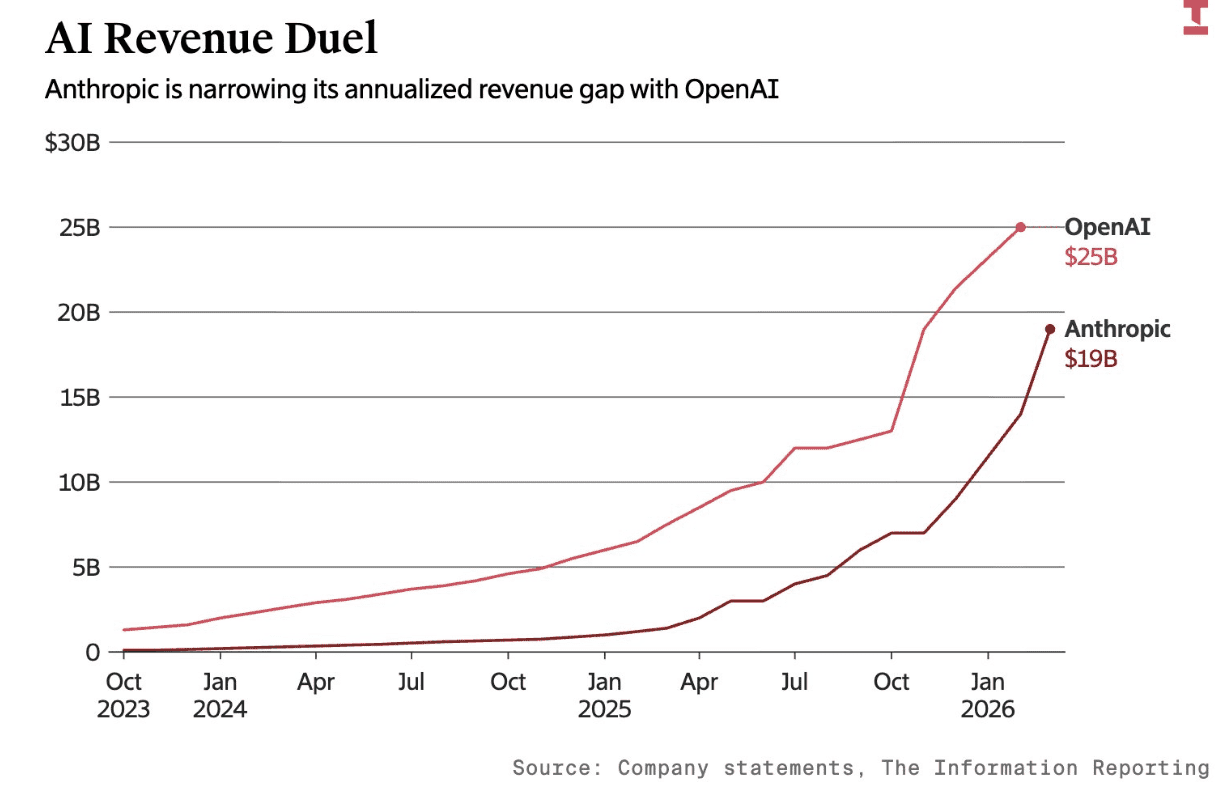
By contrast, Anthropic’s business model more closely resembles mature industrial software. Its client base is not a random collection of internet users, but professional organizations deeply rooted in production line automation. In 2026, pharmaceutical companies utilized Claude's logical reasoning to shorten clinical trial analysis cycles by over 30%, while semiconductor designers automated EDA tools through its "Computer Use" feature. For these clients, Claude is not a chat box but a precision plug-in embedded in production workflows. This deep business integration means that while the surface price per token is slightly higher, the resulting reduction in compliance costs and increased R&D efficiency constitute a "compliance premium" that enterprises are willing to pay long-term. Meanwhile, although Meta’s Llama series continues to apply pressure in the open-source field, the lack of legal endorsement and Service Level Agreement (SLA) guarantees in the B2B sector means open-source models still cannot shake Anthropic’s commercial moats.

Reconstructing the Power Chain: In-house Chips and the Financial Loop of "De-Nvidia-ization"
Current market panic over Big Tech CapEx largely overlooks the closed-loop logic of "landlords, tenants, and property management fees." In 2023 and 2024, cloud giants (landlords) were almost entirely dependent on Nvidia GPUs to build data centers, causing gross margins to be eaten away by high hardware procurement costs. However, by 2026, this situation has fundamentally reversed. Amazon’s Trainium 2/3 and Google’s TPU v6/v7 have completed the transition from experimental products to industrial-grade infrastructure through deep adaptation with top-tier models (tenants) like Anthropic.

The key to the financial loop lies in the "profit repatriation rate." While Nvidia’s Blackwell B200 chips still lead in throughput, the inference cost per million tokens remains between $0.10 and $0.20, and for cloud giants, this expenditure represents a pure "profit outflow." In contrast, Google’s in-house TPUs, through native adaptation with Anthropic, have driven inference costs down to $0.04–$0.06, with a profit repatriation rate as high as 65%. This cost-based asymmetric competition means that by supporting Anthropic, cloud giants have successfully decoupled from Nvidia’s CUDA ecosystem. According to Morgan Stanley estimates, as over 30% of inference workloads shift to in-house chips, the operating margins of top cloud service providers are expected to increase by 3% to 5% by 2027. This expansion of gross margins, driven by the return of technical sovereignty, is direct evidence of CapEx converting into long-term profitability.

The Twilight of Nvidia’s Valuation: From Absolute Monopoly to Red Ocean Competition
In 2026, the "Year One of Inference," Nvidia is facing unprecedented strategic pressure. In the early stages of AI development, the scarcity of training compute established Nvidia’s hegemony; however, in the inference phase, cost-performance, power consumption, and native cloud integration have become the core competitive factors. As Anthropic proves that top-tier logic can run equally well on non-Nvidia chips, Nvidia’s CUDA defensive line has begun to crack.
From a valuation perspective, Nvidia’s current P/E ratio requires it to maintain gross margins above 75% and an absolute monopoly. However, as trillion-dollar giants like Amazon and Google join forces to achieve supply chain self-sufficiency by supporting Anthropic, Nvidia is falling from being the "sole heartbeat of computing" to a "high-priced universal spare tire." The market is re-evaluating the cyclical risks of hardware commodity suppliers, while capital is flowing back to cloud platform giants that possess core data, distribution channels, and in-house chip loops. The source of Alpha (excess returns) has shifted entirely from the underlying hardware layer to the controllers of productivity tools.
Conclusion: The "Harvest Phase" Strategy for Rational Investors
In summary, the market adjustment of 2026 is not the bursting of an AI bubble, but a redistribution of industrial power. Investors should discard blind fear of total CapEx and instead focus on the "quality" of capital expenditure—specifically, whether these investments are effectively converted into adaptation for in-house chips and the securing of high-stickiness tenants like Anthropic.
On an operational level, investors should currently approach the high-premium hardware commodity segment with caution and focus on cloud platform giants capable of achieving "lower costs and higher profits" through technical loops. If the productivity gains from AI are certain, then this market pullback triggered by "de-monopolization" is essentially a discounted entry ticket as asset allocation shifts from "infrastructure logic" to "operational logic." The future logic of confidence lies not in the scale of computing power, but in the certainty of profit repatriation.
Nothing in this material constitutes investment advice, personal recommendation, investment research, an offer, or a solicitation to buy or sell any financial instrument. The content has been prepared without consideration of your individual investment objectives, financial situation, or needs, and should not be treated as such.
Past performance is not a reliable indicator of future performance and/or results. Forward-looking scenarios or forecasts are not a guarantee of future performance. Actual results may differ materially from those anticipated.
Mitrade makes no representation or warranty as to the accuracy or completeness of the information provided and accepts no liability for any loss arising from reliance on such information.
Recommended Articles


