



Looking to the Future of AI from Nvidia’s GTC: Which Stocks Will Benefit?
TradingKey - During the 2026 GTC conference, NVIDIA ( NVDA) CEO Jensen Huang's keynote and a series of partnerships and technology launches have sent ripples through the global tech supply chain. From computing hardware to application scenarios, multiple sectors are seeing clear investment opportunities.
I. AI Chip Manufacturing, Foundry, and Packaging
As a veteran player in the global memory chip sector, Samsung's successful entry into NVIDIA's logic chip foundry landscape is undoubtedly a breakthrough in the high-end manufacturing track.
During the conference, Jensen Huang explicitly confirmed that the Groq 3 LPU, designed for high-speed AI inference scenarios, is being produced exclusively by Samsung's foundry. This news directly shifts Samsung's role in the NVIDIA supply chain from a mere HBM memory supplier to a core area of logic chip foundry services.
The Groq 3 LPU is a core component of NVIDIA's Vera Rubin platform. Its built-in 500MB ultra-high-speed SRAM provides up to 150TB/s of bandwidth for bandwidth-intensive AI inference decoding tasks, far exceeding traditional HBM storage solutions.
Samsung's ability to secure this order not only continues the cooperation established before Groq was acquired by NVIDIA but also proves its technical strength in advanced process manufacturing. Its influence in the high-end AI chip foundry market is expected to grow continuously.
Meanwhile, Intel ( INTC) has demonstrated long-term strategic value in its collaboration with NVIDIA through a dual-track layout.
On one hand, Intel officially confirmed that its Xeon 6 processor will provide computing support for the NVIDIA DGX Rubin NVL8 system. This processor offers a 2.3x increase in memory bandwidth compared to the previous generation, perfectly matching the accelerated workload requirements of next-generation GPUs and providing a scalable high-performance computing foundation for AI data centers.
On the other hand, more forward-looking news indicates that NVIDIA intends to engage in deep foundry cooperation with Intel, utilizing Intel's advanced packaging technologies—including EMIB—to provide packaging support for the Feynman GPU debuting in 2026.
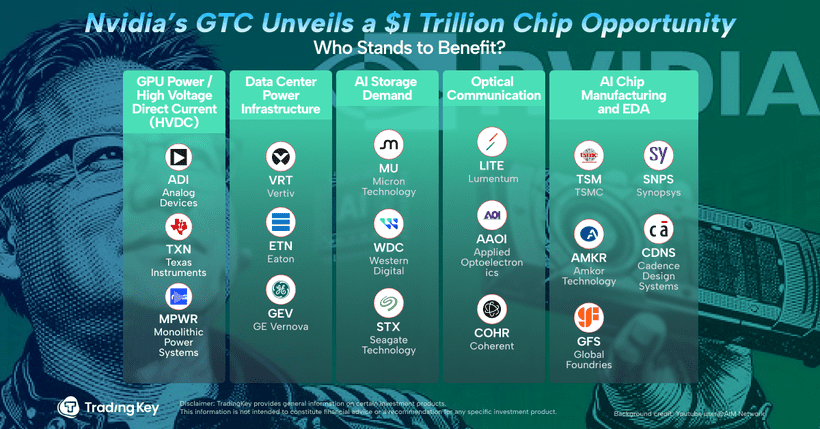
Notably, while the Feynman GPU die is expected to be produced using TSMC's 1.6nm process, Intel's involvement in the packaging stage signifies that its advanced packaging technology has been recognized by top industry players, further highlighting its competitiveness in the high-end chip packaging market.
TSMC ( TSM) and NVIDIA's partnership is a prime model of strategic symbiosis in the AI era. Leveraging leading advanced process nodes (such as 4nm and 3nm) and CoWoS advanced packaging technology, TSMC has been the core foundry partner for NVIDIA's high-performance GPUs.
The upcoming Feynman architecture, NVIDIA's next-generation core product following Rubin, will utilize TSMC's 1.6nm A16 process. Driven by this positive news, TSMC's US-listed shares rose 1.69% on Tuesday.
II. Optical Communications (AI Networking)
Inter-chip interconnects, the core of global AI computing infrastructure, are undergoing a historic leap from 'electrical' to 'optical.' On March 16 local time, NVIDIA released the Feynman chip, introducing optical communications to inter-chip interconnects for the first time, which can reduce AI data center communication energy consumption by over 70%.
Amidst this industrial wave of optical communications, Coherent ( COHR ), an optical communication component manufacturer, previously received a $2 billion strategic investment from NVIDIA, with both parties signing a multi-year procurement agreement. This major partnership directly pushed Coherent's stock price up nearly 7%.
Moving forward, Coherent will be deeply involved in the optical technology layout of NVIDIA's AI infrastructure, providing high-bandwidth, low-power optical communication solutions for its computing clusters. With NVIDIA's industry influence, Coherent's share in the AI optical communication market is expected to expand rapidly.
Lumentum ( LITE ), which also received a $2 billion investment from NVIDIA, has also secured a favorable position in this AI communications upgrade. Lumentum possesses deep technical expertise in laser chips and optical modules. Its partnership with NVIDIA not only provides sufficient capital to accelerate capacity expansion but also allows it to optimize its product technology specifically for NVIDIA's AI use cases.
As the demand for high-speed optical modules in AI computing clusters continues to climb, Lumentum's production advantages and technical strength will be fully utilized, making it a key link in the AI optical communication supply chain.
Meanwhile, Credo Technology ( CRDO) is expected to be a dark horse in short-range AI interconnects due to its unique technical route. The company's microLED near-package optical transmission solution significantly shortens signal transmission paths by packaging optical components close to the chip, reducing total interconnect power consumption within data centers to about 5% of traditional copper solutions while offering higher bandwidth.
In an era where AI computing clusters constantly pursue energy efficiency ratios, the advantages of this solution are evident. Credo Technology has thus gained broad room for growth, and its prospects will be even more impressive if it successfully enters NVIDIA's supply chain.
III. AI Memory Demand
Micron ( MU) has debunked previous market rumors with action, re-establishing its core position in NVIDIA's supply chain.
At the GTC conference, Micron officially announced that its 36GB 12-high HBM4 began volume production for NVIDIA's Vera Rubin platform in Q1 2026. This product features a pin rate exceeding 11 Gb/s and single-die bandwidth over 2.8 TB/s—a 2.3x performance increase over HBM3E with over 20% better power efficiency, fully meeting the extreme bandwidth needs of next-gen AI computing platforms.
Previous rumors suggested Micron was excluded from the Vera Rubin supply chain. The announcement of volume production not only crushed those rumors but also made Micron a core memory supplier for NVIDIA's new generation of AI platforms.
Simultaneously, Micron revealed it has started sampling 48GB 16-high HBM4 to customers, showcasing its technical reserves in high-end memory and laying the groundwork for capturing more AI memory market share. Its stock price rose 4.5% after the conference.
SK Hynix and SanDisk ( SNDK) have opened up long-term growth potential through their layout of new memory technologies. The two jointly launched an OCP (Open Compute Project) workflow to drive the standardization of HBF storage technology. As a complementary memory layer between HBM and SSDs, HBF provides HBM-like speeds with SSD capacity in AI inference scenarios, balancing performance and cost.
Buoyed by the conference, SK Hynix's Korean shares rose over 8% on Wednesday, and SanDisk's stock recorded a 2.35% gain on Tuesday.
IV. AI Cloud Services
The implementation of AI technology is reshaping service models across industries. The AI application and service landscape built around NVIDIA's computing ecosystem is becoming a new battleground for tech giants and vertical players.
As a global leader in cloud computing, Amazon ( AMZN) has taken another critical step in its AI computing layout. In 2026, AWS will deploy over 1 million NVIDIA GPUs. This massive investment will not only provide AWS with stronger AI support but also make it the first major cloud provider to support the RTX PRO 4500 Blackwell server edition.
This Blackwell-based server GPU, optimized for AI training and inference, offers enterprise users more efficient AI computing solutions.
Beyond cloud computing, Amazon will collaborate with NVIDIA to develop a multimodal Alexa assistant for vehicles, leveraging NVIDIA's AI chips and algorithms to expand Alexa's reach in smart cars. With both cloud and smart vehicle businesses moving forward, Amazon will fully benefit from the industrial transformation of the AI era. Its stock price recorded a 1.63% gain on Tuesday.
Adobe ( ADBE) has solidified its leading position in the creative design field through its technical collaboration with NVIDIA. The next-generation AI models jointly developed by both parties have infused Adobe's creative tools with more powerful AI capabilities, while the launch of the public beta for its cloud-based 3D digital twin solution marks a significant breakthrough for Adobe in AI creative applications.
This solution, relying on NVIDIA's high-performance computing power, enables creative professionals to rapidly build high-precision 3D digital twin scenes, which are widely applied in architecture, film and television, gaming, and other fields. By deeply integrating AI technology into creative workflows, Adobe has not only enhanced the competitiveness of its products but also provided new directions for the digital transformation of the creative industry.
CrowdStrike ( CRWD) has combined its Falcon platform with NVIDIA OpenShell to launch the "Security-by-Design AI Blueprint," providing full lifecycle security protection from development to deployment for autonomous AI agents. Its stock price rose 2.21% on Tuesday.
This collaboration marks CrowdStrike's formal entry into the rapidly growing market for AI autonomous agent security. Through its deep alignment with the NVIDIA AI ecosystem, the company is expected to attract more corporate customers seeking to protect on-device and cloud-based AI systems.
Analysts believe this move not only solidifies CrowdStrike's leadership in cybersecurity but also opens up growth opportunities in the next-generation AI security market, with promising potential for incremental revenue.
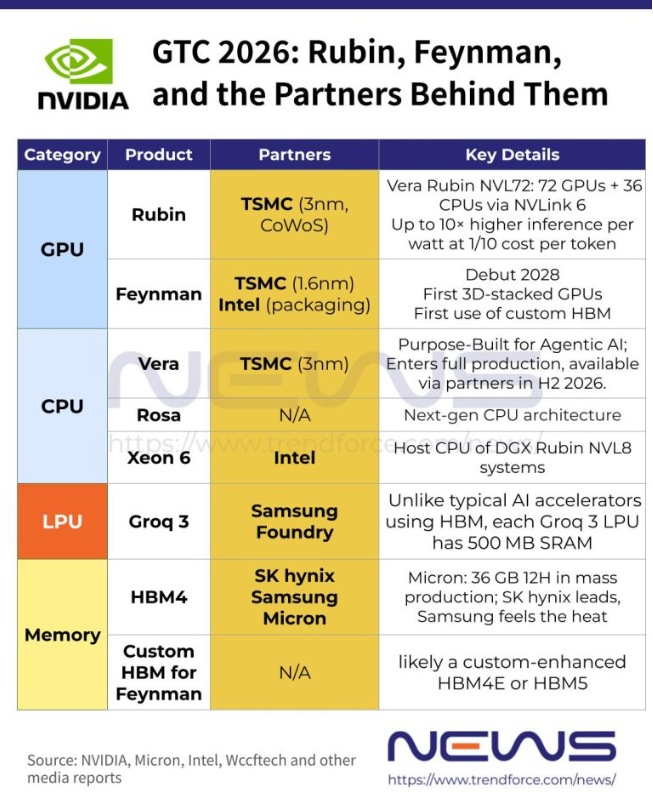
V. GPU Power / High Voltage Direct Current (HVDC)
As the demand for computing power for training large AI models grows exponentially, the power consumption of individual GPUs continues to rise. Traditional AC power architectures struggle to meet the efficient power supply requirements of AI servers. High Voltage Direct Current (HVDC) architectures, with their advantages of high conversion efficiency and low transmission loss, are increasingly becoming a new trend in data center power solutions.
Texas Instruments ( TXN ), ON Semiconductor ( ON ), Analog Devices ( ADI ), and other industry giants, leveraging their technical expertise in the field of HVDC power management, have become direct beneficiaries of this trend.
Texas Instruments not only announced at the 2026 GTC conference that it is joining forces with NVIDIA to accelerate the safe deployment of humanoid robots—integrating its real-time motor control, sensing, and power technologies with NVIDIA's robotics computing platform—but it also introduced a series of high-efficiency power management solutions for the 48V power architecture of AI data centers, with its data center business unit revenue surging 70% year-over-year in the fourth quarter of 2025.
ON Semiconductor focuses on the power conversion chain from the grid to the GPU, providing high-efficiency AC-DC and DC-DC conversion solutions for high-power-density cabinets in AI data centers. Its power management products have become critical components in NVIDIA's AI server supply chain.
Analog Devices' high-precision power monitoring and conversion chips are also widely used in NVIDIA's AI computing clusters, providing a reliable guarantee for the stable operation of GPUs.
Following the 2026 GTC conference, Texas Instruments' stock rose 3.2% on Tuesday, ON Semiconductor rose 2.8%, and Analog Devices rose 2.1%, fully reflecting the market's recognition of their growth potential in the AI power sector.
Monolithic Power Systems ( MPWR) also holds a significant position in the AI power upgrade wave. The high-efficiency power solutions it develops are deeply optimized for the high power consumption characteristics of AI servers, minimizing energy loss during power conversion while meeting the peak power demands of GPUs.
With the continuous expansion of AI computing clusters, MPWR's products will face a broader market space, and its stock price also rose 1.5% after the conference.
At the same time, STMicroelectronics ( STM ), Infineon (IFNNY), ROHM Semiconductor (ROHCY), and Renesas Electronics (RNECY) are also expected to benefit.
VI. Data Center Power Infrastructure
The large-scale deployment of AI computing clusters not only places higher demands on internal server power solutions but also presents significant challenges to the overall power infrastructure of data centers.
Flex ( FLEX) as a top-tier global electronic manufacturing services provider, maintains a close partnership with NVIDIA, crafting customized power components and integration services tailored for its AI servers. Leveraging its deep understanding of NVIDIA's AI computing platform, Flex is able to precisely match power supply requirements in various scenarios, ensuring that solutions are both highly reliable and scalable, perfectly aligning with the rapid expansion pace of AI computing clusters.
Eaton ( ETN) has become a core power safeguard for AI data centers with its intelligent power distribution systems and high-capacity UPS equipment; Vertiv Holdings ( VRT) provides integrated solutions ranging from high-voltage distribution, uninterruptible power supply to precision cooling, building a power ecosystem that is both resilient and energy-efficient; GE Vernova ( GEV) leverages its expertise in grid-scale power management technology to provide full-process technical support for AI data centers, from grid access to load scheduling.
As NVIDIA's AI computing clusters continue to expand, market demand for these companies will also grow. Their stock prices all saw various degrees of increases after the conference: Vertiv Holdings rose 2.5%, Eaton rose 1.8%, and GE Vernova rose 1.2%.
Conclusion
The signals released by NVIDIA at GTC not only showcase the evolutionary direction of its own technology but also outline a future blueprint for the AI industry.
Wedbush analysts estimate that every $1 spent on NVIDIA chips will generate a multiplier effect of $8 to $10 within the technology ecosystem. As the AI industry enters a high-growth phase, companies in these six sub-sectors will undoubtedly become core players continuing to benefit from this technological wave, and their long-term growth potential warrants significant market attention.
Nothing in this material constitutes investment advice, personal recommendation, investment research, an offer, or a solicitation to buy or sell any financial instrument. The content has been prepared without consideration of your individual investment objectives, financial situation, or needs, and should not be treated as such.
Past performance is not a reliable indicator of future performance and/or results. Forward-looking scenarios or forecasts are not a guarantee of future performance. Actual results may differ materially from those anticipated.
Mitrade makes no representation or warranty as to the accuracy or completeness of the information provided and accepts no liability for any loss arising from reliance on such information.
Recommended Articles


