



SpaceX Valuation at $2 Trillion: How It Surpasses Meta and Tesla?
TradingKey - On April 3, 2026, news shook global capital markets—according to media reports citing people familiar with the matter, SpaceX has raised its IPO target valuation to over $2 trillion. If achieved, the rocket company would surpass Meta ( META) and Tesla ( TSLA ), trailing only NVIDIA ( NVDA ), Apple ( AAPL ), Google's parent company Alphabet ( GOOGL ), Microsoft ( MSFT) and Amazon ( AMZN) as the world's sixth-largest public company. Just months ago, following the completion of SpaceX's acquisition of xAI, the combined entity was valued at approximately $1.25 trillion. With its valuation jumping nearly two-thirds in such a short period—why is the market willing to offer such a staggering price for a 'rocket-building' company?
I. What are the key drivers behind the surge in SpaceX's valuation?
Reason 1: Acquiring xAI and Crafting a New "Space + AI" Narrative
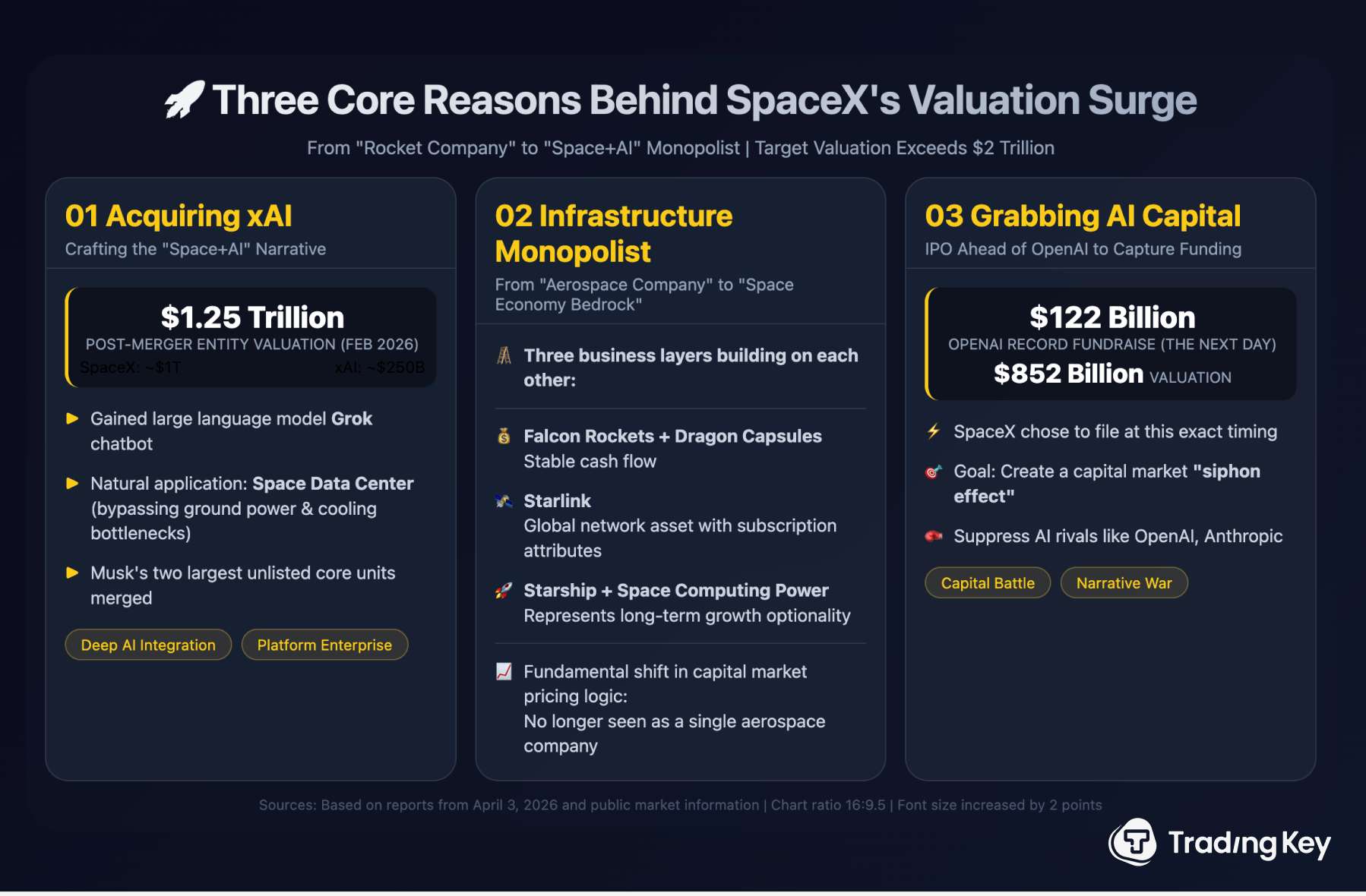
In February 2026, SpaceX acquired Elon Musk's artificial intelligence firm xAI in an all-stock transaction, bringing the merged entity's valuation to $1.25 trillion, with SpaceX valued at approximately $1 trillion and xAI at about $250 billion. This deal combined the two most critical private components of Musk's business empire, upgrading the company's market narrative from a "rocket company" to a "platform enterprise deeply integrating AI and space infrastructure." Through xAI, SpaceX gained large language model technology (the Grok chatbot) and secured a natural application scenario for its "space data center" initiative—deploying AI computing power in orbit to circumvent the power and cooling constraints faced by terrestrial data centers.
Reason 2: Transforming from an "Aerospace Company" to a "Space Infrastructure Monopolist"
Capital markets' valuation logic for SpaceX has fundamentally shifted. The market no longer perceives it as a standalone aerospace entity, but rather as the "infrastructure monopolist of the future space economy." Its three major business segments build upon one another: Falcon rockets and the Dragon spacecraft provide steady cash flow; Starlink constitutes a global network asset with subscription-based characteristics; and Starship, along with space-based computing, represents long-term growth optionality.
Reason 3: Going Public Ahead of OpenAI to Compete for AI Capital
The timing of SpaceX's IPO filing is noteworthy—occurring just one day after competitor OpenAI closed a record $122 billion funding round that saw its valuation soar to $852 billion. SpaceX aims to front-run its IPO to create a capital "siphon effect" against AI rivals like OpenAI and Anthropic. This is more than a technological race; it is a battle for capital and narrative dominance.
II. What Justifies SpaceX’s $2 Trillion Valuation?
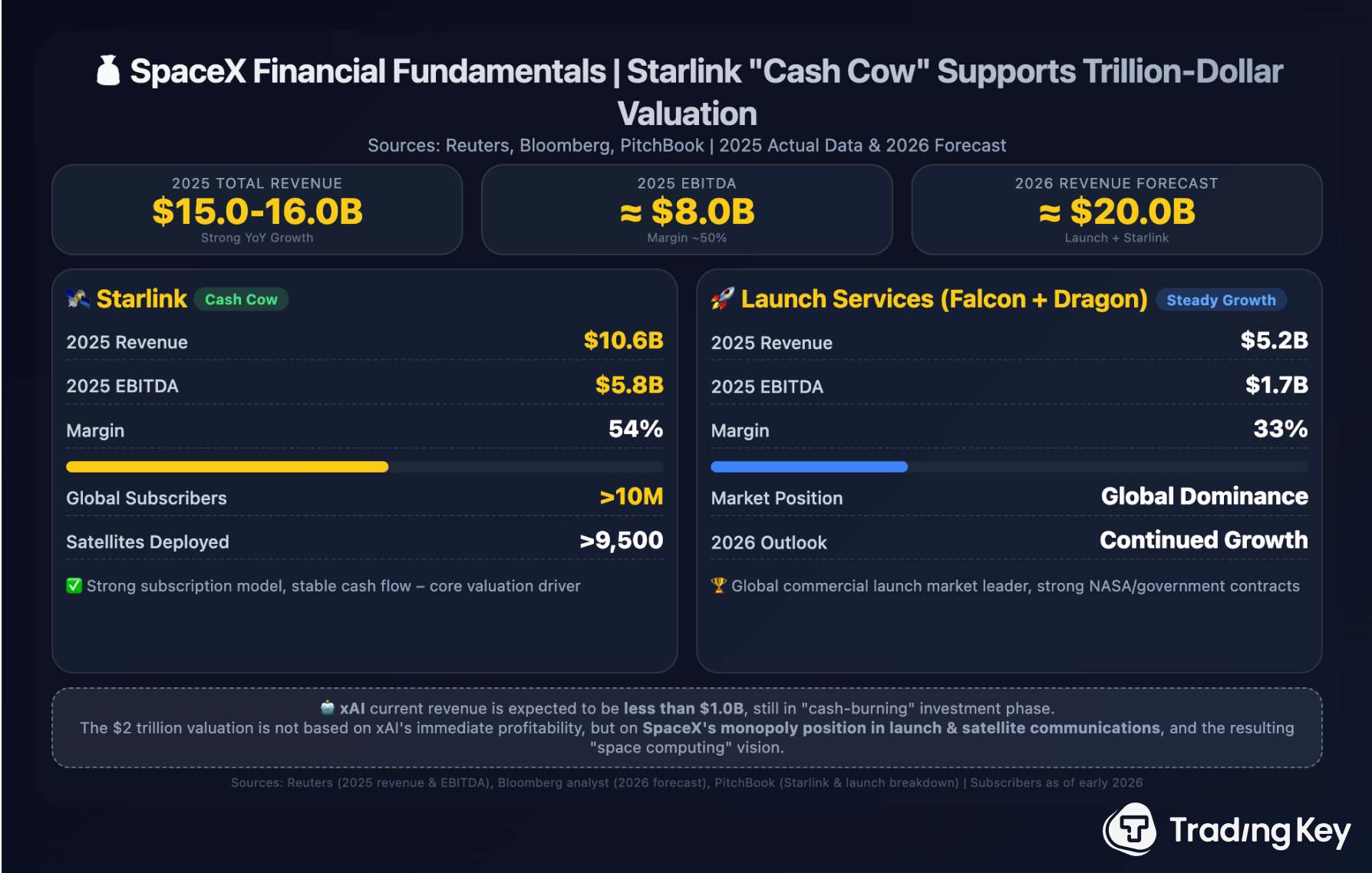
Capital markets are willing to bet trillions on SpaceX not based on narrative alone; financial fundamentals also provide support. According to Reuters, citing sources familiar with the matter, SpaceX is expected to achieve revenue of approximately $15 billion to $16 billion in 2025, with an EBITDA of about $8 billion. Bloomberg analysts expect that combined revenue from the launch business and Starlink will approach $20 billion by 2026.
Of the two core engines, Starlink has become a "cash cow." According to estimates from market analysis firm PitchBook, Starlink will generate approximately $10.6 billion in revenue in 2025, with an EBITDA of $5.8 billion and a profit margin as high as 54%. By early 2026, Starlink's global subscribers surpassed 10 million. Regarding the launch business, 2025 revenue is approximately $5.2 billion, with an EBITDA of about $1.7 billion and a 33% profit margin. xAI's current revenue is projected to be under $1 billion and remains a "cash-burning" business requiring ongoing investment. In other words, the $2 trillion valuation is underpinned not by xAI's immediate earnings, but by SpaceX's monopolistic dominance in rocket launches and satellite communications, along with the visionary potential for "space computing" that follows.
III. What are the risks to a $2 trillion valuation?
Risk One: Excessive valuation multiples. A $2 trillion valuation is equivalent to more than 125 times annual revenue (approximately $16 billion). In comparison, Apple's P/E ratio is about 30x and Amazon's is around 60x. One anonymous Wall Street analyst admitted: "SpaceX's valuation is unlike that of any public company. It is not selling current profitability, but rather the dream of humanity becoming a multi-planetary species."
Risk Two: Key technological breakthroughs have not yet been achieved. Starship's thermal protection issues have yet to be fully resolved, and key test flights in 2026 failed to achieve breakthrough progress. Musk’s grand vision—building space AI data centers and lunar factories—requires unprecedented levels of capital and technological breakthroughs.
Risk Three: Questionable synergy between rockets and AI. Some analysts question whether the "unusual combination" of a rocket company and an AI company can truly generate synergy. Although "space data centers" theoretically establish a vertically integrated platform, the concept remains a long way from commercialization.
Risk Four: Increasing regulatory and competitive pressures. China is accelerating its commercial aerospace development, with several domestic rocket companies planning to launch their first reusable launch vehicles in 2026. Meanwhile, SpaceX relies heavily on NASA contracts, and with Musk simultaneously leading two trillion-dollar companies, SpaceX and Tesla, antitrust regulation looms large.
IV. Conclusion: SpaceX’s IPO Is a High-Stakes Gamble
SpaceX's IPO is essentially a high-stakes gamble—a bet on whether humanity can truly enter the space age and whether Musk's ambitions can translate into reality. Supporters see the potential for up to $75 billion in capital raising to accelerate Starship R&D, expand the Starlink network, and establish lunar bases; detractors, however, warn that any technical setbacks or regulatory delays could trigger a sharp valuation correction.
As one veteran investor noted: "If SpaceX were an ordinary company, I would never buy in at its current valuation. But it is SpaceX, a Musk enterprise—you cannot evaluate it using traditional logic."
Is $2 trillion a fair price for a dream, or is it the eve of a bubble in a capital feast? The answer may not emerge until SpaceX officially hits the capital markets. One thing is certain, however: regardless of the outcome, its IPO will stand as one of the most iconic events in capital market history—potentially signaling the true dawn of the commercial aerospace and space economy era.
Nothing in this material constitutes investment advice, personal recommendation, investment research, an offer, or a solicitation to buy or sell any financial instrument. The content has been prepared without consideration of your individual investment objectives, financial situation, or needs, and should not be treated as such.
Past performance is not a reliable indicator of future performance and/or results. Forward-looking scenarios or forecasts are not a guarantee of future performance. Actual results may differ materially from those anticipated.
Mitrade makes no representation or warranty as to the accuracy or completeness of the information provided and accepts no liability for any loss arising from reliance on such information.
Recommended Articles


