



Sandisk (SNDK) Leads the S&P 500 in 2026 as Micron’s Record Quarter Strengthens the AI Memory Thesis
TradingKey - As of June 25, Sandisk Corporation (NASDAQ: SNDK) hit $2,150.89, hovering within an ascending black channel on the 2H chart above the $1,790.65 2H chart EMA200, right after Micron reported its 3Q26 earnings with $41.46 billion in revenue growth of 346% YOY and 84.6% gross margin, along with a 4Q guide of $50 billion with margins around 86%. Micron's results underscore that the NAND and HBM supply crunch that precipitated Sandisk's 3Q results, which saw $5.95 billion in revenues growth of 97% sequentially, EPS of $23.41, 4Q guidance of $7.75-$8.25 billion in revenues and non-GAAP EPS of $30-$33, is far from easing.
Sandisk is the number one-performing component of the S&P 500 for the calendar year 2026 with YTD returns of approx 857%. The RSI sits at 57.95, which is in neutral-bullish territory with additional upside and no bearish divergences.
What Micron’s $41.5 Billion Quarter Means for Sandisk’s Investment Case
Although Sandisk and Micron don't compete with each other in the same memory technology with Micron producing DRAM and HBM and Sandisk producing NAND-based flash memory and enterprise solid-state drives, they do compete for the same end-demands and are exposed to the same industry supply constraints. Sandisk's 3Q results and 4Q guidance were already in the cards. Micron's 3Q results were the icing on the cake. Micron management's 3Q comments on NAND supply and demand "being very tight with no line of sight to balance."
That comment is directly corroborated of the type of demand environment that led to Sandisk's 3Q beat as well as its multi-year NBM customer deals. The same CEO comments that "demand is outstripping supply" by a significant amount and then go so far to guide for revenues to grow a further 21% sequentially to $50 billion means the odds just went up that Sandisk's current 4Q guidance of $7.75-$8.25 billion will prove to be conservative by the time Q4 results come out.
The growth rates in the numbers are what sets Sandisk apart from other AI beneficiaries. Earnings growth rates for Sandisk are expected to be c. 2,096.7% for the current FY, whereas, according to Micron, earnings growth rates are forecast for c. 626.5% for FY26. Sandisk is up c. 4,625.9% for the year over last year, and that's against Micron's incredible 835.3% return. 233% quarter-over-quarter growth for the data centre revenue after 4Q 64% YoY growth in Q4 was also driven by the TLC based NAND enterprise SSDs while QLC based enterprise "Stargate" drives started shipping last quarter.
The cloud segment has been driven almost 100% by the TLC-based enterprise SSDs. NAND-based supply and demand "being very tight" across the industry. Sandisk management seeing on-going average selling price increase through CY26 and beyond. 27 may even be an understatement.
The New Business Model Shift — Why This Cycle Is Different From Prior NAND Supercycles
The defining structural shift that distinguishes this NAND supercycle from the ones in 2018 and 2021 is the move away from selling commodities on the spot market toward securing multi-year, fixed-price Strategic Customer Agreements. Under Sandisk’s New Business Model (NBM) framework, hyperscaler and data center customers have signed contracts that lock in both pricing and volume over several years, mirroring the approach Micron outlined in its Q3 earnings. Historically, during previous NAND cycles, the profit surge resulting from tight supplies would quickly evaporate once new capacity came online, as there was no underlying contract to guarantee prices. NBM contracts create a structural safety net that effectively turns the cycle’s upside profitability into steady, recurring revenue rather than a fleeting spot-market boom.
The prevailing bearish view on Sandisk, which was recently highlighted in a Seeking Alpha article, is that the reported gross margin of about 78% in Q3 and the Q4 guidance range of 79 to 81% are unlikely to hold up once supply catches up to current pricing levels. Proponents of this bearish stance also argue that trading the shares at roughly 17x forward revenue suggests the market has priced in a permanent era of high margins—something contradicted by the historical, commodity-like behavior of the NAND sector. It is certainly a valid structural worry.
However, bulls contend that the combination of these NBM contracts, the historically rapid pace of AI infrastructure expansion, and the multi-year lead times required to construct new NAND manufacturing plants will extend the duration before cycle mean reversion occurs far more than in prior periods. The validity of both viewpoints will come to light over the coming four to six quarters as we get a clearer picture of the actual supply response.
SNDK Technical Setup — EMA200 at $1,790, Channel Target $2,351, Pivot at $2,167
The SNDK stock is at $2,150.89 on the 2H chart; it is within the rising black channel, and is above the EMA200 at $1,790.65. The green candles have found a confluence with the trendline and are holding following the measured decline. RSI at 57.95 is bullish neutral with potential to continue upwards until overbought and without bearish divergence.
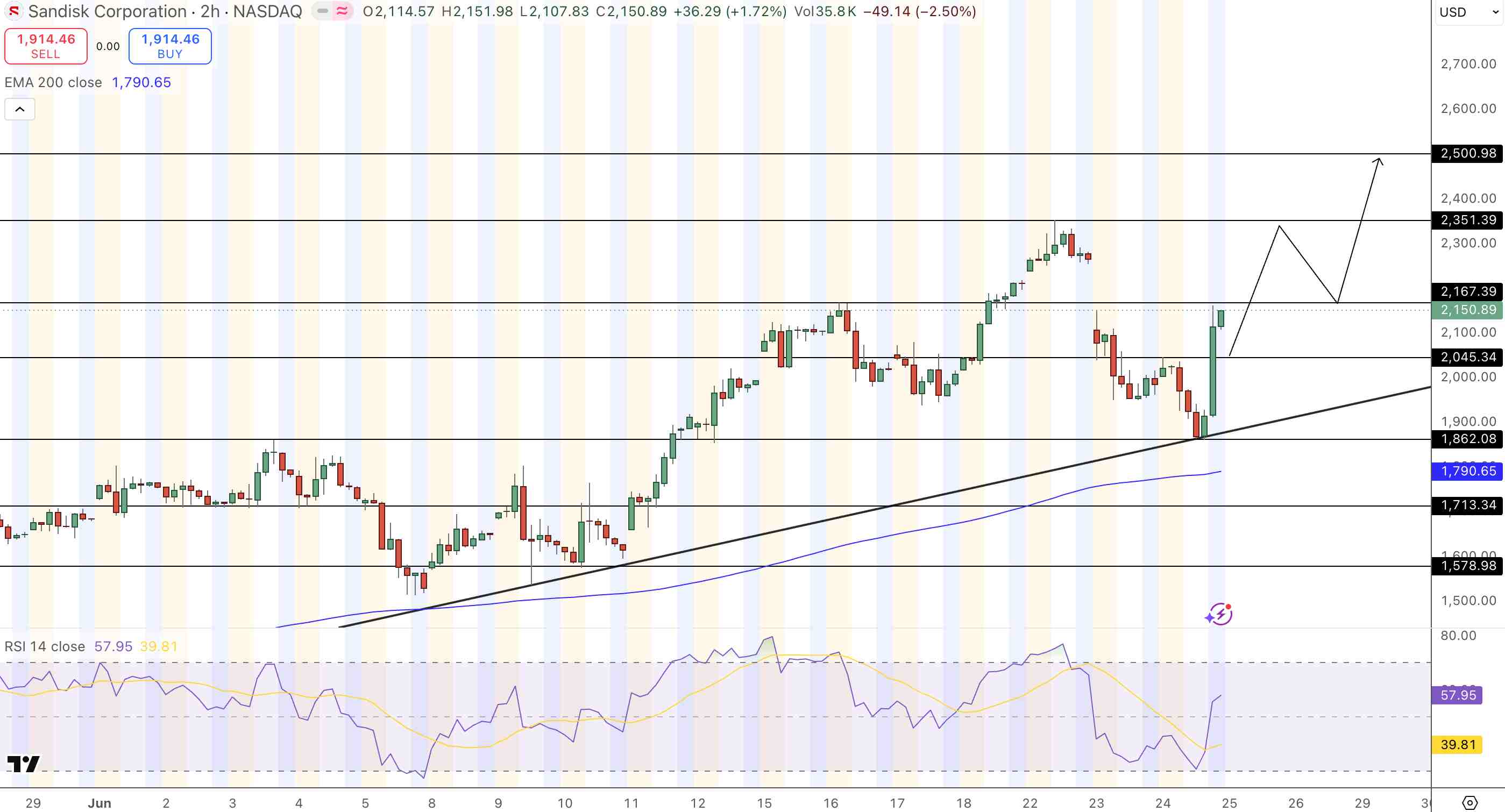
Sandisk (SNDK) Price Chart - Source: Tradingview
The Street’s Guilfoyle Framework Pivot is $2,167, the June 16 high. The revised price target is $2,600, and the panic level is at the 21-day EMA near $1,813. The ascending channel shows a further stretch to $2,167 and $2,351. A breakout at $2,167 should target the channel at $2,351.
- Entry: Long above $2,167 — pivot and channel resistance cleared
- Target: $2,351 — channel extension
- Analyst target: $2,600 — Guilfoyle/Sarge986, raised June 24
- Stop Loss: Close below $1,862 — horizontal support fails
- Panic level: $1,813 — 21-day EMA per Guilfoyle framework
- YTD return: ~857% — #1 S&P 500 performer in 2026 as of June 22
What Did Sandisk Report in Fiscal Q3 2026 and What Is Q4 Guidance?
Fiscal Q3 2026 revenue for Sandisk came in at $5.95 billion, which represents a 97% increase sequentially and beat expectations. Non-GAAP EPS was $23.41. GAAP gross margin was roughly 78% and Sandisk expects gross margin to increase slightly to a range of 79% to 81% in Q4. Data center revenue increased 233% quarter over quarter due to higher TLC based enterprise SSD demand and QLC Stargate drive shipments starting in the quarter. Fiscal Q4 2026 revenue is expected to be in a range of $7.75 billion to $8.25 billion and non-GAAP EPS is expected to be in a range of $30.00 to $33.00. Also today, Sandisk announced new multi year customer agreements which are part of the Sandisk New Business Model.
How Does Micron’s Record Q3 2026 Affect Sandisk’s Investment Case?
Micron’s record Q3 2026 results, $41.46 billion revenue up 346% year over year, with an 84.6% gross margin, and a Q4 revenue guidance of $50 billion with 86% margins, reinforce the NAND supply and demand tightness that is reflected in Sandisk’s own results. Micron management said there is no line of sight on supply-demand balance and guided for a 21% sequential revenue increase in Q4. This validates Sandisk’s Q4 guidance range and increases the likelihood that it will prove conservative. Both Micron and Sandisk have moved from spot pricing sales to multi-year fixed price agreements that lock in pricing and extend the cycle profitability beyond spot market dynamics.
What Is the Bear Case on Sandisk at $2,150?
The main bear case is that NAND gross margin of 78% to 81% are unsustainable peak cycle margins levels that will mean revert as NAND supply increases in response to current elevated price levels, and that Sandisk is valued at a multiple of approximately 17X this year’s revenue, which assumes these peak margins and revenues are sustainable long term when historically NAND pricing and profitability have reversioned quickly back to industry average levels.
The case for a more extended cycle of profitability is the fact that Sandisk has moved to New Business Model multi-year fixed price revenue agreements, the pace of AI data center buildouts are at an unprecedented level, and the lead time to build new NAND fab capacity is multiple years. Both cases will need to be tested in the next 4 to 6 quarters.
Bottom Line
Sandisk is the best performing stock in the S&P 500 with year to date returns of 857% and Micron’s record Q3 2026 results of $41.46 billion and Q4 guidance of $50 billion reinforces the thesis for the strong NAND demand cycle that is driving Sandisk stock. Sandisk’s fiscal Q4 2026 guidance range of $7.75 to $8.25 billion in revenue and $30 to $33 non-GAAP EPS reinforces the tight supply-demand that Micron also confirmed is the state of the market and there are no signs of supply-demand balance in the near term. The multi-year agreements that Sandisk has announced today are the key difference between these results and historical NAND cycles and pricing.
Nothing in this material constitutes investment advice, personal recommendation, investment research, an offer, or a solicitation to buy or sell any financial instrument. The content has been prepared without consideration of your individual investment objectives, financial situation, or needs, and should not be treated as such.
Past performance is not a reliable indicator of future performance and/or results. Forward-looking scenarios or forecasts are not a guarantee of future performance. Actual results may differ materially from those anticipated.
Mitrade makes no representation or warranty as to the accuracy or completeness of the information provided and accepts no liability for any loss arising from reliance on such information.
Recommended Articles


