



Intuit Tumbles 11% Pre-Market as Adjusted Profit Guidance Beats Expectations: What Is the Market Still Worried About?
TradingKey - Tax and financial software company Intuit (INTU) reported its fourth-quarter fiscal 2026 results after the market close on August 25. Quarterly performance exceeded market expectations, but fiscal 2027 guidance fell below analyst estimates, causing the company's shares to drop over 11% in pre-market trading on August 26.
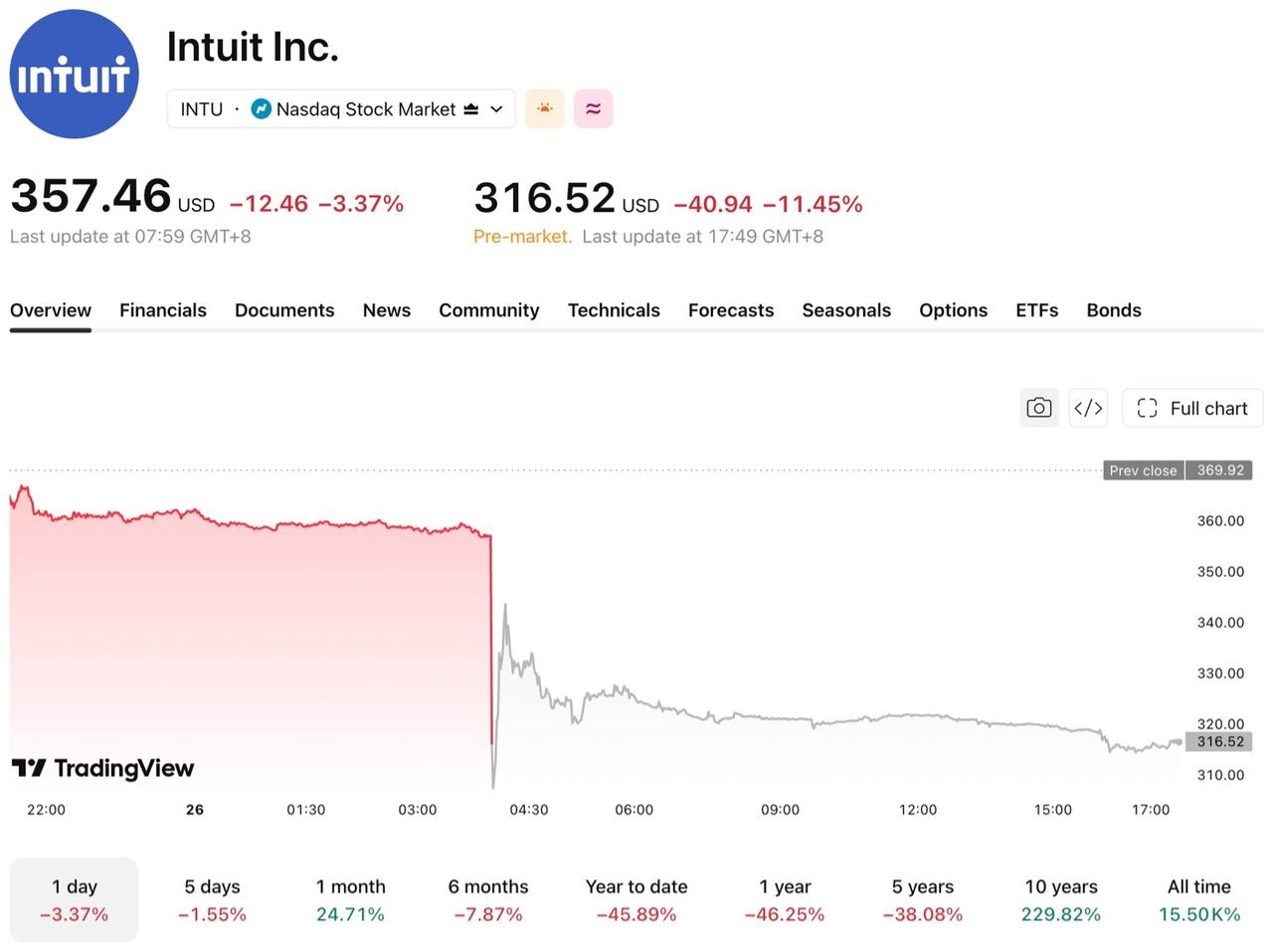
[Source: TradingView]
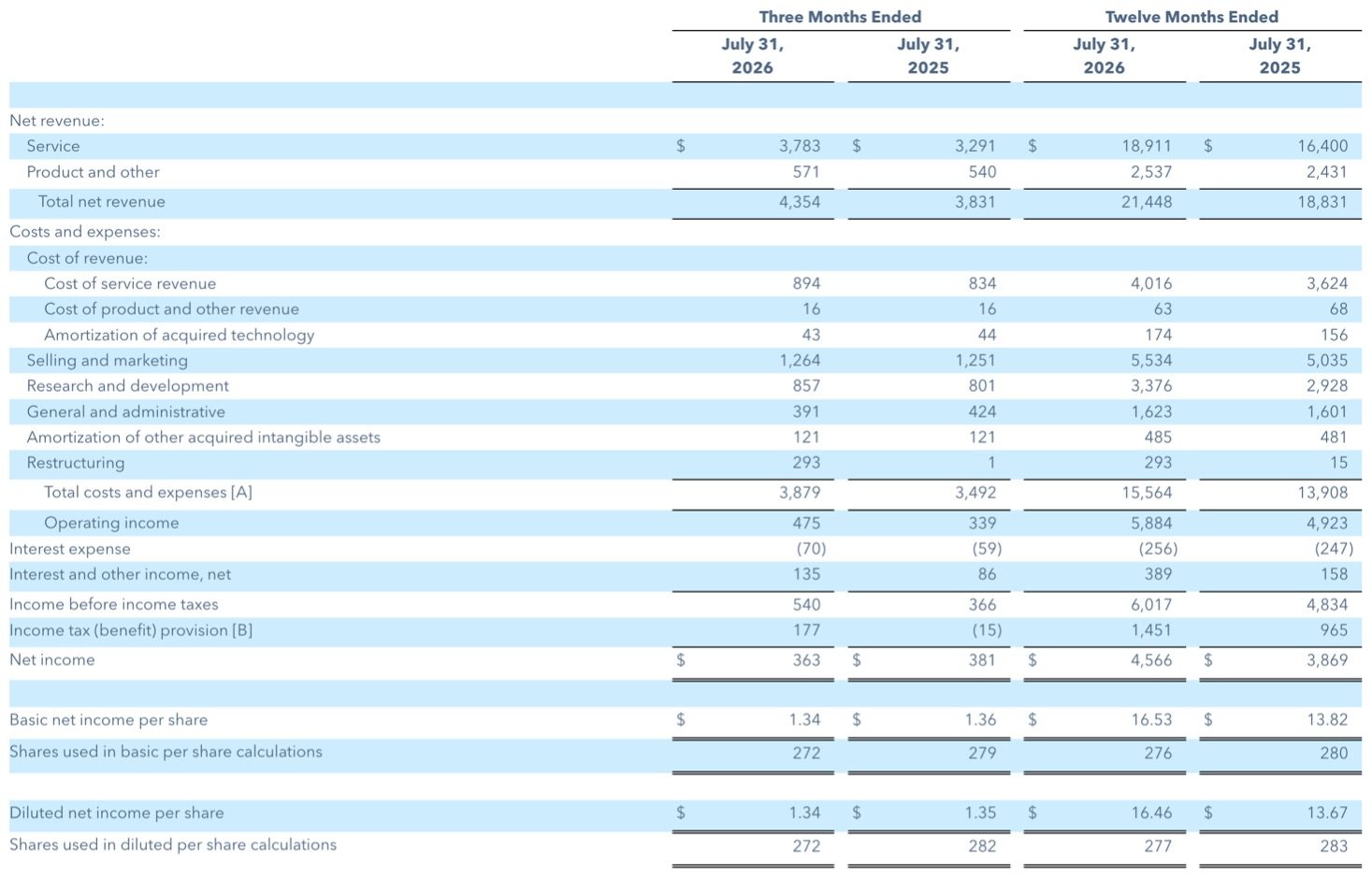
In the fourth fiscal quarter, Intuit generated revenue of $4.354 billion, up 14% year-over-year, exceeding market expectations of $4.27 billion. Adjusted earnings per share were $4.03, up 47% year-over-year, also surpassing analysts' estimates of $3.58. For the full fiscal year 2026, the company reported revenue of $21.448 billion, an increase of 14% year-over-year, with adjusted EPS of $24.27, up 20% year-over-year.
[Source: Intuit Official Website]
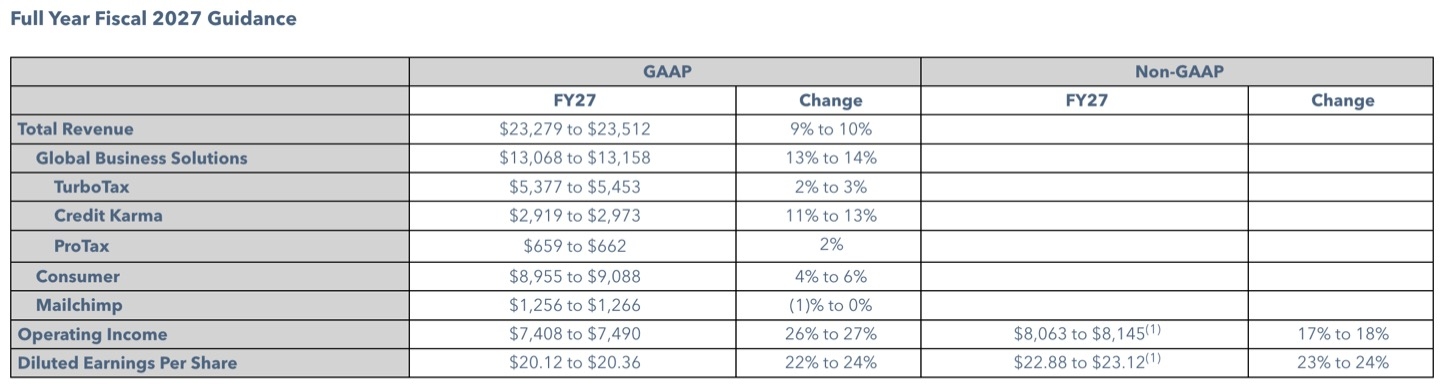
Market attention quickly shifted to fiscal 2027 guidance. Intuit expects revenue for the new fiscal year to range between $23.28 billion and $23.51 billion, below analyst expectations of $23.72 billion. Adjusted EPS is projected at $22.88 to $23.12, compared with the market's previous expectation of $27.30.
However, this gap stems primarily from a change in accounting methodology. The company announced that starting in the new fiscal year (August 1, 2026), it will no longer exclude stock-based compensation expenses from Non-GAAP metrics. According to disclosures in Intuit's earnings materials, this adjustment has a book value impact of $5.81 per share on the new fiscal year's EPS.
Wall Street calculations show that under the previous methodology, actual earnings expectations for the new fiscal year would be approximately $28.81, which would have exceeded analysts' previous estimates.
[Source: Intuit Official Website]
While the gap in earnings guidance can be attributed to accounting adjustments, the slowdown in revenue guidance is unaffected by this factor. Intuit expects year-over-year revenue growth for the new fiscal year to decelerate to 9%–10%, falling short of analyst expectations of $23.72 billion, which was the main reason for the market's negative reaction.
Several factors contributed to the slowdown in revenue guidance:
User growth for the core product, TurboTax, has been sluggish. In May 2026, the company disclosed that TurboTax online paying users grew by only 2%, alongside an industry-wide contraction in IRS tax filings during the same period.
Meanwhile, generative AI tax tools are entering the market. Wall Street institutional modeling estimates that the theoretical cost of token consumption for AI to process a single tax return is only $0.12, compared to TurboTax's average charge of $162 per return. Although this impact has not yet fully reflected in current numbers, the market worries that the adoption of AI tools will accelerate user churn.
Another acquired business, Mailchimp, also performed poorly. Mailchimp, a marketing automation platform previously acquired by Intuit, accounts for approximately 7% of total revenue; its revenue guidance for the new fiscal year ranges from -1% to flat.
In August 2026, investors filed a class-action lawsuit against the company regarding disclosures related to Mailchimp's performance and the impact of AI competition. Intuit has designated Mailchimp as a separate reporting segment in the new fiscal year to enhance business transparency.
At the strategic level, Intuit announced in May 2026 that it would lay off approximately 3,000 employees, or about 17% of its global workforce, reallocating freed-up resources toward customer acquisition, including launching low-friction products such as a free version of QuickBooks to attract new users.
However, against the backdrop of slowing revenue guidance and simultaneous pressure on both core and acquired businesses, the market remains in a wait-and-see mode regarding this transformation plan.
Nothing in this material constitutes investment advice, personal recommendation, investment research, an offer, or a solicitation to buy or sell any financial instrument. The content has been prepared without consideration of your individual investment objectives, financial situation, or needs, and should not be treated as such.
Past performance is not a reliable indicator of future performance and/or results. Forward-looking scenarios or forecasts are not a guarantee of future performance. Actual results may differ materially from those anticipated.
Mitrade makes no representation or warranty as to the accuracy or completeness of the information provided and accepts no liability for any loss arising from reliance on such information.
Recommended Articles


