



Meta Launches Muse Personal AI Assistant, META Rises Over 5% Pre-Market: Can AI Subscriptions Open New Revenue Streams?
TradingKey - On September 8 ET, Meta (META) officially launched its personal AI assistant, Muse, rolling it out first in the United States. Unlike Q&A-focused chatbots, Muse centers on task execution.
Once users set a goal, it can send emails, book travel, fill out forms, shop, and continue processing certain time-consuming tasks even after the user exits the app. For sensitive operations such as sending emails or purchasing items, Muse will ask the user for confirmation.
Muse runs in a dedicated Muse Secure VM, giving each user an isolated cloud computing environment and an exclusive browser. The system is also equipped with a separate Sentinel agent, whose approval Muse must obtain before accessing the internet.
Users can decide for themselves which apps Muse connects to and what level of permissions it receives. Meta stated that conversation and virtual machine data in Muse will not be provided to its advertising system.
Regarding payments, Muse has integrated Stripe's Link, which can generate a one-time card number during checkout to hide the user's real bank card information. Shop Pay will be added soon, and 1Password support is also planned. Muse can also remember information that users deem important, such as compiling a shopping list based on recipes saved on Instagram.
Alexandr Wang, Meta's Chief AI Officer, stated that usage among current Muse users is 10 times that of the test group. He himself treats Muse as a "second brain" to arrange schedules, create fitness plans, and plan meals.
Meta Boasts 3.6 Billion Daily Active Users: Can Muse Boost AI Return on Investment?
Muse is currently available via a standalone app or WhatsApp and has launched in the US across iOS, Android, and web, with future support for AI glasses planned.
As of the second quarter of 2026, daily active users across Meta's Family of Apps reached 3.6 billion, up 3% year-over-year. The massive existing user base of Facebook, Instagram, and WhatsApp provides a foundation for the subsequent rollout of Muse.
For Meta, the key going forward for Muse lies in whether it can further convert its existing user base into paying users and new revenue streams.
Meta's latest forecast projects 2026 capital expenditures of $130 billion to $145 billion, raising the lower end from its previous range of $125 billion to $145 billion. Meta previously stated that the rise in capital expenditures primarily reflects higher component prices and some additional data center construction costs.
Meta currently lacks a major public cloud business similar to AWS, Azure, or Google Cloud. Currently, AI is already playing a role in Meta's advertising and core business, and the company is also expanding into new revenue streams through new products such as Muse.
Most of Muse's features are free, while subscription plans are offered for higher-usage users. For Meta, this means consumer AI is beginning to have a clearer direct monetization path. The integration of shopping, payments, and third-party services also offers more possibilities for future revenue expansion.
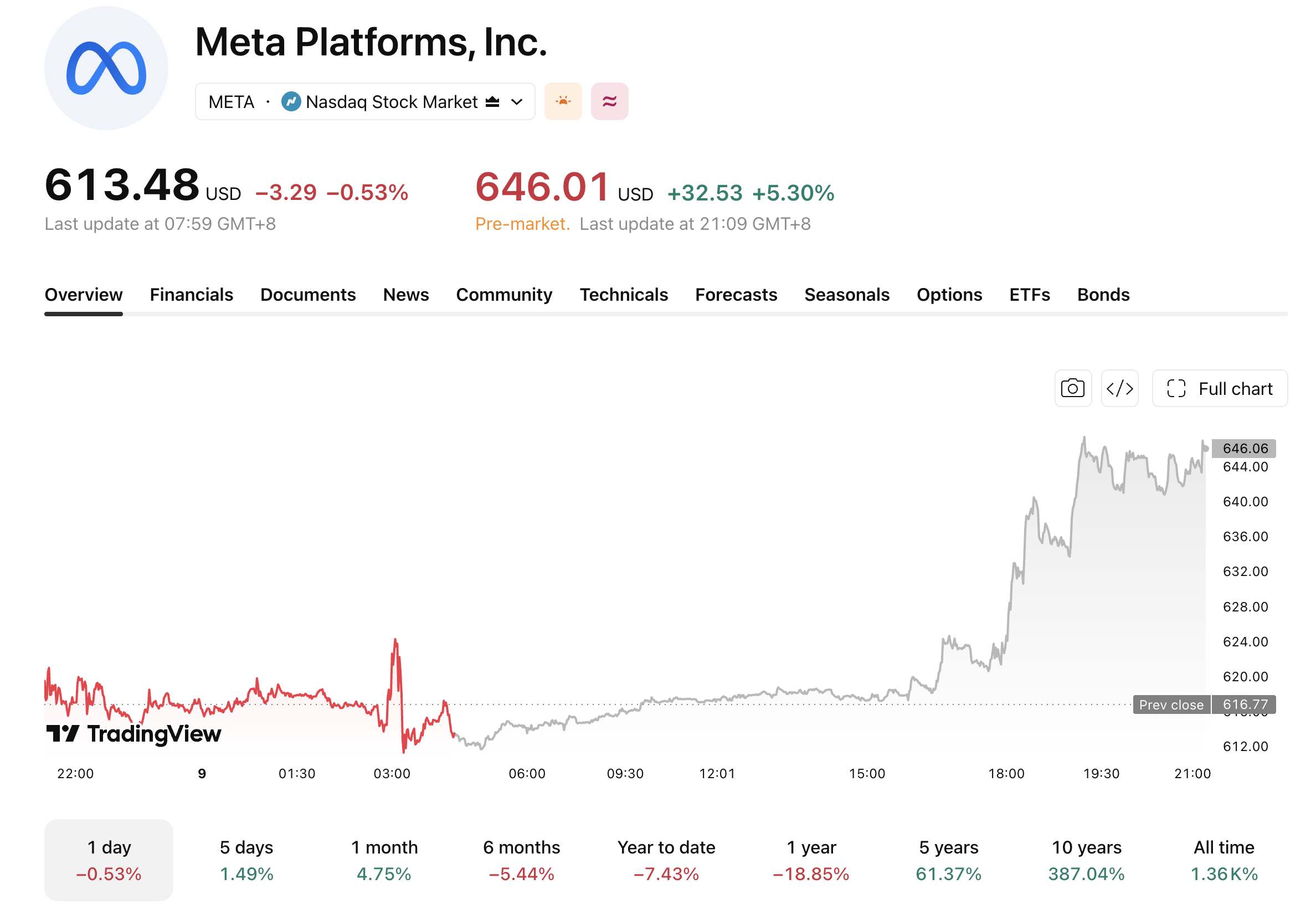
Meta Rises Over 5% Pre-Market as Market Focuses on AI Commercialization Progress
In U.S. pre-market trading on September 9, META rose over 5%, while S&P 500 futures fell about 0.31% over the same period, with Meta standing out among mega-cap tech stocks.
[Source: TradingView]
Following the launch of Muse, its commercialization prospects have become a new focal point for assessing Meta's return on AI investments. Meta currently projects capital expenditures for 2026 to be between $130 billion and $145 billion. As capital spending remains high, market attention toward Meta's return on AI investments and the monetization capabilities of new products is also growing.
Going forward, key focus areas include the size of Muse's paying user base, usage frequency, and whether subscription and transaction features can gradually generate tangible revenue.
At this stage, Meta's earnings still primarily derive from its advertising business. In the second quarter of 2026, advertising revenue accounted for approximately 97.6% of the company's total revenue. Muse has not yet had a significant impact on the overall revenue structure, but as AI infrastructure spending continues to expand, whether Muse can generate steady revenue will serve as a crucial reference point for tracking Meta's AI commercialization progress.
Nothing in this material constitutes investment advice, personal recommendation, investment research, an offer, or a solicitation to buy or sell any financial instrument. The content has been prepared without consideration of your individual investment objectives, financial situation, or needs, and should not be treated as such.
Past performance is not a reliable indicator of future performance and/or results. Forward-looking scenarios or forecasts are not a guarantee of future performance. Actual results may differ materially from those anticipated.
Mitrade makes no representation or warranty as to the accuracy or completeness of the information provided and accepts no liability for any loss arising from reliance on such information.
Recommended Articles


