



EUR/USD extends losses amid reports of Trump announcing Warsh as Fed Chair
- EUR/USD drops to the lower range of the 1.1900s as the US Dollar picks up.
- Reports that Trump prepares to announce Kevin Warsh as the next Fed Chair on Friday have soothed investors.
- In Europe, the Eurozone GDP and German HICP are likely to drive Euro pairs.
The Euro (EUR) drifts lower on Friday, and trades at 1.1920 at the time of writing, with support at the 1.1900 area in focus. The US Dollar (USD) has trimmed some losses on speculation that Kevin Warsh will be the next Federal Reserve (Fed) Chairman, and hopes that another government shutdown can be avoided.
US President Donald Trump is expected to reveal the name of the person who will replace Jerome Powell as the head of the Fed, and all signs point to former Fed Governor Kevin Warsh. The market has reacted positively to the news, on the belief that Warsh will guarantee the central bank’s independence rather than act on Trump's command.
Beyond that, news that US Senate Democrats and Republicans have reached an agreement on a package of spending bills has boosted hopes that another government shutdown can be averted, providing additional support for the Greenback.
US economic data released on Thursday was mixed. Factory Orders bounced up beyond forecasts, but Initial Jobless Claims were also higher than expected, and the trade deficit widened. On Friday, the preliminary Eurozone Q4 Gross Domestic Product (GDP) and German Harmonised Index of Consumer Prices (HICP) will grab the attention during the European session. Later on, all eyes will be on the US Producer Price Index (PPI) data for December.
Euro Price Today
The table below shows the percentage change of Euro (EUR) against listed major currencies today. Euro was the strongest against the Australian Dollar.
| USD | EUR | GBP | JPY | CAD | AUD | NZD | CHF | |
|---|---|---|---|---|---|---|---|---|
| USD | 0.29% | 0.29% | 0.48% | 0.20% | 0.69% | 0.45% | 0.33% | |
| EUR | -0.29% | 0.00% | 0.17% | -0.09% | 0.40% | 0.16% | 0.05% | |
| GBP | -0.29% | -0.00% | 0.17% | -0.09% | 0.40% | 0.16% | 0.04% | |
| JPY | -0.48% | -0.17% | -0.17% | -0.25% | 0.23% | -0.01% | -0.12% | |
| CAD | -0.20% | 0.09% | 0.09% | 0.25% | 0.48% | 0.24% | 0.13% | |
| AUD | -0.69% | -0.40% | -0.40% | -0.23% | -0.48% | -0.23% | -0.35% | |
| NZD | -0.45% | -0.16% | -0.16% | 0.01% | -0.24% | 0.23% | -0.12% | |
| CHF | -0.33% | -0.05% | -0.04% | 0.12% | -0.13% | 0.35% | 0.12% |
The heat map shows percentage changes of major currencies against each other. The base currency is picked from the left column, while the quote currency is picked from the top row. For example, if you pick the Euro from the left column and move along the horizontal line to the US Dollar, the percentage change displayed in the box will represent EUR (base)/USD (quote).
Daily Digest market Movers: Warsh's name soothes markets
- The US Dollar is trimming some of the losses seen over the last two weeks after the name of Kevin Warsh has emerged as the next Fed Chair, soothing investors who were concerned about the central bank's autonomy. Beyond that, hopes that a deal to avoid an immediate US shutdown is still possible and some profit-taking ahead of the weekend have contributed to giving some oxygen to the battered US Dollar.
- In Europe, the recent Euro rally is starting to raise concerns about the competitiveness of European products in foreign markets and the growing downside risks for inflation, which has prompted the first calls for interest rate cuts since last summer. If more European Central Bank (ECB) officials follow this path, we might see a deeper Euro correction.
- In the Eurozone, German GDP figures revealed that growth accelerated to 0.3% in Q4, from a flat reading in the previous quarter, and beating expectations of a 0.2% improvement. Year-on-year, the German economy grew 0.4% from 0.3% in Q3.
- Investors, however, are likely to wait for the Eurozone data to confirm the improving economic growth. The region's GDP is expected to have slowed down to a 0.2% growth in the quarter and 1.2% year on year, down from 0.3% and 1.4% respective advances in the previous quarter.
- Somewhat later, the preliminary German HICP is expected to show a 0.2% contraction in January, following a 0.2% growth in the previous month, although the yearly inflation is seen as steady at 2%.
- In the US, Producer Price Index (PPI) figures for December are forecast to have moderated to a 2.7% yearly growth, from 3% in the previous month, while the core PPI is seen easing to 2.9% year-on-year, from 3% in the previous month.
Technical Analysis: EUR/USD corrects lower, with support at 1.1900 under pressure
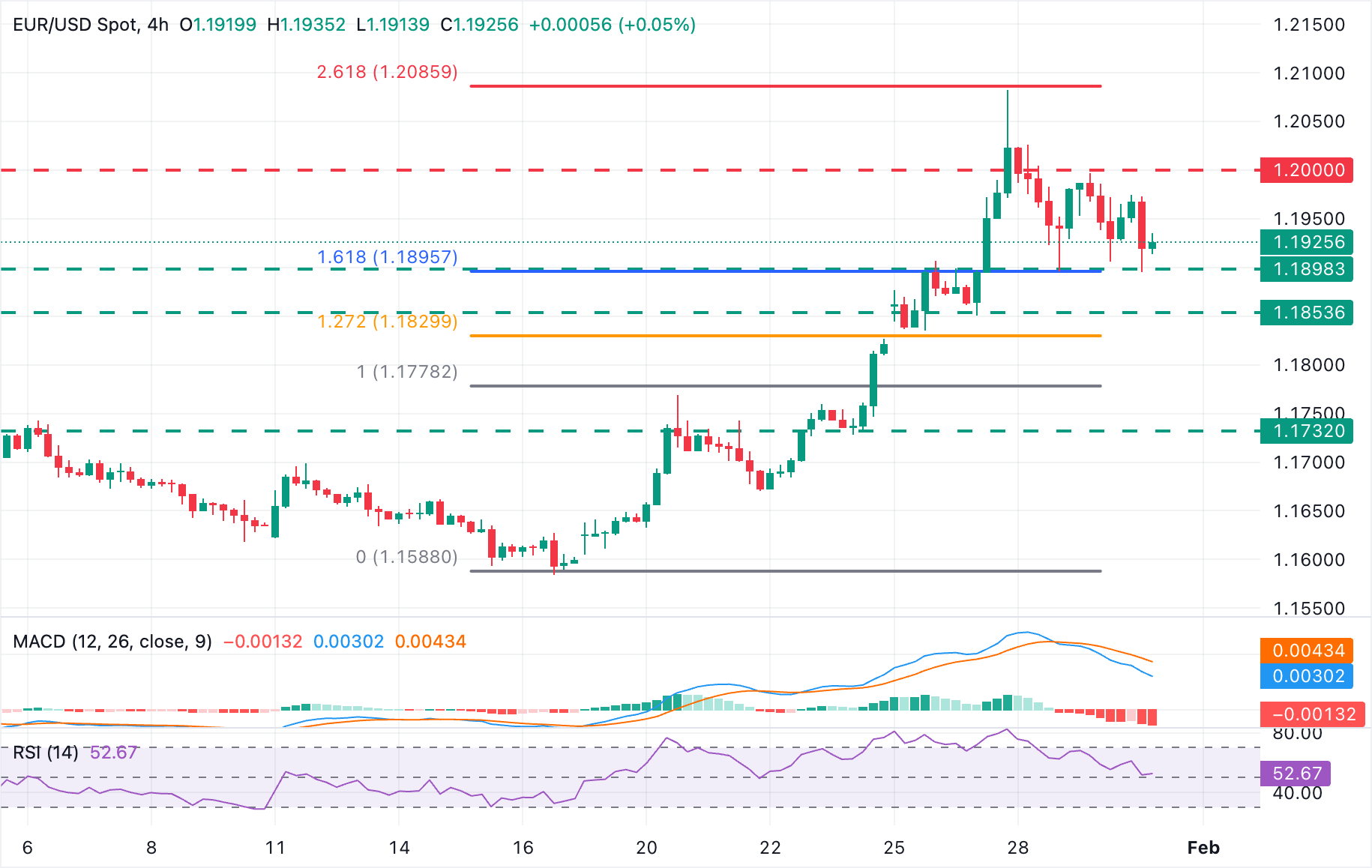
The EUR/USD rally has lost steam as the last two days' lower highs suggest that sellers are taking control, although support at 1.1895 is limiting losses for now. Technical indicators show increasing bearish momentum. The Moving Average Convergence Divergence (MACD) histogram has slipped below zero on the 4-hour chart, and the red bars are expanding, while the Relative Strength Index (RSI) is attempting to break the key 50 level on the same time frame.
A confirmation below the mentioned 1.1895 area (January 28, 29 lows) increases negative pressure towards the January 27 low, at 1.1850, and the January 23 low near 1.1730. To the upside, resistances are at the January 29 high, near the 1.2000 psychological level, and the January 27 high, at 1.2082.
(The technical analysis of this story was written with the help of an AI tool.)
Fed FAQs
Monetary policy in the US is shaped by the Federal Reserve (Fed). The Fed has two mandates: to achieve price stability and foster full employment. Its primary tool to achieve these goals is by adjusting interest rates. When prices are rising too quickly and inflation is above the Fed’s 2% target, it raises interest rates, increasing borrowing costs throughout the economy. This results in a stronger US Dollar (USD) as it makes the US a more attractive place for international investors to park their money. When inflation falls below 2% or the Unemployment Rate is too high, the Fed may lower interest rates to encourage borrowing, which weighs on the Greenback.
The Federal Reserve (Fed) holds eight policy meetings a year, where the Federal Open Market Committee (FOMC) assesses economic conditions and makes monetary policy decisions. The FOMC is attended by twelve Fed officials – the seven members of the Board of Governors, the president of the Federal Reserve Bank of New York, and four of the remaining eleven regional Reserve Bank presidents, who serve one-year terms on a rotating basis.
In extreme situations, the Federal Reserve may resort to a policy named Quantitative Easing (QE). QE is the process by which the Fed substantially increases the flow of credit in a stuck financial system. It is a non-standard policy measure used during crises or when inflation is extremely low. It was the Fed’s weapon of choice during the Great Financial Crisis in 2008. It involves the Fed printing more Dollars and using them to buy high grade bonds from financial institutions. QE usually weakens the US Dollar.
Quantitative tightening (QT) is the reverse process of QE, whereby the Federal Reserve stops buying bonds from financial institutions and does not reinvest the principal from the bonds it holds maturing, to purchase new bonds. It is usually positive for the value of the US Dollar.
Nothing in this material constitutes investment advice, personal recommendation, investment research, an offer, or a solicitation to buy or sell any financial instrument. The content has been prepared without consideration of your individual investment objectives, financial situation, or needs, and should not be treated as such.
Past performance is not a reliable indicator of future performance and/or results. Forward-looking scenarios or forecasts are not a guarantee of future performance. Actual results may differ materially from those anticipated.
Mitrade makes no representation or warranty as to the accuracy or completeness of the information provided and accepts no liability for any loss arising from reliance on such information.
Recommended Articles


