



USD/INR extends winning streak amid fears of prolonged Hormuz closure
- The Indian Rupee weakens further against the US Dollar amid higher oil prices.
- The selling pressure from FIIs in the Indian stock market has increased.
- Investors expect the Fed to hold interest rates steady next week.
The Indian Rupee (INR) opens positively against the US Dollar (USD) on Friday, extending its losing streak for the fifth trading day. The USD/INR pair trades firmly near the weekly high of 94.38 as the Indian currency continues to underperform in the wake of higher energy prices and the resumption of significant foreign selling in the Indian stock market.
In addition to the above-mentioned headwinds for the Indian Rupee, the upbeat US Dollar is also supporting the USD/INR pair. As of writing, the US Dollar Index (DXY), which tracks the Greenback’s value against six major currencies, trades firmly near the 10-day high of around 99.00.
Oil prices remain firm on prolonged Hormuz closure
Higher oil prices amid the suspension of oil flows through the Strait of Hormuz, a vital passage to almost 20% of global energy supply, by Iran as part of retaliation against the United States (US) have undermined the Indian Rupee.
During the press time, the WTI Oil price holds onto weekly gains at around $95.00. Currencies from economies, such as India, which rely heavily on oil imports to meet their energy needs, underperform in a high oil price environment.
Investors doubt that the Hormuz will open soon, as Iran has not yet agreed to resume peace talks with the US, blaming Washington for the continuous blockade of Iranian sea ports.
Meanwhile, a report from CNN has shown that US military officials are developing new plans to target Iran’s capabilities in the Strait of Hormuz in the event the current ceasefire with Iran fails.
FIIs remain net sellers in last four trading days
So far this week, FIIs have remained net sellers in all four trading days and have offloaded their stake worth Rs. 8,311.99 crore. Foreign investors have resumed selling after a brief pause in the last three trading days of the previous week. Elevated oil prices have dimmed the interest of overseas investors in the Indian stock market amid concerns over India Inc.'s forward earnings and the expectations that the government would trim its capital expenditure to offset obligations towards rising energy prices.
Investors shift focus to the Fed policy
Going forward, the major trigger for global markets will be the monetary policy announcement by the Federal Reserve (Fed) on Wednesday. The Fed is widely anticipated to leave interest rates unchanged in the range of 3.50%-3.75% and warn of upside inflation risks in the wake of higher energy prices. Investors will pay close attention to cues regarding whether the Fed plans to hike interest rates anytime this year.
Technical Analysis:
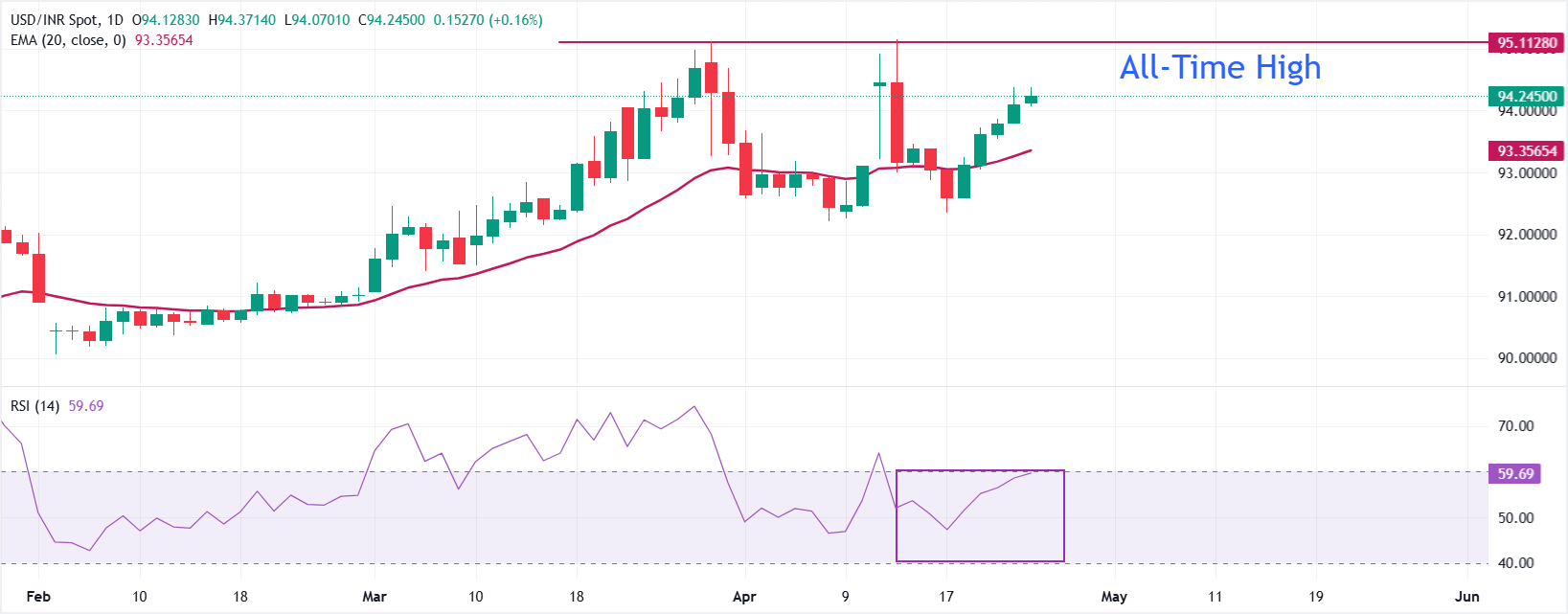
USD/INR trades higher above 94.20 at the press time, holding a constructive bullish bias as spot remains firmly above the 20-period Exponential Moving Average (EMA) at 93.3565. The positioning over this short-term trend line suggests buyers retain control, while the Relative Strength Index (14) near 59 shows positive but not overstretched momentum, hinting that the advance could extend as long as the pair defends its underlying supports.
On the downside, initial support is seen at the 20-period EMA at 93.3565, which underpins the current structure and is likely to attract dip buyers on shallow pullbacks. A daily close below this dynamic floor would weaken the immediate bullish tone and expose deeper retracements, whereas holding above it keeps the door open for further gains toward the all-time high at around 95.20.
(The technical analysis of this story was written with the help of an AI tool.)
Indian Rupee FAQs
The Indian Rupee (INR) is one of the most sensitive currencies to external factors. The price of Crude Oil (the country is highly dependent on imported Oil), the value of the US Dollar – most trade is conducted in USD – and the level of foreign investment, are all influential. Direct intervention by the Reserve Bank of India (RBI) in FX markets to keep the exchange rate stable, as well as the level of interest rates set by the RBI, are further major influencing factors on the Rupee.
The Reserve Bank of India (RBI) actively intervenes in forex markets to maintain a stable exchange rate, to help facilitate trade. In addition, the RBI tries to maintain the inflation rate at its 4% target by adjusting interest rates. Higher interest rates usually strengthen the Rupee. This is due to the role of the ‘carry trade’ in which investors borrow in countries with lower interest rates so as to place their money in countries’ offering relatively higher interest rates and profit from the difference.
Macroeconomic factors that influence the value of the Rupee include inflation, interest rates, the economic growth rate (GDP), the balance of trade, and inflows from foreign investment. A higher growth rate can lead to more overseas investment, pushing up demand for the Rupee. A less negative balance of trade will eventually lead to a stronger Rupee. Higher interest rates, especially real rates (interest rates less inflation) are also positive for the Rupee. A risk-on environment can lead to greater inflows of Foreign Direct and Indirect Investment (FDI and FII), which also benefit the Rupee.
Higher inflation, particularly, if it is comparatively higher than India’s peers, is generally negative for the currency as it reflects devaluation through oversupply. Inflation also increases the cost of exports, leading to more Rupees being sold to purchase foreign imports, which is Rupee-negative. At the same time, higher inflation usually leads to the Reserve Bank of India (RBI) raising interest rates and this can be positive for the Rupee, due to increased demand from international investors. The opposite effect is true of lower inflation.
Nothing in this material constitutes investment advice, personal recommendation, investment research, an offer, or a solicitation to buy or sell any financial instrument. The content has been prepared without consideration of your individual investment objectives, financial situation, or needs, and should not be treated as such.
Past performance is not a reliable indicator of future performance and/or results. Forward-looking scenarios or forecasts are not a guarantee of future performance. Actual results may differ materially from those anticipated.
Mitrade makes no representation or warranty as to the accuracy or completeness of the information provided and accepts no liability for any loss arising from reliance on such information.
Recommended Articles


