



Intel Better-Than-Expected Earnings Released, Stock Surges 20% After-Hours, AI Computing Power Enters CPU Moment?
TradingKey - Propelled by the global surge in AI infrastructure investment, demand for server chips is seeing explosive growth. Intel ( INTC ), which trailed during the early stages of the AI race, is accelerating its recovery on the back of results that surpassed expectations.
On April 23, Intel released its first-quarter fiscal 2026 results, reporting revenue of $13.6 billion, up 7% year-over-year and $1.2 billion ahead of the consensus estimate of $12.4 billion. Net loss was $3.7 billion, compared to a loss of $800 million in the prior-year period. Adjusted first-quarter earnings per share reached $0.29, up from $0.13 a year ago and well above the estimated $0.01.
At the same time, the company issued second-quarter revenue guidance of $13.8 billion to $14.8 billion, with a midpoint of roughly $14.3 billion, significantly higher than the average analyst forecast of $13 billion. This represents the sixth consecutive quarter that Intel has outperformed expectations.
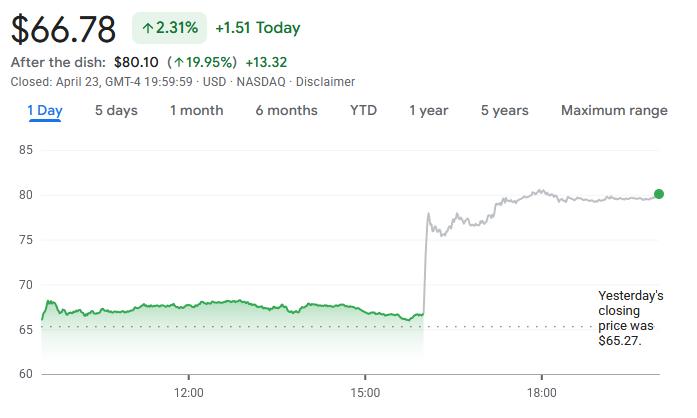
Following the report, Intel's shares jumped nearly 20% in after-hours trading. The stock has climbed 81% so far this year, closing the session at $66.78. Intel CEO Lip-Bu Tan noted in an interview that customer demand is immense and that the company still faces a capacity shortfall, prompting a full-scale push to expand its manufacturing footprint.
As the former dominant force in the chip industry, Intel failed to keep pace during the early stages of AI development, falling behind competitors such as Nvidia ( NVDA) and AMD ( AMD ), allowing rivals to widen the gap and leaving the company in a period of stagnation. However, as the AI industry shifts from 'model training' to 'model deployment,' the value of CPUs is being redefined, creating a turnaround opportunity for Intel.
Since taking charge, Lip-Bu Tan has implemented a series of restructuring initiatives, optimizing the balance sheet through divestitures and layoffs. He also secured investments from the U.S. government, Nvidia, SoftBank, and others, providing the company with fresh capital and restoring market confidence in its long-term growth prospects.
Data center business sees explosive growth
Amid the industry wave of AI technology shifting from the training phase to large-scale inference deployment, Intel's Data Center and AI Group (DCAI) has emerged as a core engine driving performance. The division's revenue reached $5.1 billion this quarter, representing a robust 22% year-over-year growth that exceeded Wall Street expectations; this performance is underpinned by the continuous rise in demand for general-purpose computing chips as the AI industry expands.
As enterprises and cloud service providers accelerate the transformation of AI technology into commercial services, the strategic value of general-purpose CPUs is being redefined, and market demand for Intel's flagship Xeon server processors is surging accordingly.
Intel CEO Lip-Bu Tan has repeatedly mentioned in public interviews and earnings calls that customer order demand continues to climb, with product supplies across all business segments remaining tight. In particular, demand for Xeon server CPUs has far exceeded current capacity, and the company is making increased factory output its top priority as it pushes for capacity expansion.
Currently, Xeon 6 products based on the Intel 3 process and Core series products based on the Intel 18A process have entered the production ramp-up phase, both setting the company's fastest mass-production pace for new products in five years.
Intel Xeon 6 processors have been selected as the host CPUs for NVIDIA’s DGX Rubin NVL8 systems, further solidifying their central role in high-end AI infrastructure deployments.
Notably, the AI computing market, long dominated by GPUs, is undergoing structural changes as the role of the CPU moves from the background to center stage.
Tan stated that while the industry's focus in high-performance computing has been largely on GPUs and other accelerators over the past few years, recent customer feedback indicates that CPUs are once again becoming an indispensable computing foundation for the AI era.
The current ratio of server CPUs to accelerators in customer deployments is gradually shifting toward CPUs, a trend that directly supports Intel’s recent decision to spend $14 billion to buy back the 49% stake in its Irish chip manufacturing plant previously sold to Apollo Global Management.
Intel CFO David Zinsner also noted: "The CPU is seeing a renaissance, and Intel has become a substantive beneficiary of the AI investment wave."
Foundry Business Achieves Key Progress
Foundry revenue reached $5.4 billion this fiscal quarter, up 16% year-over-year. However, CFO Dave Zinsner revealed that wafer foundry revenue from external customers was less than $200 million, with the remainder coming from internal business. The company is currently continuing to expand external customers for its foundry business and achieved key progress this quarter.
On the eve of the earnings release, Tesla ( TSLA) CEO Elon Musk announced that Tesla plans to use Intel's next-generation 14A chip manufacturing process for its Terafab advanced AI chip manufacturing project in Austin, Texas.
This collaboration is not only the first major customer order for Intel's 14A process but is also seen as a key signal for its foundry business to break the market deadlock.
Intel CEO Lip-Bu Tan stated during the earnings call that he and Musk agree that global semiconductor supply is struggling to match the continuous growth in market demand, and both parties are exploring unconventional ways to improve manufacturing efficiency.
Meanwhile, the multi-year partnership between Intel and Google ( GOOGL) continues to deepen. The two parties are not only deploying the latest Xeon 6 processors in Google's workload-optimized instances such as C4 and N4, but have also launched the joint development of custom ASIC Infrastructure Processing Units (IPUs), aimed at improving the operational efficiency and resource utilization of AI workloads.
Intel Core Ultra Series 3 processors hit the PC market in January, and the latest Xeon 6+ data center processors were officially launched in March. Both products utilize the 18A process node from the newly built fab in Arizona, which is technically comparable to TSMC's 2nm process node. However, Intel currently remains the only major customer for its own 18A fabs. How to attract TSMC ( TSM )'s long-term customers to switch to the 18A process is one of the challenges the company faces.
Intel is accelerating research and development for the next-generation 14A technology, with progress outpacing that of the previous 18A technology. Currently, several customers are actively evaluating the technology.
Lip-Bu Tan previously stated that Intel would invest heavily in upgrading 14A technology only after securing major customers. In January, he revealed that the company is "vigorously developing 14A technology," and the intent for cooperation from Musk's companies undoubtedly injects momentum into the commercialization of the technology.
Intel's Transformation May Face Challenges
Regarding capital expenditures, Dave Zinsner stated that the company will invest more in new production equipment, with full-year capital spending remaining largely flat compared to last year, reversing previous plans to cut capital outlays.
However, market analysts generally noted that whether Intel can keep pace with market demand ultimately depends on its ability to steadily expand manufacturing capacity and whether it encounters production bottlenecks or supply chain disruptions.
From a long-term development perspective, analysts believe Intel is undergoing a high-stakes transformation—the legacy chip giant is attempting to reinvent itself as a competitive wafer foundry with plans to challenge TSMC's industry leadership by 2030.
Michael Schulman, a partner at wealth management firm Cerity Partners, stated: "If Intel can successfully capture the chip demand brought by the future wave of robotics and AI agents, its current valuation may be seen as a highly attractive long-term investment opportunity."
Nothing in this material constitutes investment advice, personal recommendation, investment research, an offer, or a solicitation to buy or sell any financial instrument. The content has been prepared without consideration of your individual investment objectives, financial situation, or needs, and should not be treated as such.
Past performance is not a reliable indicator of future performance and/or results. Forward-looking scenarios or forecasts are not a guarantee of future performance. Actual results may differ materially from those anticipated.
Mitrade makes no representation or warranty as to the accuracy or completeness of the information provided and accepts no liability for any loss arising from reliance on such information.
Recommended Articles


