



Aussie Dollar's romp over the Kiwi meets a 13-year ceiling
- The Aussie has surged 14% on the Kiwi since July, powered by two central banks moving in opposite directions.
- That rate gap is now at its widest, but both banks are converging again and draining the trend's fuel.
- Back-to-back Australian inflation and an RBNZ decision on Wednesday could be the inflection point.
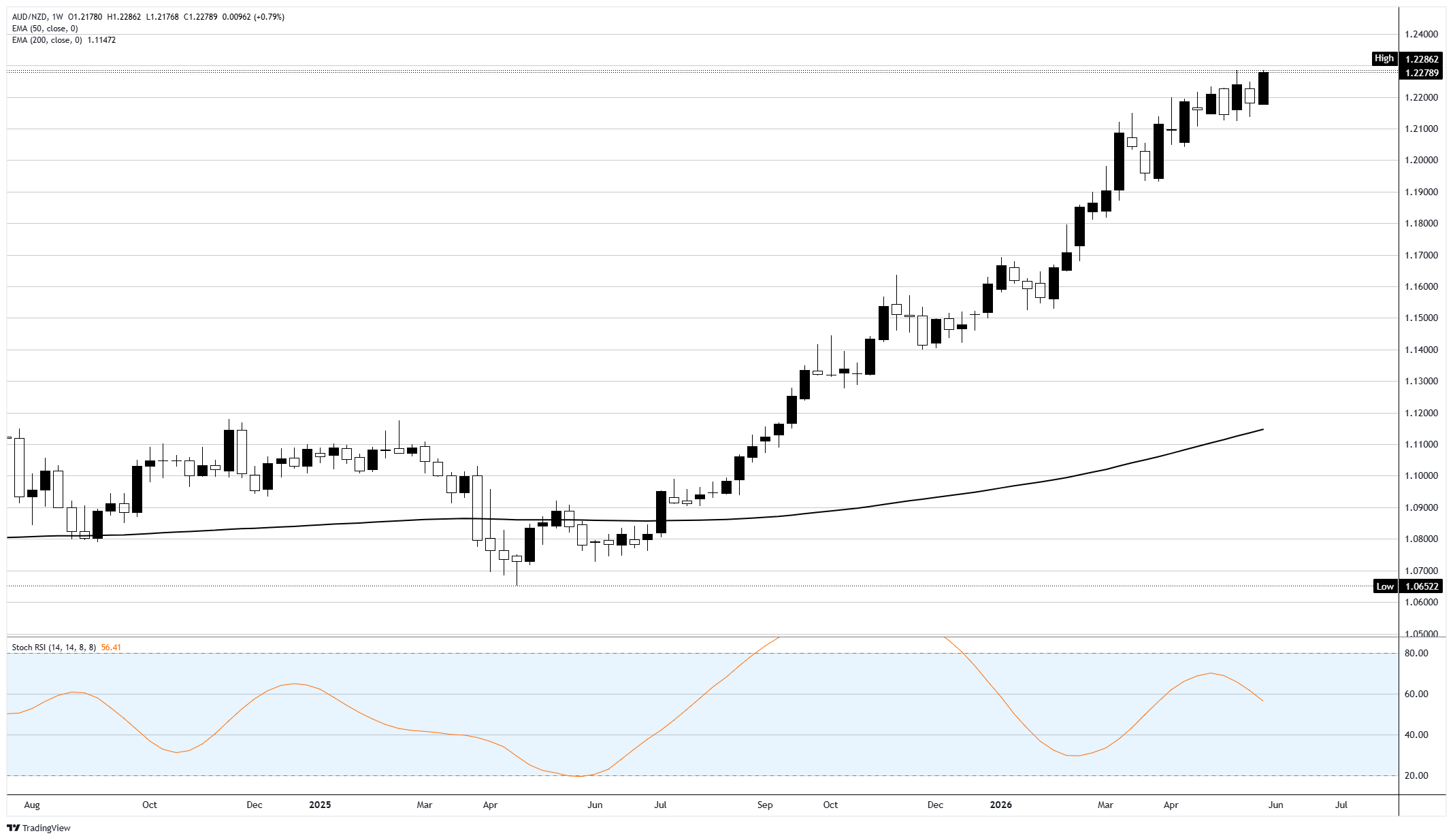
The Australian Dollar has spent the better part of a year bullying its trans-Tasman cousin, and the scoreboard is lopsided. AUD/NZD has just tagged its highest level since around 2013, up roughly 14% from its July low, closing higher in eight of the last ten months and on pace to make it eleven. The engine behind that run is the rarest thing in currency markets, two neighbouring central banks marching in opposite directions at the same time. The trouble for anyone still chasing the Aussie higher here is that this is precisely the moment the engine starts to run out of fuel.
Two neighbours, two opposite playbooks
The divergence has been stark. The Reserve Bank of New Zealand (RBNZ) slashed its Official Cash Rate (OCR) from a 5.5% peak all the way to 2.25%, the most aggressive easing cycle in the developed world, as the New Zealand economy ground through a downturn. The Reserve Bank of Australia (RBA) did the exact opposite, hiking three times this year to 4.35% as Australian growth held up and inflation refused to cool. The same Middle East Oil shock that is feeding price pressure on both sides of the Tasman landed on two economies sitting at opposite ends of the cycle, and the central banks responded in opposite directions. The result was a yield gap that blew out in the Aussie's favour and a trend that has only really known one way.
The fuel gauge is dropping
Here is the catch. A trend built on a widening rate gap struggles the moment that gap stops widening, and convergence is now creeping in from both ends. The RBNZ has stopped cutting entirely, holding three meetings in a row, and is openly flirting with hikes because its own inflation is breaching the top of its target band and heading toward 4%. The RBA, after three straight increases, has signalled it now has room to pause and assess. So the differential that has powered the Aussie for a year is set to plateau, and could begin narrowing if the Kiwi side starts hiking while the Aussie side sits still. The very mechanism that drove the move is quietly going into reverse.
Stretched at levels last seen 13 years ago
The chart is flashing the same warning. On the monthly candlesticks, the Stochastic RSI is pinned in overbought territory near 80, and price is pressing into a region the pair has not visited in roughly 157 months. Closing green in eight of the last ten months is an extraordinarily persistent run, and persistence like that tends to mean-revert rather than extend indefinitely. The Aussie is currently leaning on the 1.2300 handle, a long way above its rising daily averages, with the 50-day sitting back near 1.2100 as the first real trend support. This is not a top call, but it is a mature trend meeting its first serious overhead resistance with momentum already stretched thin.
Wednesday is the inflection
The timing could hardly be sharper. Wednesday delivers a back-to-back trans-Tasman collision, with Australian Consumer Price Index (CPI) data at 01:30 GMT followed just thirty minutes later by the RBNZ decision at 02:00 GMT and its press conference at 03:00 GMT. The bullish-Aussie case needs hot Australian inflation to keep the RBA hiking, paired with a dovish RBNZ. The reversal case needs the opposite, and consensus is leaning that way. Headline CPI is seen cooling to around 4.4% YoY from 4.6%, which would hand the RBA exactly the excuse it flagged to pause, while a hawkish RBNZ that upgrades its inflation track and signals hikes would attack the trade from the other side.
For now the bias stays higher while the pair holds above the 1.2250 area, with a clean monthly break of the 1.2300 handle opening a path toward the 1.2400 zone where the 2013 highs sit. The more interesting setup, though, is the fade. A soft inflation print and a hawkish RBNZ on Wednesday could cap the move, and a slip back below the 1.2200 handle would be the first real crack in the gap-driven trend, with the rising 50-day near 1.2100 marking the line that still defines the broader uptrend. The Aussie has had the Kiwi's number for nearly a year. Wednesday is when the market finds out whether the gap can keep doing all the heavy lifting.
AUD/NZD weekly chart
Australian Dollar FAQs
One of the most significant factors for the Australian Dollar (AUD) is the level of interest rates set by the Reserve Bank of Australia (RBA). Because Australia is a resource-rich country another key driver is the price of its biggest export, Iron Ore. The health of the Chinese economy, its largest trading partner, is a factor, as well as inflation in Australia, its growth rate and Trade Balance. Market sentiment – whether investors are taking on more risky assets (risk-on) or seeking safe-havens (risk-off) – is also a factor, with risk-on positive for AUD.
The Reserve Bank of Australia (RBA) influences the Australian Dollar (AUD) by setting the level of interest rates that Australian banks can lend to each other. This influences the level of interest rates in the economy as a whole. The main goal of the RBA is to maintain a stable inflation rate of 2-3% by adjusting interest rates up or down. Relatively high interest rates compared to other major central banks support the AUD, and the opposite for relatively low. The RBA can also use quantitative easing and tightening to influence credit conditions, with the former AUD-negative and the latter AUD-positive.
China is Australia’s largest trading partner so the health of the Chinese economy is a major influence on the value of the Australian Dollar (AUD). When the Chinese economy is doing well it purchases more raw materials, goods and services from Australia, lifting demand for the AUD, and pushing up its value. The opposite is the case when the Chinese economy is not growing as fast as expected. Positive or negative surprises in Chinese growth data, therefore, often have a direct impact on the Australian Dollar and its pairs.
Iron Ore is Australia’s largest export, accounting for $118 billion a year according to data from 2021, with China as its primary destination. The price of Iron Ore, therefore, can be a driver of the Australian Dollar. Generally, if the price of Iron Ore rises, AUD also goes up, as aggregate demand for the currency increases. The opposite is the case if the price of Iron Ore falls. Higher Iron Ore prices also tend to result in a greater likelihood of a positive Trade Balance for Australia, which is also positive of the AUD.
The Trade Balance, which is the difference between what a country earns from its exports versus what it pays for its imports, is another factor that can influence the value of the Australian Dollar. If Australia produces highly sought after exports, then its currency will gain in value purely from the surplus demand created from foreign buyers seeking to purchase its exports versus what it spends to purchase imports. Therefore, a positive net Trade Balance strengthens the AUD, with the opposite effect if the Trade Balance is negative.
Nothing in this material constitutes investment advice, personal recommendation, investment research, an offer, or a solicitation to buy or sell any financial instrument. The content has been prepared without consideration of your individual investment objectives, financial situation, or needs, and should not be treated as such.
Past performance is not a reliable indicator of future performance and/or results. Forward-looking scenarios or forecasts are not a guarantee of future performance. Actual results may differ materially from those anticipated.
Mitrade makes no representation or warranty as to the accuracy or completeness of the information provided and accepts no liability for any loss arising from reliance on such information.
Recommended Articles


