



Australian Dollar finds a saviour in data centres
- US Core PCE lands in line at 3.3% YoY with a softer 0.2% MoM print.
- Q1 Australian Capex blows out at 6.5% versus 1.0% expected, driven by data centre spend.
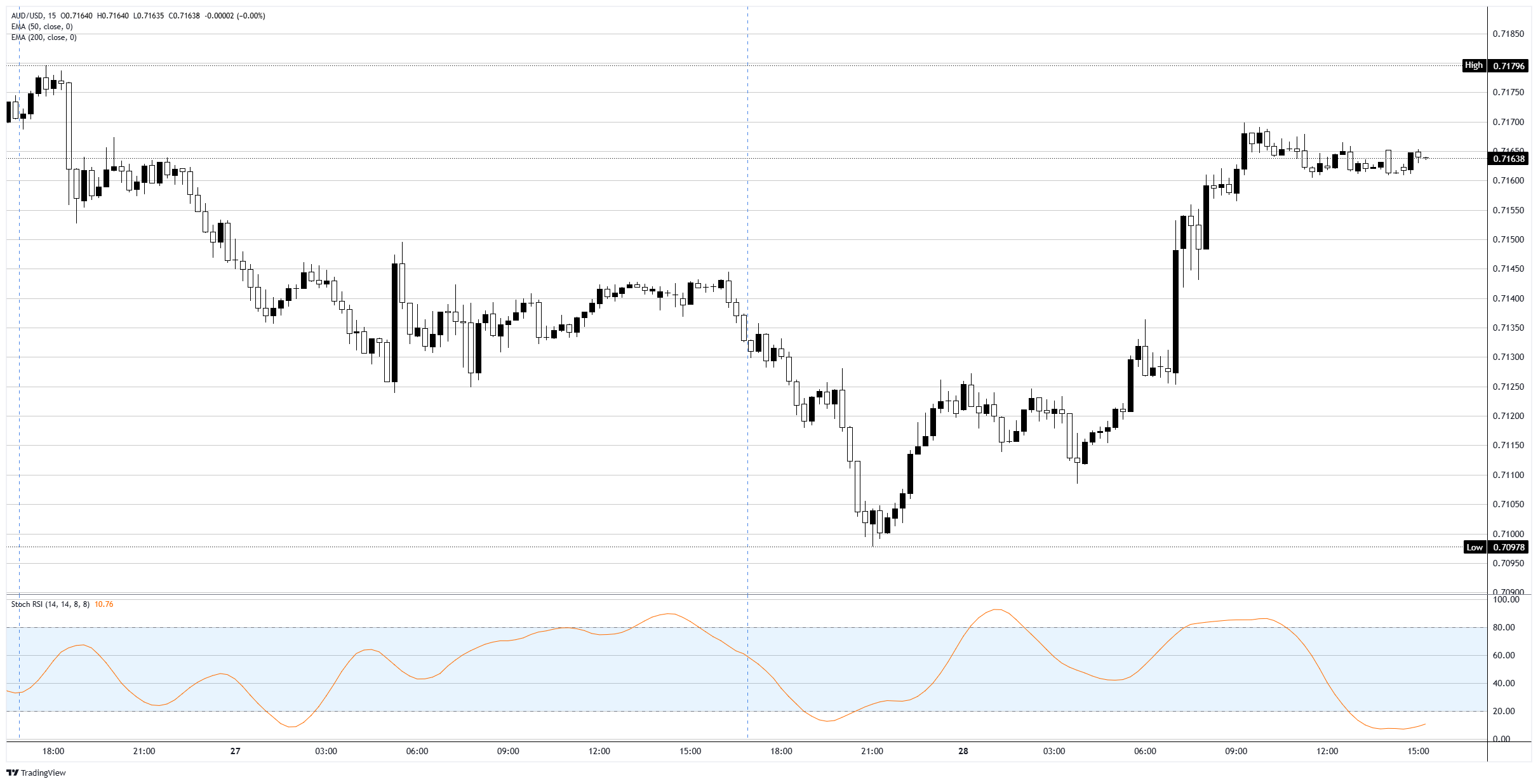
- AUD/USD holds the bounce off 0.7100 into the Friday Asia open.
The Aussie Dollar walks into Friday's Asia session in better shape than yesterday's soft Consumer Price Index (CPI) had any right to leave it. AUD/USD spent Thursday clawing back from a test of the 0.7100 handle to settle near 0.7150, helped by a Q1 business investment print that no one saw coming and a US Personal Consumption Expenditures (PCE) release that gave the Federal Reserve (Fed) very little to chew on. The result is a pair that looks heavy on the daily chart, supported by a structural story almost no analyst is talking about.
PCE was a non-event, and that mattered
April Core PCE printed at 3.3% year-on-year (YoY), matching consensus, with the monthly figure softening to 0.2% from the 0.3% expected. Headline PCE accelerated to 3.8% YoY, the highest since May 2023, but the market correctly read that as an energy story tied to the Iran conflict rather than a broadening inflation problem. CME FedWatch pricing still tilts roughly 50/50 on whether the Fed will hike at least once by year-end, and the muted reaction across risk assets, stocks barely flinched, says traders are content to wait for the next jobs print before re-pricing the curve. For AUD/USD that translated to a US Dollar that couldn't punch through 0.7100 even with PCE on the tape.
The data centre trade is doing structural work
The standout from Thursday's Australian release was the Q1 Private Capital Expenditure (Capex) print at 6.5% quarter-on-quarter against the 1.0% consensus. Equipment, plant and machinery surged 18.1%. The Australian Bureau of Statistics (ABS) attributed almost all of the jump to data centre buildout, and forward estimates for 2026-27 capex were revised up nearly 10%. This is the kind of investment cycle that doesn't show up cleanly in the Reserve Bank of Australia's (RBA) inflation models but absolutely shows up in growth, productivity, and eventually in the rate path. The same release showed April household spending falling 1.1% month-on-month (MoM), more than double the expected drop. The RBA now has a clean split, capex booming, the consumer rolling over, and that probably keeps it on hold rather than cutting aggressively. A held cash rate is a yield buffer the Aussie has been quietly leaning on.
Technical setup heading into Asia
The daily 50-period Exponential Moving Average (EMA) sits near 0.7100 and held cleanly on the Thursday test. Daily Stochastic Relative Strength Index (Stoch RSI) is rolling over from overbought but still has room to work lower before reaching support, suggesting any push higher is on borrowed time without a fresh catalyst. The cycle high near 0.7300 from earlier this month remains the line in the sand. Friday's Asia session is likely to be quiet, the calendar carries only second-tier US data later in the day, and most of the actionable risk sits in the weekend China Purchasing Managers Index (PMI) prints and next Wednesday's Australian Gross Domestic Product (GDP).
End-of-week framework
Bias is neutral with a marginal upside lean while 0.7100 holds on a daily close. A reclaim of 0.7200 puts 0.7250 back in play, with 0.7300 the level bears need to defend to keep the recent pullback alive. Below 0.7100, the path opens quickly to 0.7050 and then the psychological 0.7000 handle, where structural buyers should reload. The events that matter into next week are the China NBS PMIs on Sunday, Fed Chair Powell's speech Monday, Australian Q1 GDP Wednesday, and US Nonfarm Payrolls (NFP) Friday. Until then, expect grinding range trade and let the data do the work.
AUD/USD 15-minute chart
Australian Dollar FAQs
One of the most significant factors for the Australian Dollar (AUD) is the level of interest rates set by the Reserve Bank of Australia (RBA). Because Australia is a resource-rich country another key driver is the price of its biggest export, Iron Ore. The health of the Chinese economy, its largest trading partner, is a factor, as well as inflation in Australia, its growth rate and Trade Balance. Market sentiment – whether investors are taking on more risky assets (risk-on) or seeking safe-havens (risk-off) – is also a factor, with risk-on positive for AUD.
The Reserve Bank of Australia (RBA) influences the Australian Dollar (AUD) by setting the level of interest rates that Australian banks can lend to each other. This influences the level of interest rates in the economy as a whole. The main goal of the RBA is to maintain a stable inflation rate of 2-3% by adjusting interest rates up or down. Relatively high interest rates compared to other major central banks support the AUD, and the opposite for relatively low. The RBA can also use quantitative easing and tightening to influence credit conditions, with the former AUD-negative and the latter AUD-positive.
China is Australia’s largest trading partner so the health of the Chinese economy is a major influence on the value of the Australian Dollar (AUD). When the Chinese economy is doing well it purchases more raw materials, goods and services from Australia, lifting demand for the AUD, and pushing up its value. The opposite is the case when the Chinese economy is not growing as fast as expected. Positive or negative surprises in Chinese growth data, therefore, often have a direct impact on the Australian Dollar and its pairs.
Iron Ore is Australia’s largest export, accounting for $118 billion a year according to data from 2021, with China as its primary destination. The price of Iron Ore, therefore, can be a driver of the Australian Dollar. Generally, if the price of Iron Ore rises, AUD also goes up, as aggregate demand for the currency increases. The opposite is the case if the price of Iron Ore falls. Higher Iron Ore prices also tend to result in a greater likelihood of a positive Trade Balance for Australia, which is also positive of the AUD.
The Trade Balance, which is the difference between what a country earns from its exports versus what it pays for its imports, is another factor that can influence the value of the Australian Dollar. If Australia produces highly sought after exports, then its currency will gain in value purely from the surplus demand created from foreign buyers seeking to purchase its exports versus what it spends to purchase imports. Therefore, a positive net Trade Balance strengthens the AUD, with the opposite effect if the Trade Balance is negative.
Nothing in this material constitutes investment advice, personal recommendation, investment research, an offer, or a solicitation to buy or sell any financial instrument. The content has been prepared without consideration of your individual investment objectives, financial situation, or needs, and should not be treated as such.
Past performance is not a reliable indicator of future performance and/or results. Forward-looking scenarios or forecasts are not a guarantee of future performance. Actual results may differ materially from those anticipated.
Mitrade makes no representation or warranty as to the accuracy or completeness of the information provided and accepts no liability for any loss arising from reliance on such information.
Recommended Articles


