



EUR/USD Price Forecast: Starts the US NFP week cautiously
- EUR/USD edges down to near 1.1645 as the US Dollar trades slightly higher.
- This week, major triggers will be the flash Eurozone HICP and the US NFP data for May.
- The removal of Iran’s uranium enrichment remains the key demand by the US for a permanent peace deal.
The EUR/USD pair trades slightly lower to near 1.1645 during the Asian trading session on Monday. The major currency pair faces marginal selling pressure as the US Dollar (USD) ticks up, with investors awaiting key United States (US) economic releases this week, especially the Nonfarm Payrolls (NFP) data for May.
As of writing, the US Dollar Index (DXY), which tracks the Greenback’s value against six major currencies, trades 0.1% higher to near 99.03.
Investors will pay close attention to the US NFP data to get fresh cues on the Federal Reserve’s (Fed) monetary policy outlook. Later in the day, market participants will focus on the US ISM Manufacturing PMI data for May, which will be published at 14:00 GMT.
In the Eurozone, investors await the preliminary Harmonized Index of Consumer Prices (HICP) data for May, which will be released on Tuesday. The inflation data will influence market expectations for the European Central Bank’s (ECB) monetary policy outlook.
On the geopolitical front, negotiations between the US and Iran regarding a permanent peace deal remain ongoing, with Washington hardening its stance on Tehran destroying its uranium dust and giving up its nuclear ambitions.
EUR/USD technical analysis
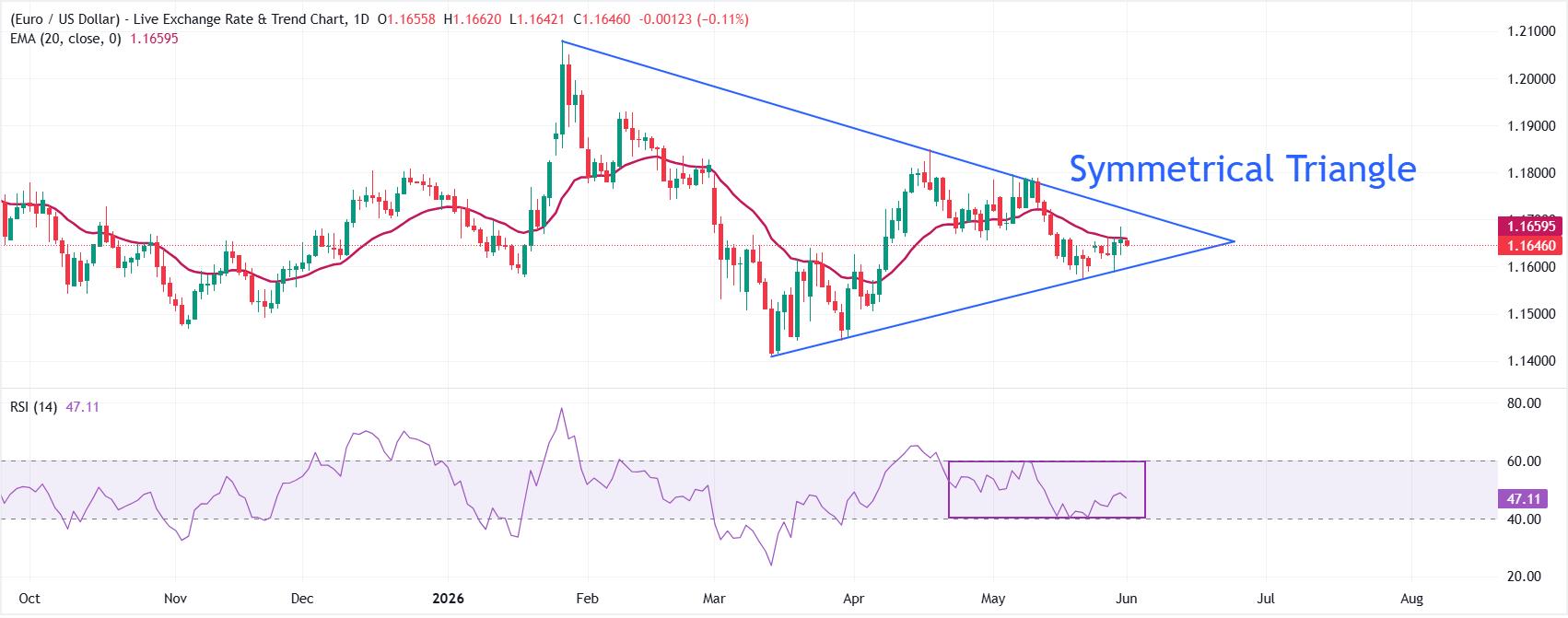
EUR/USD ticks lower at around 1.1645 in the Asian trade. The 20-day Exponential Moving Average (EMA) near 1.1646 acts as a key barrier for the Euro bulls. The pair holds just above the upward-sloping border of the Symmetrical Triangle formation near 1.1599.
The Relative Strength Index (14) has slipped to around 47, suggesting fading bullish momentum and reinforcing the idea of consolidation with a bearish lean rather than a decisive recovery.
On the topside, the 20-day EMA is the immediate resistance, followed by the downward-sloping border of the Triangle formation around 1.1719. On the downside, the first line of defense sits at the former ascending trend-line break at 1.1599; a sustained move below that support would expose a deeper pullback towards 1.1500.
(The technical analysis of this story was written with the help of an AI tool.)
Euro FAQs
The Euro is the currency for the 20 European Union countries that belong to the Eurozone. It is the second most heavily traded currency in the world behind the US Dollar. In 2022, it accounted for 31% of all foreign exchange transactions, with an average daily turnover of over $2.2 trillion a day. EUR/USD is the most heavily traded currency pair in the world, accounting for an estimated 30% off all transactions, followed by EUR/JPY (4%), EUR/GBP (3%) and EUR/AUD (2%).
The European Central Bank (ECB) in Frankfurt, Germany, is the reserve bank for the Eurozone. The ECB sets interest rates and manages monetary policy. The ECB’s primary mandate is to maintain price stability, which means either controlling inflation or stimulating growth. Its primary tool is the raising or lowering of interest rates. Relatively high interest rates – or the expectation of higher rates – will usually benefit the Euro and vice versa. The ECB Governing Council makes monetary policy decisions at meetings held eight times a year. Decisions are made by heads of the Eurozone national banks and six permanent members, including the President of the ECB, Christine Lagarde.
Eurozone inflation data, measured by the Harmonized Index of Consumer Prices (HICP), is an important econometric for the Euro. If inflation rises more than expected, especially if above the ECB’s 2% target, it obliges the ECB to raise interest rates to bring it back under control. Relatively high interest rates compared to its counterparts will usually benefit the Euro, as it makes the region more attractive as a place for global investors to park their money.
Data releases gauge the health of the economy and can impact on the Euro. Indicators such as GDP, Manufacturing and Services PMIs, employment, and consumer sentiment surveys can all influence the direction of the single currency. A strong economy is good for the Euro. Not only does it attract more foreign investment but it may encourage the ECB to put up interest rates, which will directly strengthen the Euro. Otherwise, if economic data is weak, the Euro is likely to fall. Economic data for the four largest economies in the euro area (Germany, France, Italy and Spain) are especially significant, as they account for 75% of the Eurozone’s economy.
Another significant data release for the Euro is the Trade Balance. This indicator measures the difference between what a country earns from its exports and what it spends on imports over a given period. If a country produces highly sought after exports then its currency will gain in value purely from the extra demand created from foreign buyers seeking to purchase these goods. Therefore, a positive net Trade Balance strengthens a currency and vice versa for a negative balance.
Nothing in this material constitutes investment advice, personal recommendation, investment research, an offer, or a solicitation to buy or sell any financial instrument. The content has been prepared without consideration of your individual investment objectives, financial situation, or needs, and should not be treated as such.
Past performance is not a reliable indicator of future performance and/or results. Forward-looking scenarios or forecasts are not a guarantee of future performance. Actual results may differ materially from those anticipated.
Mitrade makes no representation or warranty as to the accuracy or completeness of the information provided and accepts no liability for any loss arising from reliance on such information.
Recommended Articles


