



AI US Stocks and AI Cryptocurrencies, Which One Is More Worth Investing?
TradingKey - Entering 2026, artificial intelligence (AI) stocks in the U.S. market have demonstrated robust performance, with shares of companies such as Nvidia, Micron, and Broadcom consistently reaching new record highs. In contrast, AI cryptocurrencies have been sluggish, with their total market capitalization continuing to fall; most are oscillating within low price ranges or even weakening to hit new record lows.
Despite being driven by the same AI wave, why is there such a stark performance gap between U.S. AI stocks and AI cryptocurrencies, and will this disparity widen further in the future? Is it time to abandon AI cryptocurrencies?
Divergent performance of U.S. AI stocks and AI cryptocurrencies
In 2026, capital flooded into AI stocks in the U.S. market, where hardware infrastructure such as chips, memory, and AI servers gained significant traction, driving the market capitalization of major leaders to record highs. In early 2026, chip giant NVIDIA ( NVDA) officially breached the $5 trillion market cap milestone, becoming the first company globally to do so. Following a brief correction, NVIDIA's share price continued to rebound, surging to $236 on May 14 to hit an all-time high; its market capitalization reached $5.35 trillion, firmly securing its position as the world's most valuable listed company. Although NVIDIA is the world's largest company by market cap, it has risen only 12% year-to-date, significantly lagging behind memory king Micron Technology ( MU) which has seen its price surge over 200% this year.
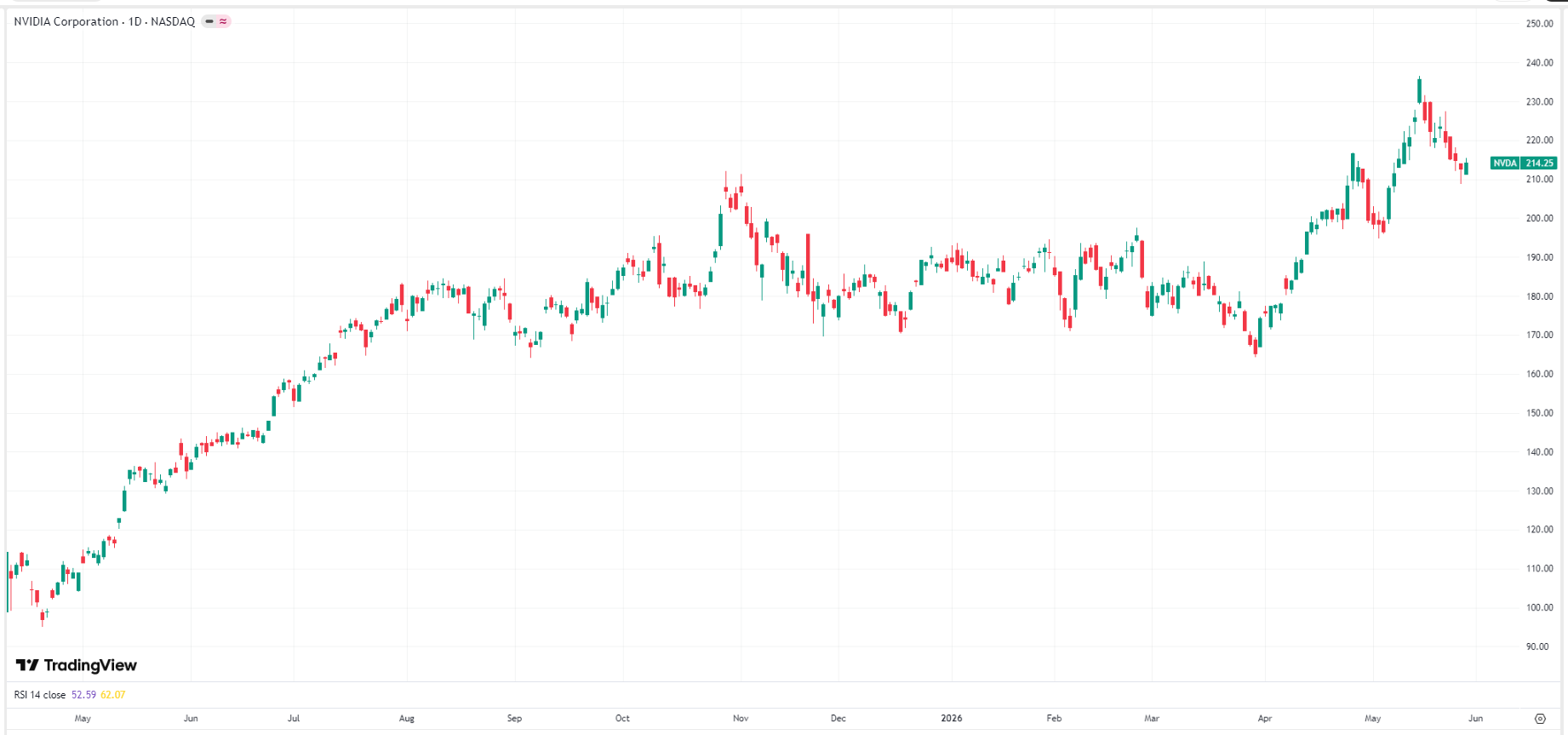 NVIDIA stock price chart, source: TradingView
As of May 28, the leading decentralized AI network Bittensor ( TAO) was fluctuating around $260, a decline of approximately 65% from its all-time high of $757 set in March 2024. During the same period, the decentralized GPU computing network Render (RENDER) hovered around $2.00, down 84% from its March 2024 peak of $13.
Why is there such a stark divergence between AI-related US stocks and AI cryptocurrencies?
Despite both being AI-themed, the U.S. stock and cryptocurrency markets have diverged into a "heaven and hell" disparity, primarily due to differences in their underlying business logic. Whether it is Microsoft ( MSFT ), Google ( GOOG ), Meta ( META ), or OpenAI, their first and only step to training large models and competing for AI supremacy is to buy chips from Nvidia and High Bandwidth Memory (HBM) from Micron. Meanwhile, the vision for Web3 AI projects is "decentralized computing power," seeking to break the monopoly of centralized giants like AWS and Microsoft, but reality has proven otherwise.
Compared to AI-related U.S. stocks, cryptocurrencies lack actual rigid demand support, while valuations hinge on the "illusory FDV." As a result, projects were hyped to multi-billion-dollar market caps in their early stages based solely on a white paper and the grand narrative of "decentralized AI." As tokens continue to unlock and large holders sell off, while actual on-chain fee revenue and burn rates fail to keep up, the bubble naturally bursts rapidly in the absence of fundamental support.
AI US Stocks vs. AI Cryptocurrencies: Which is the Better Investment?
AI US stocks and AI cryptocurrencies represent two distinctly different investment logics. The former is a revaluation by traditional capital of tangible technology implementation, backed by earnings and high pricing power with relatively rational valuations, though it may face a plateau. The latter is Web3’s preemptive speculation on a future decentralized AI economy; currently in the "vision and narrative" stage, it lacks real-world application, leading to extreme volatility, but it may break the Web2 monopoly in the future.
Therefore, if you prefer assets with financial statements, institutional endorsements, and the support of tangible industrial chains, AI US stocks are suitable for your portfolio. If you are willing to bear the risk of significant principal drawdowns to bet on a new paradigm that could disrupt technological architectures over the next 5 to 10 years, you may choose AI cryptocurrencies. Naturally, you can also allocate to both based on a specific ratio.
Nothing in this material constitutes investment advice, personal recommendation, investment research, an offer, or a solicitation to buy or sell any financial instrument. The content has been prepared without consideration of your individual investment objectives, financial situation, or needs, and should not be treated as such.
Past performance is not a reliable indicator of future performance and/or results. Forward-looking scenarios or forecasts are not a guarantee of future performance. Actual results may differ materially from those anticipated.
Mitrade makes no representation or warranty as to the accuracy or completeness of the information provided and accepts no liability for any loss arising from reliance on such information.
Recommended Articles


