



Rigetti Stock Pulls Back to $25: Is Its Cloud-First Ecosystem the Ideal Re-Entry Point for RGTI?
TradingKey - Rigetti Computing (NASDAQ: RGTI) is currently trading at $25.39, building support above the 0.236 Fibonacci level of $24.86. The RSI is oscillating between 57.95 and 62.45, while the upward-sloping trendline extending from $15.48 remains unbroken. Much of the recent momentum can be chalked up to government investment tailwinds and Lyra roadmap progress; however, what is getting relatively less play is the Rigetti Quantum Cloud Services platform, the cloud-architecture first infrastructure, that provides access to Rigetti’s quantum systems to customers like researchers, financial services institutions, pharmaceutical companies and technology developers to execute quantum algorithms from their computers without purchasing a quantum machine or building a data center to host one.
That’s the commercial pipeline that is transitioning from pilot to contract when the hardware fidelity becomes high enough to yield some competitive advantage. Understanding QCS is understanding how Rigetti generates revenue before fault-tolerant quantum is here.
What the QCS Platform Is and Why Cloud-First Gives Rigetti a Commercial Moat
The Quantum Cloud Service (QCS) platform is the cloud based infrastructure that allows customers to access Rigetti’s quantum processors via API to run quantum programs without needing to buy, host, or maintain a quantum computer. It’s the same commercial approach that AWS took for classical computing in 2006: lower the barrier to access for experimentation so the potential market goes from companies that can buy a quantum machine (a non-existent group of firms) to any entity that can afford a subscription to the API (virtually all companies). That market comprises government labs, university groups, financial companies experimenting with portfolio optimization, pharmaceutical companies with molecular simulations to execute.
A cloud-first strategy creates a data flywheel that doesn’t exist for competitors building proprietary onsite hardware systems. Every circuit that runs on the QCS cloud platform creates calibration data, error signature data and data on workload performance that Rigetti can leverage to make the qubits better, to make the gates more reliable and to calibrate the system better for the next generation of quantum computer. IBM’s Quantum Network is using the same approach, and there is no chance this is coincidental that the two companies with the most robust cloud access platform for quantum computing are also the two that Washington is funding the most. The cloud data loop drives the hardware roadmap.
The $2 Billion Quantum Program and the Lyra System: What Changes Between Now and Q4 2026?
The revenue-generating pipeline for RGTI isn’t for the next decade, it’s for the next 12 to 24 months in terms of commercial hybrid quantum-classical systems, not general-purpose error-corrected (fault-tolerant) systems, which won’t be here until 2029 or 2030 or beyond. The hybrid systems use a quantum processor as a co-processor, only for the parts of the workload that benefit from quantum computation, while using classical systems for all the rest of the tasks. The most promising commercial pilots that have a higher probability of converting to contracts:
- financial (portfolio optimization, risk modeling)
- pharmaceuticals (molecular simulations for drug discovery)
- logistics (combinatorial optimization)
The pilots don’t need error-corrected systems to provide an advantage. They need quantum systems that are reliable and low-error enough to provide a measurable advantage to the classical computers for solving a particular subset of problems. Rigetti has the systems that it currently ships and the 100+ qubit systems that it is aiming to have in place by late 2026 with Lyra. They are targeting the threshold of performance in each of these use cases where the end user of a QCS platform can solve a portfolio optimization problem to get a result that is demonstrably faster or better than the results that could be generated by the existing classical system that the user would have to be using otherwise. Rigetti is already shipping a 36-qubit system this quarter to a US government agency. This proves that for certain government use cases it already has systems that can deliver better results than classical machines. The commercial customers are the ones trying to see if the same is true for their specific workflows.
Rigetti Computing Trading Plan and Risk/Reward Ratio
Flag consolidation at $25.39, with targets at $27.77 and $28.77. On the 4-hour chart, RGTI is holding support at $24.86, the 0.236 Fibonacci retracement, with green candles protecting the breakout zone and very little red selling in the follow-through. The upward black trendline from $15.48 is holding steady and the $19.43 50-day moving average is serving as support.
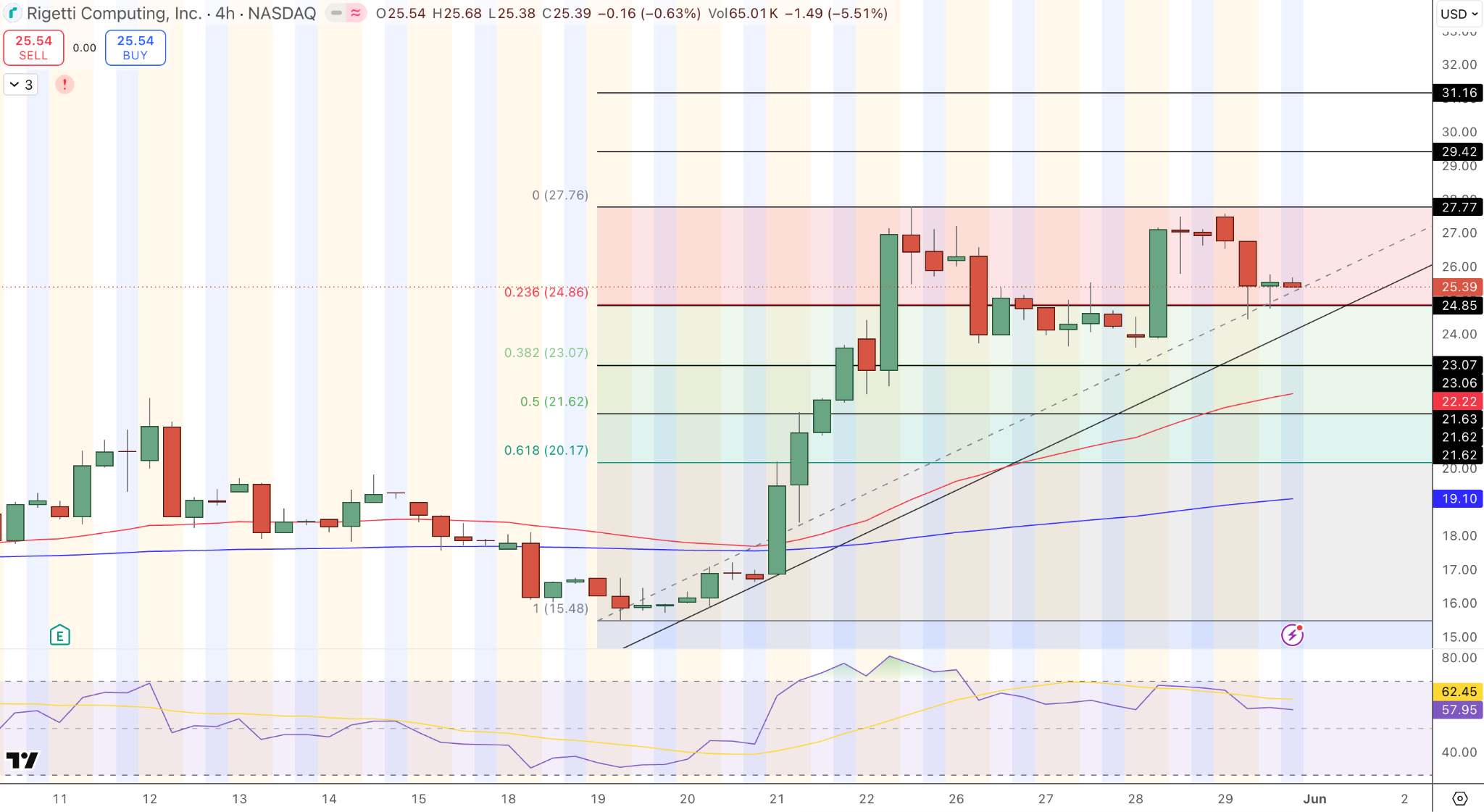
Rigetti Computing (NASDAQ: RGTI) Price Chart - Souce: Tradingview
RSI is between 57.95 and 62.45, indicating neutral-to-bullish conditions with no divergence and tapering volumes on the decline that are the sign of healthy flag consolidation before the next move. Fibonacci extensions at $27.77 (2.272) and $28.77 (3.0) represent the next targets. If we go above $25.54 and below $24.85 as stop loss that’s a 3.4:1 risk to return ratio to the first target.
RGTI trade setup
- Entry: Longs above $25.54, confirming breakout of consolidation target.
- Target 1: $27.77, Fibonacci 2.272 extension.
- Target 2: $28.77, Fibonacci 3.0 extension.
- Stop: Daily close below $24.85, break of the 0.236 Fibonacci level and the support line.
So, Why Has Rigetti Stock Retraced Following This Breakout?
RGTI is now in a classic, healthy consolidation, pulling back 5.9% from the 2.618 Fibonacci breakout level of $26.97 down to $25.39. This pullback aligns with the RSI falling from an overbought 77 to 81 reading down to a neutral/bullish 57 to 62 reading.
The trading volume has also dried up as the stock has fallen. Together, all of these signals support the idea that RGTI is in the middle of a flag-style pause while the stock continues in an uptrend, not the middle of a distribution, or a complete breakdown of the bullish setup.
The $2.618 breakout from $26.97, the ascending trendline from the $15.48 low, and higher lows above the MA50 at $19.43 have all held through this retracement. RGTI’s $24.86 Fib 0.236 level is the key area to watch.
What Are The Top Three Catalysts That Could Move RGTI For The Remainder of 2026?
I think there are three ordered catalysts for RGTI in H2 2026:
- Any named award announcement and any announced contract amount from the $2B federal quantum computing initiative.
- Any interim Lyra progress, such as announced qubit count, coherence time, or gate fidelity data ahead of the formal late-2026 delivery.
- Any QCS pilot to commercial contract announcements for existing financial services or pharmaceutical pilot programs.
Of course, I believe any single one of these events can move RGTI on a stand-alone basis.
Is RGTI Stock More Attractive Now At $25.39 Following This Retest Compared To The Initial $26.97 Breakout?
Yes, on a relative basis because the RSI has reset, from 81 to 58-62, with only a 5.9% retracement, aligning momentum and price for a higher probability continuation trade. If a trader entered today at $25.54, their downside is $0.69 to the $24.85 level, and the first upside target is $27.77, offering a 3.4:1 risk-reward. At the time of the breakout trade, the RSI was overbought and the risk-reward profile was less favorable than what is available now. All the fundamentals remain the same: the federal quantum computing initiative is still worth $2B, and the Q4 2026 delivery of the 36-qubit government system, and the Lyra quantum computer.
Final Thoughts On RGTI Stock
RGTI stock is retracing, the RSI has reset, and volume has fallen. It is a textbook flag setup, and I think this is an even better entry than the breakout. The $24.86 level, the 0.236 level, and the $15.48 trendline have held, and the $2B federal quantum computing award announcement, the Lyra intermediate milestone announcement, and any pilot-to-commercial contract announcement are all yet to come.
If you enter today, your downside is $24.85, your first upside target is $27.77, the second target is $28.77, and the risk-reward profile is better than 3:1. RGTI stock is a speculative position, a pre-commercial position, which requires a smaller position size.
Nothing in this material constitutes investment advice, personal recommendation, investment research, an offer, or a solicitation to buy or sell any financial instrument. The content has been prepared without consideration of your individual investment objectives, financial situation, or needs, and should not be treated as such.
Past performance is not a reliable indicator of future performance and/or results. Forward-looking scenarios or forecasts are not a guarantee of future performance. Actual results may differ materially from those anticipated.
Mitrade makes no representation or warranty as to the accuracy or completeness of the information provided and accepts no liability for any loss arising from reliance on such information.
Recommended Articles


