



The Euro already hiked; now it waits on Warsh
- EUR/USD stalled below its 200-day EMA on Tuesday, even after last week's first ECB rate hike since 2023.
- Kevin Warsh chairs his first FOMC on Wednesday, with a hold priced in but a hike seen as the likelier year-end move.
- The energy shock that pushed both central banks hawkish is fading fast as the US-Iran deal sinks Crude Oil.
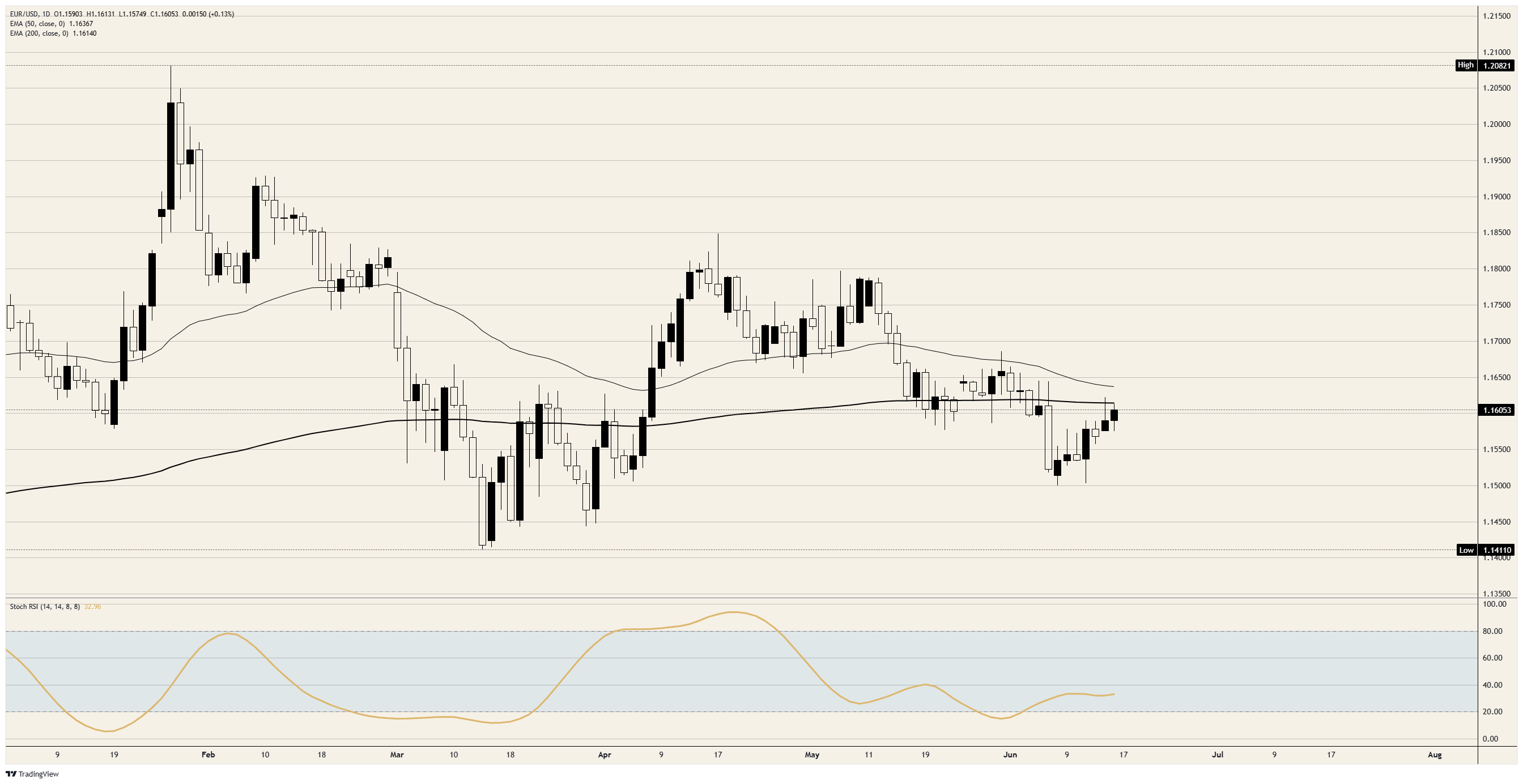
EUR/USD has gone almost nowhere since the weekend's deal headlines, and Tuesday was more of the same: a dip that held above 1.1550, a grind back to the 1.1600 handle, and a hard stall at the 200-day Exponential Moving Average (EMA) sitting just overhead. The frustration for Euro bulls is that the currency is carrying a genuinely hawkish domestic story into Federal Reserve (Fed) week and still cannot get out of its own way.
Frankfurt already pulled the trigger
The European Central Bank (ECB) raised rates last Thursday for the first time since 2023, lifting the deposit rate to 2.25% and reversing eight straight cuts. Christine Lagarde leaned hawkish and rejected the idea that this was a one-off insurance move, while the bank marked its inflation forecasts higher across the horizon. This is the hawkish turn the market is still only waiting on from the Fed, and the Euro has already banked it.
The follow-through has been steady rather than loud. Several desks now pencil in another hike as soon as September, and even Philip Lane, usually among the Council's more cautious voices, struck a hawkish tone on Tuesday. German investor expectations swung back to positive in the same session for the first time since winter, though current conditions stayed deeply negative, so this is hope, not a recovery anyone can see yet. With core inflation stuck near 2.5%, the Council has cover to keep going; on the trajectory that drives this pair, the Euro is arguably ahead of the Dollar, not behind it.
Warsh holds the only card that matters
None of that has helped, because the market has reduced this week to one question: what Kevin Warsh does on Wednesday. His first meeting as Fed Chair brings a near-certain hold, with the Federal Open Market Committee (FOMC) set to leave the range at 3.50% to 3.75%. The intrigue sits in the Summary of Economic Projections (SEP), which Warsh, a longstanding skeptic of forecasting and forward guidance, may downplay or scrap outright. The deeper irony is political: Donald Trump installed Warsh to deliver cuts, yet a Consumer Price Index (CPI) print running at 4.2% and a firm labor market have markets pricing roughly 60% odds of a December hike, with no cut showing anywhere on the curve through 2027.
The shock that justified both hikes is evaporating
The genuinely awkward part is that both central banks pivoted hawkish on the same catalyst: an energy shock from the Iran war that drove Crude Oil toward $120 and lifted inflation forecasts. That shock is now reversing. The US-Iran framework agreement announced over the weekend reopens the Strait of Hormuz, Crude Oil has collapsed back toward $80, and the Dollar slid to a 10-day low on Monday as the inflation premium bled out. The ECB, in other words, hiked on June 11 into the top of an oil spike that began reversing days later, and Wednesday's Fed could be the first official acknowledgment that the energy-inflation story is fading. It is worth remembering the deal is not yet signed; the formal version is slated for Friday in Switzerland, the nuclear file has been punted, and this administration has a habit of announcing more than it delivers.
What lands before Warsh speaks
Wednesday front-loads the data before the main event. Final May Harmonized Index of Consumer Prices (HICP) figures arrive at 09:00 GMT and should confirm core holding near 2.5%, more confirmation of the ECB's hawkish lean than a catalyst. US Retail Sales at 12:30 GMT carry more weight, feeding the growth-versus-inflation tension Warsh has to address. Then the decision at 18:00 GMT and the press conference at 18:30 GMT, where a new Chair's words carry outsized weight.
Resistance: A daily close back above the 200-day EMA, sitting a touch above 1.1600, is the first hurdle; clearing it opens 1.1650 where the 50-day EMA waits, then the 1.1700 handle. The daily Stochastic Relative Strength Index (Stoch RSI) is turning up from the lower half, leaving room to push.
Support: Tuesday's dip held above 1.1550, making it the line that matters on a pullback; losing it exposes 1.1500 and the early-June lows.
Bias: Tilts higher on a multi-session view. The rate math has quietly shifted the Euro's way, with the ECB already hiking while the Dollar's year-end hike premium leans on an oil spike that is deflating by the day. A dovish-leaning Warsh is the catalyst that lets EUR/USD finally reclaim the 200-day EMA; a hawkish surprise is the risk, and a daily close back under 1.1550 would say the Dollar won the week.
EUR/USD daily chart
Euro FAQs
The Euro is the currency for the 20 European Union countries that belong to the Eurozone. It is the second most heavily traded currency in the world behind the US Dollar. In 2022, it accounted for 31% of all foreign exchange transactions, with an average daily turnover of over $2.2 trillion a day. EUR/USD is the most heavily traded currency pair in the world, accounting for an estimated 30% off all transactions, followed by EUR/JPY (4%), EUR/GBP (3%) and EUR/AUD (2%).
The European Central Bank (ECB) in Frankfurt, Germany, is the reserve bank for the Eurozone. The ECB sets interest rates and manages monetary policy. The ECB’s primary mandate is to maintain price stability, which means either controlling inflation or stimulating growth. Its primary tool is the raising or lowering of interest rates. Relatively high interest rates – or the expectation of higher rates – will usually benefit the Euro and vice versa. The ECB Governing Council makes monetary policy decisions at meetings held eight times a year. Decisions are made by heads of the Eurozone national banks and six permanent members, including the President of the ECB, Christine Lagarde.
Eurozone inflation data, measured by the Harmonized Index of Consumer Prices (HICP), is an important econometric for the Euro. If inflation rises more than expected, especially if above the ECB’s 2% target, it obliges the ECB to raise interest rates to bring it back under control. Relatively high interest rates compared to its counterparts will usually benefit the Euro, as it makes the region more attractive as a place for global investors to park their money.
Data releases gauge the health of the economy and can impact on the Euro. Indicators such as GDP, Manufacturing and Services PMIs, employment, and consumer sentiment surveys can all influence the direction of the single currency. A strong economy is good for the Euro. Not only does it attract more foreign investment but it may encourage the ECB to put up interest rates, which will directly strengthen the Euro. Otherwise, if economic data is weak, the Euro is likely to fall. Economic data for the four largest economies in the euro area (Germany, France, Italy and Spain) are especially significant, as they account for 75% of the Eurozone’s economy.
Another significant data release for the Euro is the Trade Balance. This indicator measures the difference between what a country earns from its exports and what it spends on imports over a given period. If a country produces highly sought after exports then its currency will gain in value purely from the extra demand created from foreign buyers seeking to purchase these goods. Therefore, a positive net Trade Balance strengthens a currency and vice versa for a negative balance.
Nothing in this material constitutes investment advice, personal recommendation, investment research, an offer, or a solicitation to buy or sell any financial instrument. The content has been prepared without consideration of your individual investment objectives, financial situation, or needs, and should not be treated as such.
Past performance is not a reliable indicator of future performance and/or results. Forward-looking scenarios or forecasts are not a guarantee of future performance. Actual results may differ materially from those anticipated.
Mitrade makes no representation or warranty as to the accuracy or completeness of the information provided and accepts no liability for any loss arising from reliance on such information.
Recommended Articles


