



The Australian Dollar looks for an excuse to break ranks
- AUD/USD was knocked lower this week as a hawkish FOMC powered the US Dollar broadly higher.
- The RBA held this month, with above-target inflation keeping a further hike on the table.
- Wednesday's Australian CPI is the Aussie's best chance to trade on something other than the Dollar.
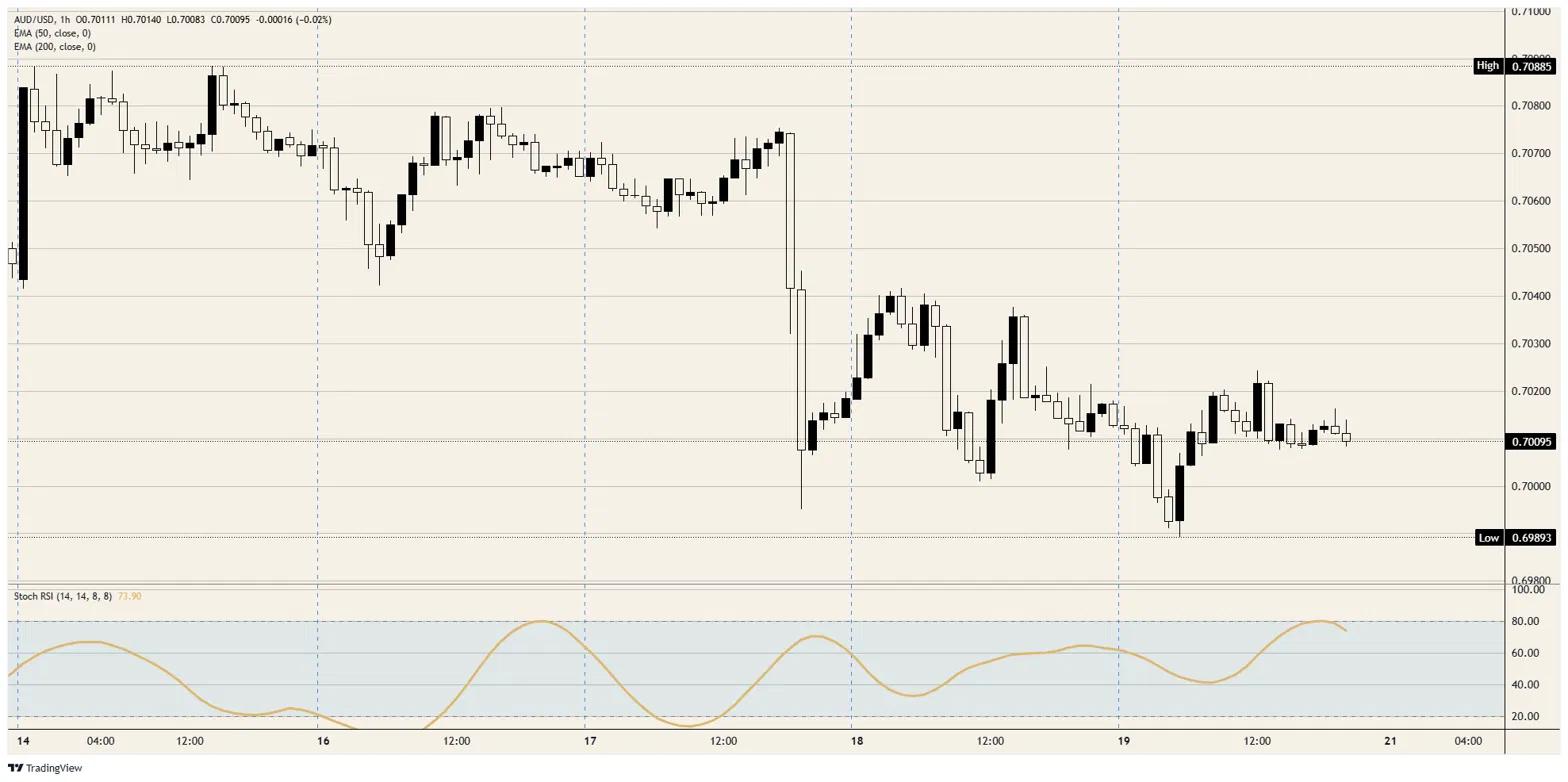
The Australian Dollar spent this week as a passenger in someone else's trade. A hawkish Federal Open Market Committee (FOMC) and a surging US Dollar dragged the Aussie down to the 0.7000 handle, with the pair's sharp mid-week drop owing more to events in Washington than to anything out of Canberra. Yet the Aussie is not quite the pure risk-proxy it tends to get treated as. It carries a domestic inflation problem of its own; next week hands it a rare chance to trade on that rather than on the Greenback's momentum.
The RBA is not done being hawkish
The Reserve Bank of Australia (RBA) left its cash rate unchanged at 4.35% this month, yet struck a far-from-dovish tone. Policymakers flagged that inflation remains elevated and has picked up materially, driven in part by higher fuel and commodity prices tied to the Middle East conflict, with pass-through into goods and services already visible. Several desks still see scope for additional tightening before any easing cycle begins; the central bank's own projections keep inflation above target into 2027. That is a meaningfully firmer footing than most of the Aussie's peers can claim.
Why the carry can't catch a bid
None of that has been enough to lift the currency, because the Aussie answers to more than its own rate story. It trades as a liquid proxy for both risk appetite and China, neither of which has helped: a stronger Dollar saps risk sentiment, while soft Chinese demand and a heavy Iron Ore market cap any rebound in Australia's terms of trade. The result is a currency with real domestic inflation pressure that still cannot pull away from the 0.7000 handle. As long as the Dollar owns the tape, the Aussie's better fundamentals stay academic.
Two home prints, then the Dollar
Next week finally gives the Aussie a domestic slate to trade. Australia's monthly Consumer Price Index (CPI) for May lands on Wednesday at 01:30 GMT, with the annual rate seen ticking up to 4.3% and the trimmed mean, the RBA's preferred core measure, in focus; a hot reading would revive hike bets and hand the currency a genuinely idiosyncratic reason to firm, even against a strong Dollar.
The May employment report follows on Thursday in the same early slot, after the prior month's surprise contraction in jobs; a rebound would reinforce the hawkish case. The complication is timing: that jobs print lands the same day the US delivers its first-quarter Gross Domestic Product (GDP) third estimate and the May Personal Consumption Expenditures Price Index (PCE) at 12:30 GMT. A firm Australian double-header into a hot US PCE would leave the Aussie pulled in both directions; the Dollar leg usually wins that tug-of-war.
Resistance: The 0.7050 level is the first hurdle, with the 50-day Exponential Moving Average (EMA) near 0.7100 capping the broader pullback; the Aussie needs a close back above 0.7100 to argue the down-leg is over.
Support: The 0.7000 handle is the line that matters; it has so far held. A sustained break exposes 0.6950, then the 200-day EMA near 0.6900.
Bias: Neutral-to-bearish while price sits below 0.7100 and the Dollar dominates, but with a clear two-way risk next week. The daily Stochastic Relative Strength Index (Stoch RSI) near oversold leaves room for a bounce; a hot Australian CPI is the catalyst most likely to deliver one. A soft CPI into a firm US PCE points the pair back through 0.7000 toward 0.6950.
AUD/USD hourly chart
Australian Dollar FAQs
One of the most significant factors for the Australian Dollar (AUD) is the level of interest rates set by the Reserve Bank of Australia (RBA). Because Australia is a resource-rich country another key driver is the price of its biggest export, Iron Ore. The health of the Chinese economy, its largest trading partner, is a factor, as well as inflation in Australia, its growth rate and Trade Balance. Market sentiment – whether investors are taking on more risky assets (risk-on) or seeking safe-havens (risk-off) – is also a factor, with risk-on positive for AUD.
The Reserve Bank of Australia (RBA) influences the Australian Dollar (AUD) by setting the level of interest rates that Australian banks can lend to each other. This influences the level of interest rates in the economy as a whole. The main goal of the RBA is to maintain a stable inflation rate of 2-3% by adjusting interest rates up or down. Relatively high interest rates compared to other major central banks support the AUD, and the opposite for relatively low. The RBA can also use quantitative easing and tightening to influence credit conditions, with the former AUD-negative and the latter AUD-positive.
China is Australia’s largest trading partner so the health of the Chinese economy is a major influence on the value of the Australian Dollar (AUD). When the Chinese economy is doing well it purchases more raw materials, goods and services from Australia, lifting demand for the AUD, and pushing up its value. The opposite is the case when the Chinese economy is not growing as fast as expected. Positive or negative surprises in Chinese growth data, therefore, often have a direct impact on the Australian Dollar and its pairs.
Iron Ore is Australia’s largest export, accounting for $118 billion a year according to data from 2021, with China as its primary destination. The price of Iron Ore, therefore, can be a driver of the Australian Dollar. Generally, if the price of Iron Ore rises, AUD also goes up, as aggregate demand for the currency increases. The opposite is the case if the price of Iron Ore falls. Higher Iron Ore prices also tend to result in a greater likelihood of a positive Trade Balance for Australia, which is also positive of the AUD.
The Trade Balance, which is the difference between what a country earns from its exports versus what it pays for its imports, is another factor that can influence the value of the Australian Dollar. If Australia produces highly sought after exports, then its currency will gain in value purely from the surplus demand created from foreign buyers seeking to purchase its exports versus what it spends to purchase imports. Therefore, a positive net Trade Balance strengthens the AUD, with the opposite effect if the Trade Balance is negative.
Nothing in this material constitutes investment advice, personal recommendation, investment research, an offer, or a solicitation to buy or sell any financial instrument. The content has been prepared without consideration of your individual investment objectives, financial situation, or needs, and should not be treated as such.
Past performance is not a reliable indicator of future performance and/or results. Forward-looking scenarios or forecasts are not a guarantee of future performance. Actual results may differ materially from those anticipated.
Mitrade makes no representation or warranty as to the accuracy or completeness of the information provided and accepts no liability for any loss arising from reliance on such information.
Recommended Articles


