



Swiss Franc falls vs USD, climbs against Euro in mixed trade
- Swiss Franc falls for fifth straight day against Greenback.
- SNB intervention warnings keep Swissie bulls on the defensive.
- Strong US PMIs reinforce Dollar strength and Fed hike bets.
The Swiss Franc extends its losses for the fifth straight trading day against the Greenback, down 0.15%, as risk appetite sours amid the AI rout and expectations that the Federal Reserve could raise rates later this year. At the time of writing, the USD/CHF trades at 0.8100
Swissie weakens as Fed repricing and SNB pressure build
The scenario for the Swissie is of a central bank ─ the Swiss National Bank ─ worried about the appreciation of the CHF. Last week, the SNB kept rates unchanged at 0%, yet its Chairman, Martin Schlegel, commented that the situation in the Middle East remained uncertain, adding that the bank is ready to intervene in the foreign exchange markets due to the Franc’s “rapid and excessive appreciation.”
Aside from this, the sudden shift of policy stance by nearly half of the FOMC board in the US triggered a depreciation of the Swiss Franc vs the Greenback by nearly 2% since June 18.
Data from the US showed that economic activity in the manufacturing and services sectors is flourishing, driven by companies front-loading orders to avoid inventory shortages and rising prices.
In Europe, economic activity remains in contractionary territory, despite improving. S&P Global reported that manufacturing activity slowed but remained in expansion. On the other hand, the S&P Services PMI improved from 47.7 to 48.9, yet it remained in contractionary territory for the second consecutive month.
USD/CHF Technical Analysis
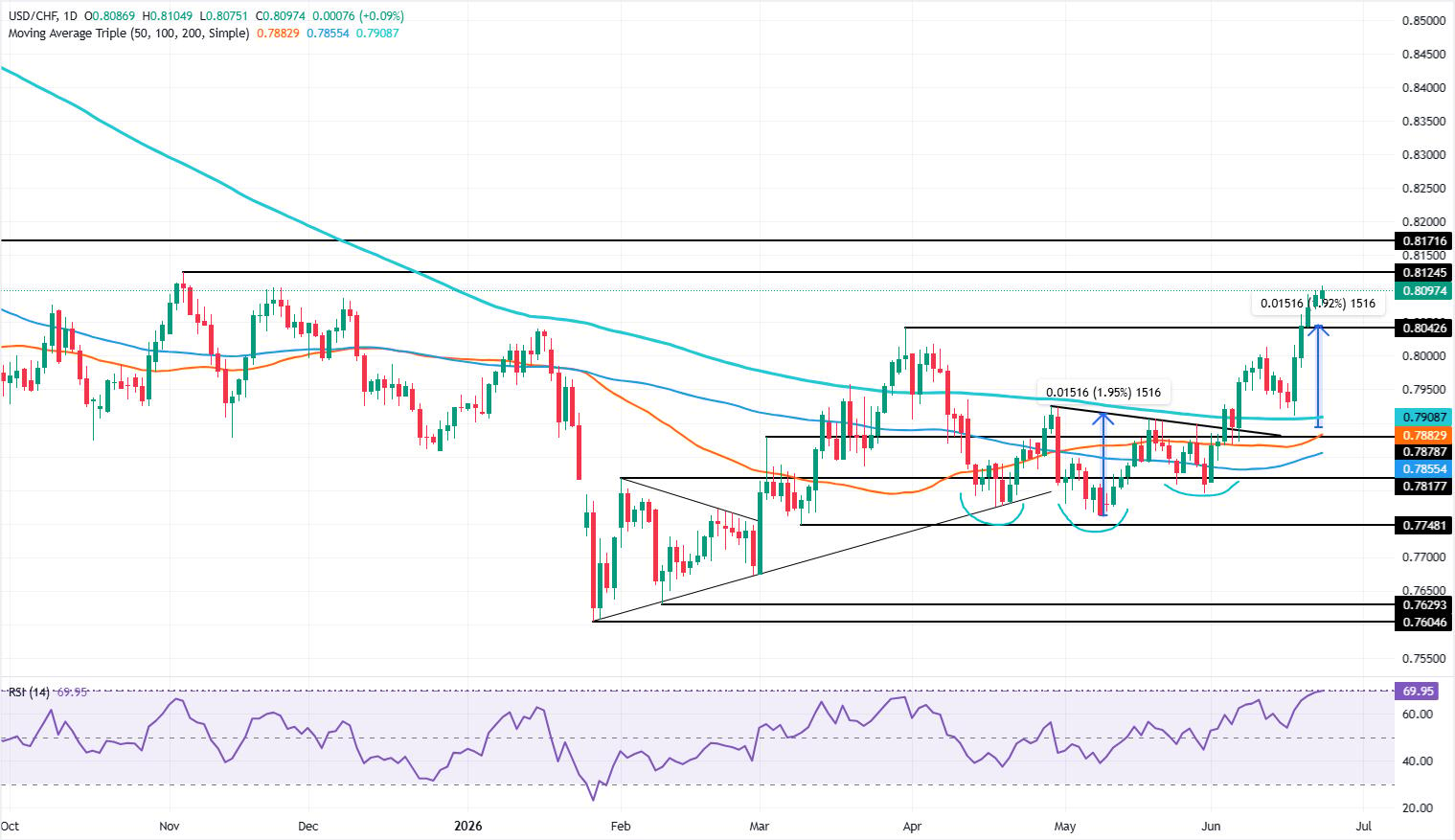
The USD/CHF daily chart shows the pair maintains an upward bias after hitting the 0.8042 target from the head-and-shoulders pattern. It is approaching the 0.8100 level, closing around 0.8090. A break above this will open the way to the 0.8100 milestone, followed by the August 1, 2025, high at 0.8172, and eventually the 0.8200 level.
EUR/CHF Technical Analysis
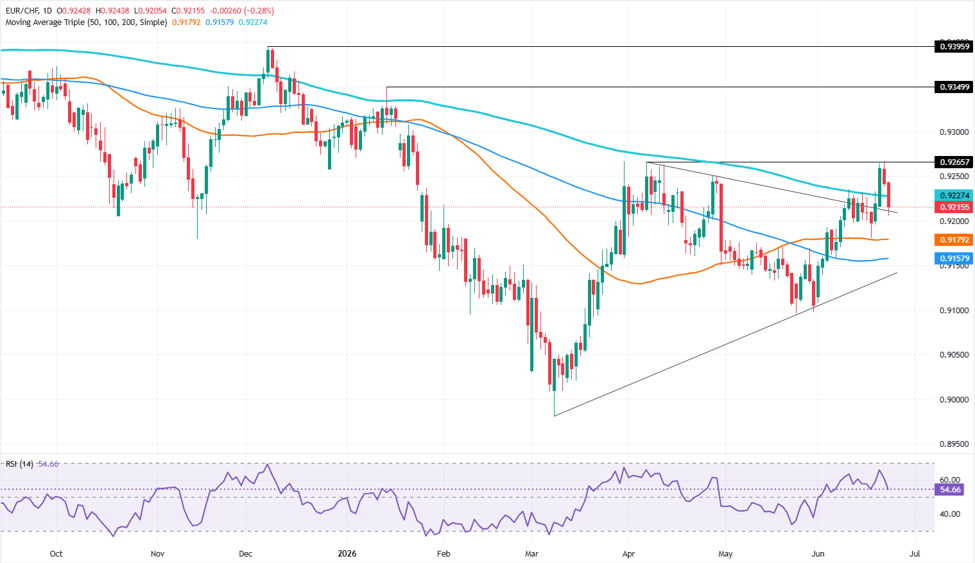
The EUR/CHF pair recoiled on Tuesday, diving below the 200-day SMA at 0.9227, opening the door to a retest of 0.9200. Worth noting that momentum remains bullish, but buyers need to clear the latest cycle high seen at 0.9266, the June 22 high, so that they can challenge the 0.9300 mark.
On the downside, if the EUR/CHF dives below 0.9200, look for further losses, with the next area of interest seen at 0.9180, the June 17 daily low.
Swiss Franc FAQs
The Swiss Franc (CHF) is Switzerland’s official currency. It is among the top ten most traded currencies globally, reaching volumes that well exceed the size of the Swiss economy. Its value is determined by the broad market sentiment, the country’s economic health or action taken by the Swiss National Bank (SNB), among other factors. Between 2011 and 2015, the Swiss Franc was pegged to the Euro (EUR). The peg was abruptly removed, resulting in a more than 20% increase in the Franc’s value, causing a turmoil in markets. Even though the peg isn’t in force anymore, CHF fortunes tend to be highly correlated with the Euro ones due to the high dependency of the Swiss economy on the neighboring Eurozone.
The Swiss Franc (CHF) is considered a safe-haven asset, or a currency that investors tend to buy in times of market stress. This is due to the perceived status of Switzerland in the world: a stable economy, a strong export sector, big central bank reserves or a longstanding political stance towards neutrality in global conflicts make the country’s currency a good choice for investors fleeing from risks. Turbulent times are likely to strengthen CHF value against other currencies that are seen as more risky to invest in.
The Swiss National Bank (SNB) meets four times a year – once every quarter, less than other major central banks – to decide on monetary policy. The bank aims for an annual inflation rate of less than 2%. When inflation is above target or forecasted to be above target in the foreseeable future, the bank will attempt to tame price growth by raising its policy rate. Higher interest rates are generally positive for the Swiss Franc (CHF) as they lead to higher yields, making the country a more attractive place for investors. On the contrary, lower interest rates tend to weaken CHF.
Macroeconomic data releases in Switzerland are key to assessing the state of the economy and can impact the Swiss Franc’s (CHF) valuation. The Swiss economy is broadly stable, but any sudden change in economic growth, inflation, current account or the central bank’s currency reserves have the potential to trigger moves in CHF. Generally, high economic growth, low unemployment and high confidence are good for CHF. Conversely, if economic data points to weakening momentum, CHF is likely to depreciate.
As a small and open economy, Switzerland is heavily dependent on the health of the neighboring Eurozone economies. The broader European Union is Switzerland’s main economic partner and a key political ally, so macroeconomic and monetary policy stability in the Eurozone is essential for Switzerland and, thus, for the Swiss Franc (CHF). With such dependency, some models suggest that the correlation between the fortunes of the Euro (EUR) and the CHF is more than 90%, or close to perfect.
Nothing in this material constitutes investment advice, personal recommendation, investment research, an offer, or a solicitation to buy or sell any financial instrument. The content has been prepared without consideration of your individual investment objectives, financial situation, or needs, and should not be treated as such.
Past performance is not a reliable indicator of future performance and/or results. Forward-looking scenarios or forecasts are not a guarantee of future performance. Actual results may differ materially from those anticipated.
Mitrade makes no representation or warranty as to the accuracy or completeness of the information provided and accepts no liability for any loss arising from reliance on such information.
Recommended Articles


