



Anthropic Launches Claude Tag, Boosting Enterprise AI Collaboration
TradingKey - Anthropic on Tuesday officially launched its new artificial intelligence agent product, Claude Tag, in Salesforce-owned workplace communication app Slack, deepening its expansion into the enterprise market, which has now become a key battleground for AI companies.
Anthropic previously offered Claude services in Slack, but with relatively limited functionality.
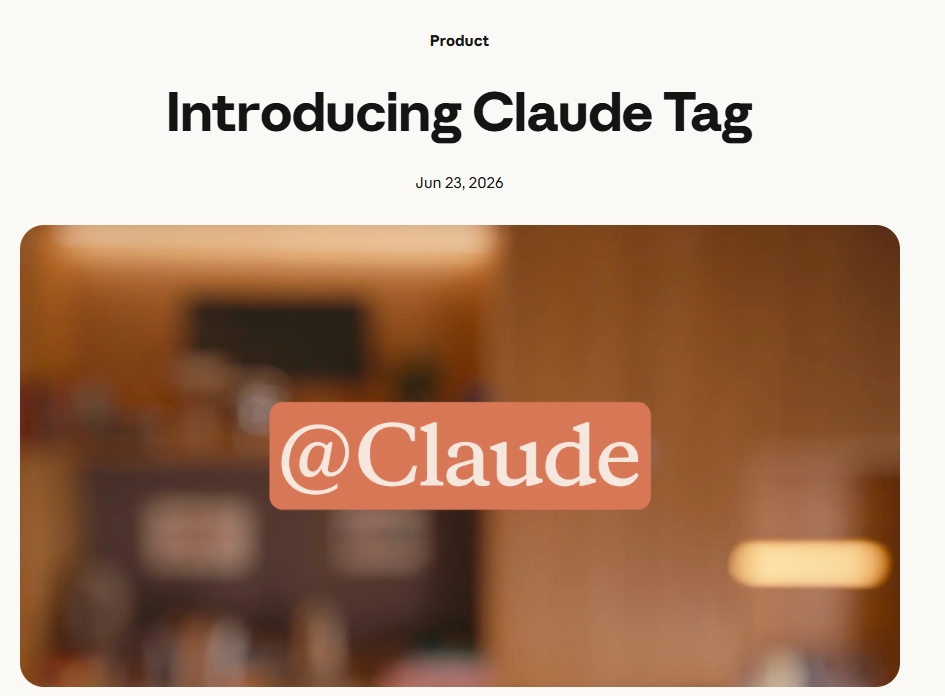
[Source: Anthropic]
Compared to previous product iterations, Claude Tag features several new capabilities. The first is multi-user collaboration: within designated Slack channels, a single Claude agent can interact with all members, allowing everyone to view its progress and pick up conversations where others left off. This differs from one-on-one or single-task modes, offering an experience closer to collaborating with human team members.
The second is continuous context accumulation; Claude retains contextual information over time, gathering more work-related background as it follows channel activity, so users do not need to repeatedly explain their requirements from scratch.
If granted permission, it can also automatically learn from other Slack channels and data sources—excluding private channels—to acquire the knowledge needed to deliver high-quality work.
Once users assign a task to Claude, they can focus on other priorities while it completes the work autonomously. It can also schedule tasks on its own, driving projects forward over hours or days. Anthropic has widely adopted this model internally, assigning tasks to multiple Claude agents in parallel, which has significantly boosted productivity.
Currently, about 65% of the code for Anthropic's product team is generated by an internal version of Claude Tag.
Reportedly, less than two weeks before the launch of Claude Tag, Anthropic suspended access to its most advanced AI models, Fable 5 and Mythos 5, due to a Trump administration ban aimed at preventing foreign nationals from obtaining the technology.
Cat Wu, product lead for Claude Code, stated that Anthropic originally planned to use both Fable 5 and Opus 4.8, released this May, as the underlying models supporting Claude Tag.
She described Fable as the optimal model for the product, outperforming Opus 4.8 in coding, executing tasks with minimal user assistance, and determining when to step into conversations.
Nothing in this material constitutes investment advice, personal recommendation, investment research, an offer, or a solicitation to buy or sell any financial instrument. The content has been prepared without consideration of your individual investment objectives, financial situation, or needs, and should not be treated as such.
Past performance is not a reliable indicator of future performance and/or results. Forward-looking scenarios or forecasts are not a guarantee of future performance. Actual results may differ materially from those anticipated.
Mitrade makes no representation or warranty as to the accuracy or completeness of the information provided and accepts no liability for any loss arising from reliance on such information.
Recommended Articles


