



Mexican Peso tumbles as Iran war jitters, denting Peso’s appetite
- US-Iran tensions lift safe-haven demand for the Greenback.
- Chip-stock selloff and Oil risks weigh on market sentiment.
- Mexico inflation, jobs and Retail Sales drive next catalyst.
The Mexican Peso loses traction against the Greenback, dropping over 0.65% during Friday’s North American session as the American currency benefits due to its safe-haven appeal as the US-Iran conflict is far from ending, despite holding talks to finish the war. The USD/MXN trades at 17.53, after bouncing off a daily low of 17.41.
USD/MXN rises as Oil risks revive Dollar and Fed support
Market sentiment deteriorated amid a sell-off on chip stocks. The rise in Oil prices fueled speculation that the Federal Reserve could hike rates and narrow the interest rate differential, which favoured the Mexican Peso, as it began its appreciation cycle early in 2025.
Benign US inflation data was cheered by investors, which trimmed the odds of a Fed rate hike at the September meeting. However, the US and Iran are poised to continue fighting for the Strait of Hormuz, which could trigger another leg-up in Oil prices.
On Friday, the University of Michigan (UoM) revealed that US consumers are slightly more optimistic about current economic conditions and the outlook. The Consumer Sentiment Index in July increased from 50.7 to 54, while short- and medium-term inflation expectations eased.
The US Dollar Index (DXY), which measures the American currency's performance against a basket of six peers, rises modestly by 0.05% to 100.76, a tailwind for the USD/MXN exotic pair.
Meanwhile, Fed officials crossed the wires. Cleveland Fed President Beth Hammack was hawkish, expressing concern about persistent high inflation, which is at the top of her list, and saying, “Inflation is too high.” Hammack added that the labor market is solid and that “growth numbers are good and consumer spending is stable.”
In Mexico, the economic docket was absent, but the next week will feature the release of Retail Sales, employment data, and inflation for the first fifteen days of July. In the US, the schedule will feature jobs data and S&P Global Flash PMIs, as Federal Reserve officials entered their blackout period ahead of the July 29 policy meeting.
USD/MXN Price Forecast: Technical outlook
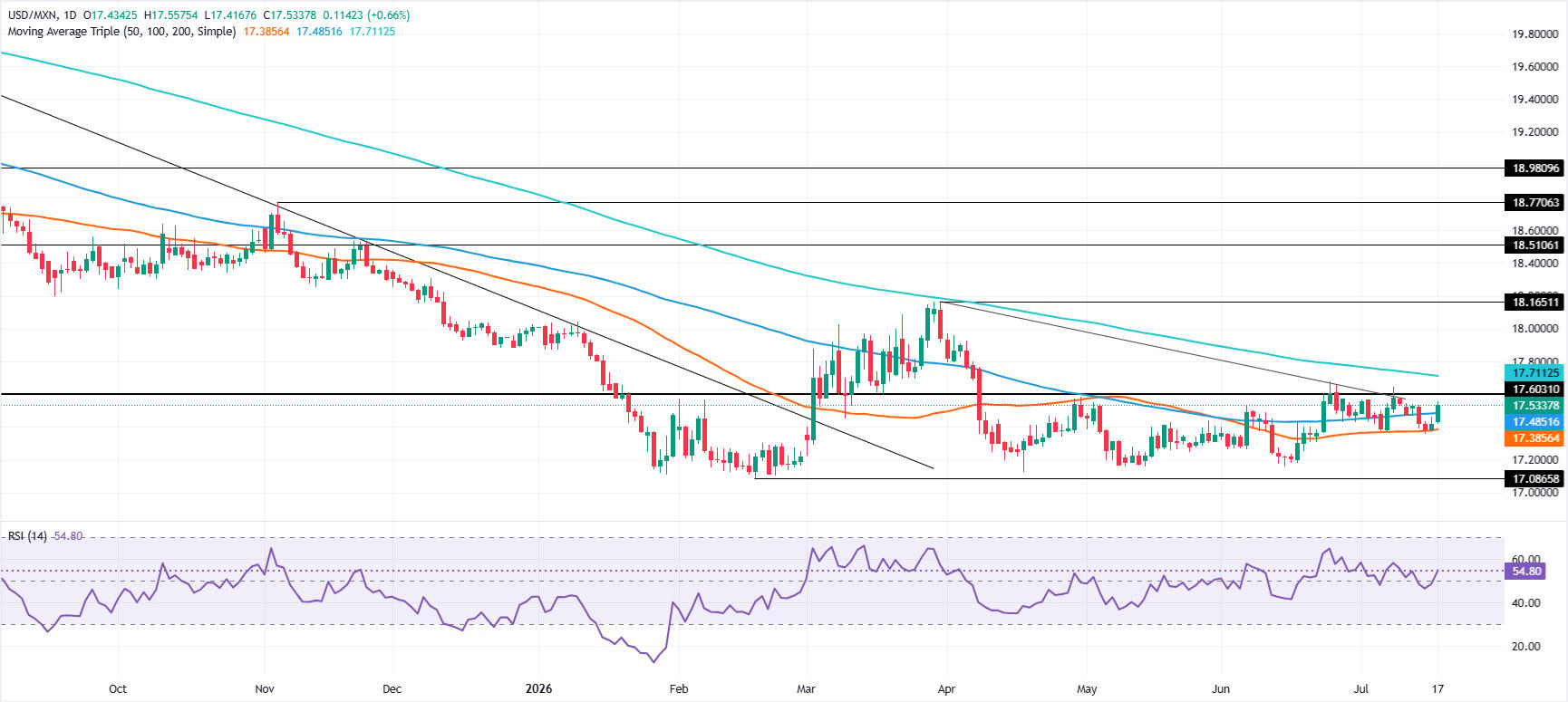
In the daily chart, USD/MXN trades at 17.5333, holding above the clustered 50/100/200-day simple moving averages (SMA) around 17.3856, which suggests a constructive near-term bias as the pair remains supported by its broader trend floor. Price is now testing the latest downward-sloping resistance trend line coming from the 18.1651 high, with that barrier emerging at 17.5456, while the Relative Strength Index (14) near 54.8 hints at mildly positive momentum without yet reaching overbought territory.
On the topside, immediate resistance is located at the near-term descending trend line at 17.5456, followed by a higher structural cap at the longer-term downward resistance drawn from 21.0808, currently coming in near 18.1200. On the downside, initial support is provided by the triple SMA cluster at 17.3856, and a sustained hold above this moving-average base would keep the bullish bias intact, whereas a daily close back below it would signal fading upside pressure and expose a deeper corrective phase.
(The technical analysis of this story was written with the help of an AI tool. Know more.)
Mexican Peso FAQs
The Mexican Peso (MXN) is the most traded currency among its Latin American peers. Its value is broadly determined by the performance of the Mexican economy, the country’s central bank’s policy, the amount of foreign investment in the country and even the levels of remittances sent by Mexicans who live abroad, particularly in the United States. Geopolitical trends can also move MXN: for example, the process of nearshoring – or the decision by some firms to relocate manufacturing capacity and supply chains closer to their home countries – is also seen as a catalyst for the Mexican currency as the country is considered a key manufacturing hub in the American continent. Another catalyst for MXN is Oil prices as Mexico is a key exporter of the commodity.
The main objective of Mexico’s central bank, also known as Banxico, is to maintain inflation at low and stable levels (at or close to its target of 3%, the midpoint in a tolerance band of between 2% and 4%). To this end, the bank sets an appropriate level of interest rates. When inflation is too high, Banxico will attempt to tame it by raising interest rates, making it more expensive for households and businesses to borrow money, thus cooling demand and the overall economy. Higher interest rates are generally positive for the Mexican Peso (MXN) as they lead to higher yields, making the country a more attractive place for investors. On the contrary, lower interest rates tend to weaken MXN.
Macroeconomic data releases are key to assess the state of the economy and can have an impact on the Mexican Peso (MXN) valuation. A strong Mexican economy, based on high economic growth, low unemployment and high confidence is good for MXN. Not only does it attract more foreign investment but it may encourage the Bank of Mexico (Banxico) to increase interest rates, particularly if this strength comes together with elevated inflation. However, if economic data is weak, MXN is likely to depreciate.
As an emerging-market currency, the Mexican Peso (MXN) tends to strive during risk-on periods, or when investors perceive that broader market risks are low and thus are eager to engage with investments that carry a higher risk. Conversely, MXN tends to weaken at times of market turbulence or economic uncertainty as investors tend to sell higher-risk assets and flee to the more-stable safe havens.
Nothing in this material constitutes investment advice, personal recommendation, investment research, an offer, or a solicitation to buy or sell any financial instrument. The content has been prepared without consideration of your individual investment objectives, financial situation, or needs, and should not be treated as such.
Past performance is not a reliable indicator of future performance and/or results. Forward-looking scenarios or forecasts are not a guarantee of future performance. Actual results may differ materially from those anticipated.
Mitrade makes no representation or warranty as to the accuracy or completeness of the information provided and accepts no liability for any loss arising from reliance on such information.
Recommended Articles


