



EUR/USD Price Forecast: Fading bullish momentum puts focus on 1.1500 support
- EUR/USD gives up earlier gains as the US Dollar recovers from its post-CPI decline.
- Repeated failures at the 100-day SMA keep the pair confined within its recent range.
- The 1.1500 mark offers immediate support, followed by the 50-day SMA at 1.1466.
EUR/USD edges lower on Wednesday, reversing earlier gains as the US Dollar (USD) shrugs off in-line US Consumer Price Index (CPI) data. At the time of writing, the pair trades around 1.1521 after touching an intraday high of 1.1563.
The US Dollar weakened immediately after the inflation report as headline and core CPI eased to 3.4% and 2.5%, respectively, prompting traders to scale back Federal Reserve (Fed) rate-hike bets.
However, the Greenback later pared its losses as elevated energy prices keep inflation risks tilted to the upside. Limited prospects for peace in the Middle East and the reopening of the Strait of Hormuz also support safe-haven demand for the US Dollar.
The US Dollar Index (DXY), which tracks the Greenback against a basket of six major currencies, trades close to the 100 psychological mark after rebounding from an intraday low of 99.61.
The US Dollar’s recovery drags EUR/USD toward the lower end of its recent range following repeated rejections at the 100-day Simple Moving Average (SMA).
Technical analysis
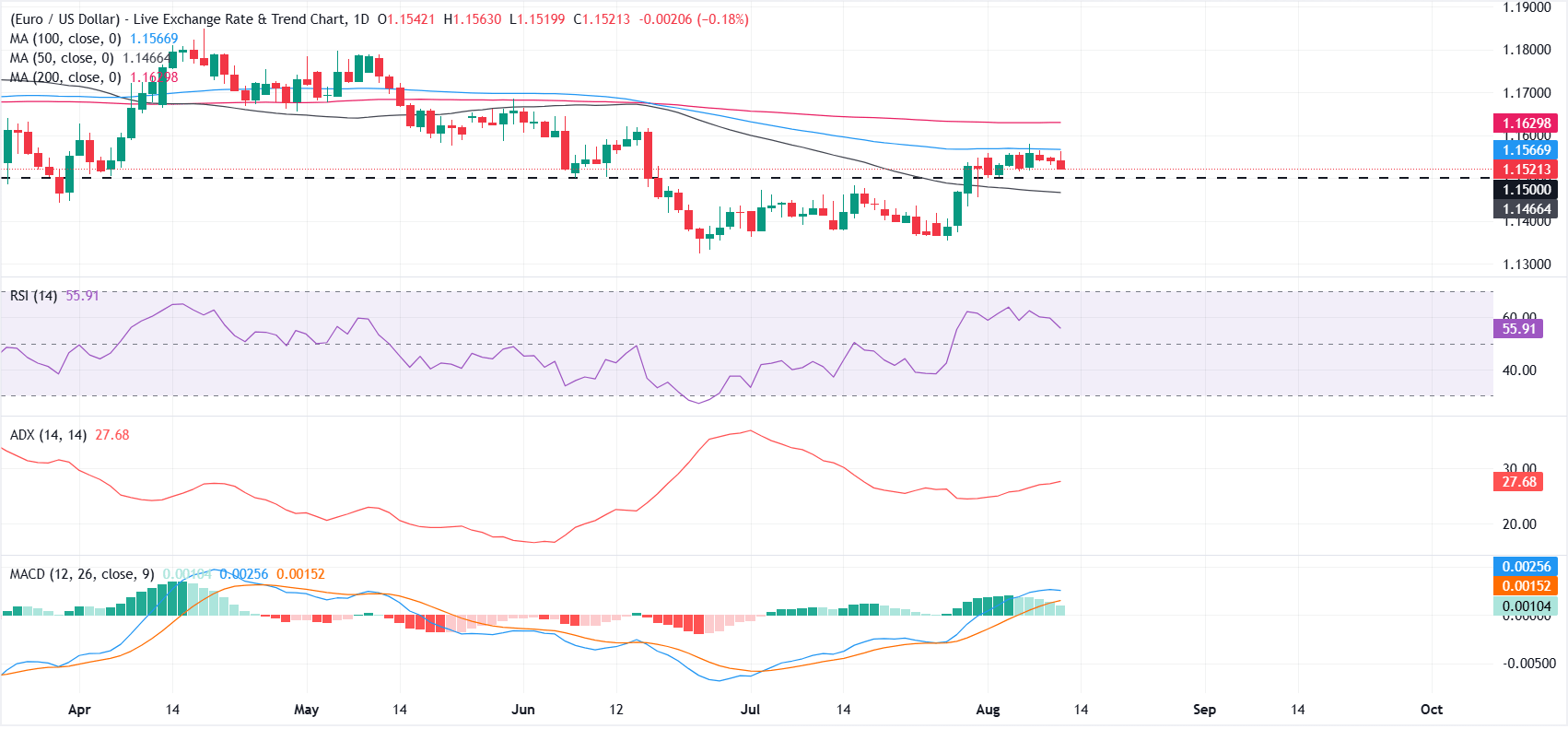
On the daily chart, EUR/USD retains a neutral-to-slightly bullish bias. The pair holds above the 1.1500 psychological mark and the 50-day Simple Moving Average (SMA) at 1.1466.
The Relative Strength Index (RSI) stands near 56, while the Moving Average Convergence Divergence (MACD) remains in positive territory, although the fading green histogram points to weakening bullish momentum. The Average Directional Index (ADX) in the high 20s suggests moderate trend strength.
On the upside, the 100-day SMA at 1.1567 offers immediate resistance. A decisive break above this level would bring the 200-day SMA near 1.1630 into focus.
On the downside, immediate support is seen at the horizontal level of 1.1500, followed by the 50-day SMA at 1.1466, a break of which would weaken the nascent positive tone and expose the pair to a deeper pullback.
(The technical analysis of this story was written with the help of an AI tool. Know more.)
US Dollar FAQs
The US Dollar (USD) is the official currency of the United States of America, and the ‘de facto’ currency of a significant number of other countries where it is found in circulation alongside local notes. It is the most heavily traded currency in the world, accounting for over 88% of all global foreign exchange turnover, or an average of $6.6 trillion in transactions per day, according to data from 2022. Following the second world war, the USD took over from the British Pound as the world’s reserve currency. For most of its history, the US Dollar was backed by Gold, until the Bretton Woods Agreement in 1971 when the Gold Standard went away.
The most important single factor impacting on the value of the US Dollar is monetary policy, which is shaped by the Federal Reserve (Fed). The Fed has two mandates: to achieve price stability (control inflation) and foster full employment. Its primary tool to achieve these two goals is by adjusting interest rates. When prices are rising too quickly and inflation is above the Fed’s 2% target, the Fed will raise rates, which helps the USD value. When inflation falls below 2% or the Unemployment Rate is too high, the Fed may lower interest rates, which weighs on the Greenback.
In extreme situations, the Federal Reserve can also print more Dollars and enact quantitative easing (QE). QE is the process by which the Fed substantially increases the flow of credit in a stuck financial system. It is a non-standard policy measure used when credit has dried up because banks will not lend to each other (out of the fear of counterparty default). It is a last resort when simply lowering interest rates is unlikely to achieve the necessary result. It was the Fed’s weapon of choice to combat the credit crunch that occurred during the Great Financial Crisis in 2008. It involves the Fed printing more Dollars and using them to buy US government bonds predominantly from financial institutions. QE usually leads to a weaker US Dollar.
Quantitative tightening (QT) is the reverse process whereby the Federal Reserve stops buying bonds from financial institutions and does not reinvest the principal from the bonds it holds maturing in new purchases. It is usually positive for the US Dollar.
Nothing in this material constitutes investment advice, personal recommendation, investment research, an offer, or a solicitation to buy or sell any financial instrument. The content has been prepared without consideration of your individual investment objectives, financial situation, or needs, and should not be treated as such.
Past performance is not a reliable indicator of future performance and/or results. Forward-looking scenarios or forecasts are not a guarantee of future performance. Actual results may differ materially from those anticipated.
Mitrade makes no representation or warranty as to the accuracy or completeness of the information provided and accepts no liability for any loss arising from reliance on such information.
Recommended Articles


