



Nebius Soars 34%, CoreWeave Jumps 19% Amid Strong AI Cloud Demand
TradingKey - As demand for AI computing power continues to heat up, two next-generation AI cloud service providers delivered better-than-expected performance, reigniting market confidence in AI infrastructure demand. During U.S. stock trading on August 12, Nebius (NBIS) shares surged 34% to close at $247.05, after jumping over 40% intraday; CoreWeave (CRWV) rose 19% to close at $107.73.
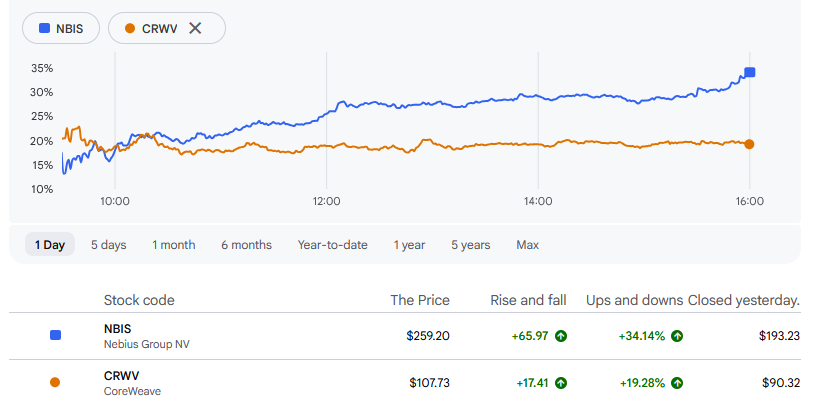
Source: Google Finance
Nebius reported particularly impressive second-quarter results. The company's revenue surged 454% year-over-year to $582.3 million, topping market expectations. Revenue from its AI cloud business reached approximately $575 million, up 514% year-over-year, accounting for almost all of the overall growth. Adjusted EBITDA reached $236 million, well above analysts' expectations of $169 million, with the margin expanding to 41% from 32% in the first quarter. However, on a GAAP basis, the company still posted a net loss from continuing operations of $190 million.
In addition, Nebius signed four major AI cloud contracts in the second quarter, with an average contract value exceeding $1 billion each. Its clients include Reflection, Cohere, and U.S. quantitative trading firms. The company stated that roughly 70% of the deals involved customer prepayments and expects full-year customer prepayments to exceed $9 billion this year. To date, cumulative customer commitments have exceeded $40 billion.
More notably, Nebius's pricing power for computing capacity is strengthening. The company recently conducted its first capacity auction, with transaction prices roughly 15% higher than the previous record-high quote for Blackwell GPUs.
Currently, the annual contract value for Nebius's long-term contracts is around $20 million to $25 million per megawatt, while prices for short-term capacity contracts have reached $40 million to $50 million per megawatt, with some deals priced even higher.
This price spread also gives the company greater operational flexibility. Nebius CEO Arkady Volozh stated that under current contract terms, the company could effectively sell out all of its planned capacity for 2027, but management chose to reserve a portion of supply to capture higher returns from short-term contracts amid booming demand.
Meanwhile, CoreWeave, which previously released its financial results, also signaled that demand for AI computing capacity remains robust. The company's second-quarter revenue reached $2.58 billion, slightly ahead of market expectations, while its loss per share of $1.14 was also better than analysts had anticipated. More importantly, CoreWeave's backlog has climbed to $104 billion, nearly doubling from last November, with new customer commitments not yet included in this quarter's financial report reaching another $25 billion.
However, the market remains distinctly divided over the long-term profitability of AI cloud companies.
Bulls argue that demand for AI computing capacity continues to significantly outstrip effective supply. Customers are willing to lock in capacity through prepayments, and short-term computing prices continue to rise, indicating that next-generation cloud providers are gaining stronger pricing power than the market previously anticipated.
Piper Sandler has raised its price target on CoreWeave to $153 and named it a top pick, while Citizens maintained its $180 target.
However, bearish concerns have not disappeared. CoreWeave needs to continuously invest massive capital into building data centers and purchasing GPUs, and its cost of capital is significantly higher than the implied return rate of certain infrastructure assets.
D.A. Davidson thus maintained its Neutral rating, warning that if capital investment continues to outpace revenue growth, the company could ultimately face declining returns on capital. Bernstein similarly believes that the capital expenditure pressure from CoreWeave's rapid expansion warrants close attention.
Nebius faces similar risks. The AI cloud market is attracting an increasing number of participants, and the entry of new players like xAI suggests competition could intensify further, leading the market to question whether current high computing prices and massive orders can be sustained over the long term.
Nothing in this material constitutes investment advice, personal recommendation, investment research, an offer, or a solicitation to buy or sell any financial instrument. The content has been prepared without consideration of your individual investment objectives, financial situation, or needs, and should not be treated as such.
Past performance is not a reliable indicator of future performance and/or results. Forward-looking scenarios or forecasts are not a guarantee of future performance. Actual results may differ materially from those anticipated.
Mitrade makes no representation or warranty as to the accuracy or completeness of the information provided and accepts no liability for any loss arising from reliance on such information.
Recommended Articles


