



UK GDP expected to show moderate Q2 growth
- The United Kingdom Q2 Gross Domestic Product is expected to show moderate quarterly growth.
- The GDP is forecast to expand in the three months to June, despite geopolitical noise.
- The GBP/USD pair is technically bullish and can reach 1.3600 on an upbeat GDP outcome.
The United Kingdom’s (UK) Office for National Statistics will release the preliminary estimate of the second-quarter Gross Domestic Product (GDP) on Thursday. Market analysts anticipate a 0.4% growth in the three months to June, after a modest 0.6% advance in the first quarter of 2026. Annual progress is expected at 1.1%, up from the 0.9% posted in March.
As usual, preliminary GDP estimates will have a large impact on the British Pound (GBP), though they are subject to revisions over the next couple of months. The GDP figures will be released alongside a myriad of other figures, including the Goods Trade Balance and Industrial and Manufacturing Production. Generally speaking, market participants anticipate tepid outcomes, as the ongoing war in the Middle East takes its toll.
UK Gross Domestic Product forecast: What numbers could tell us
The anticipated tepid UK economic progress is directly linked to a slowdown in consumer spending, driven by tighter credit conditions and weak real wage growth. Generally speaking, the figures are expected to weigh on the British Pound, though the impact may be mitigated if the outcome meets expectations.
Economic growth is not part of the Bank of England (BoE) mandate, but GDP developments are clearly correlated with monetary policy. The BoE left its key interest rate unchanged at 3.75%, in line with economists’ expectations when it met early in July. The Monetary Policy Committee (MPC), however, was divided, with three ouf ot nine members voting to lift the Bank Rate by 25 basis points. Policymakers agreed that inflation risks remain skewed to the upside, with pressure coming from higher energy prices, the latter of which is the result of the war in the Middle East.
Market players are betting on additional interest rate hikes in the near future, yet keeping the policy rate above the neutral range is unsustainable without economic progress. A poor GDP reading, then, should suggest no changes to interest rates and hence drag the GBP lower. The opposite scenario is also valid, with stronger-than-anticipated figures providing GBP with a near-term boost.
There is still one more sticky factor to consider in this equation: inflation. The Consumer Prices Index including owner occupiers' housing costs (CPIH) rose by 2.8% in the 12 months to June 2026, down from 3% the previous month. Indeed, inflation decreased globally in June, as market players were hopeful the United States (US) and Iran would be able to clinch a deal. The Memorandum of Understanding (MoU) that called for a truce between the two conflicting nations pushed Oil prices sharply down in the month, easing inflationary pressures worldwide.
Peace in the Middle East, however, is no longer an option. Tit-for-tat attacks continue, while talks have stalled. Oil prices are back up, although still far from their post-war peaks. Nevertheless, continued tensions around the Strait of Hormuz mean inflationary pressures will likely rise from July on.
When will the UK release Q2 GDP, and how could it affect GBP/USD?
As previously noted, the UK will release the preliminary estimate of Q2 GDP on Thursday at 06:00 GMT. Data is expected to show moderated growth in the three months to June, and a reading within expectations is unlikely to have a relevant impact on GBP/USD.
Ahead of the announcement, the pair trades above the 1.3500 mark, at its highest in roughly a month, as the US Dollar (USD) can’t recover from the poor employment shock in the July Nonfarm Payrolls (NFP) report. The figures weighed on the Federal Reserve (Fed) rate-hike odds, while CPI data on Wednesday showed inflation rose at an annual rate of 3.4% in July, as expected.
Valeria Bednarik, Chief Analyst at FXStreet, notes: “The GBP/USD pair is technically bullish approaching the July monthly high at 1.3558. The Q2 GDP report may introduce some noise, but as long as the pair remains above the 1.3480 price zone, the bullish case will remain in place. A better-than-anticipated outcome is likely to push the pair closer to the 1.3600 mark, although sustained gains around the level would depend on market sentiment and the consequent USD strength or weakness.”
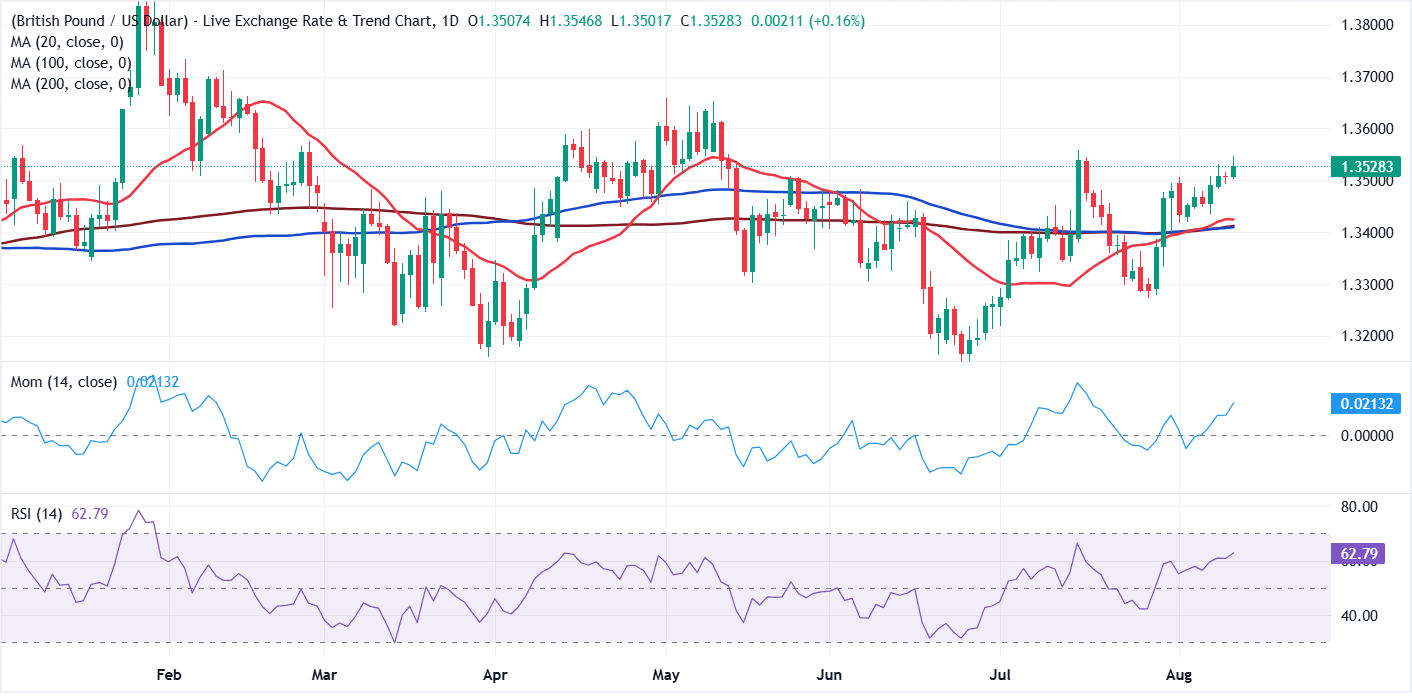
Bednarik adds: “A dismal outcome could push the pair lower, initially towards 1.3480 and later closer to the 1.3400 mark. Once the dust settles, however, speculative interest will return to the usual war-related trading.”
Economic Indicator
Gross Domestic Product (QoQ)
The Gross Domestic Product (GDP), released by the Office for National Statistics on a monthly and quarterly basis, is a measure of the total value of all goods and services produced in the UK during a given period. The GDP is considered as the main measure of UK economic activity. The QoQ reading compares economic activity in the reference quarter to the previous quarter. Generally, a rise in this indicator is bullish for the Pound Sterling (GBP), while a low reading is seen as bearish.
Read more.Next release: Thu Aug 13, 2026 06:00 (Prel)
Frequency: Quarterly
Consensus: 0.4%
Previous: 0.6%
Source: Office for National Statistics
BoE FAQs
The Bank of England (BoE) decides monetary policy for the United Kingdom. Its primary goal is to achieve ‘price stability’, or a steady inflation rate of 2%. Its tool for achieving this is via the adjustment of base lending rates. The BoE sets the rate at which it lends to commercial banks and banks lend to each other, determining the level of interest rates in the economy overall. This also impacts the value of the Pound Sterling (GBP).
When inflation is above the Bank of England’s target it responds by raising interest rates, making it more expensive for people and businesses to access credit. This is positive for the Pound Sterling because higher interest rates make the UK a more attractive place for global investors to park their money. When inflation falls below target, it is a sign economic growth is slowing, and the BoE will consider lowering interest rates to cheapen credit in the hope businesses will borrow to invest in growth-generating projects – a negative for the Pound Sterling.
In extreme situations, the Bank of England can enact a policy called Quantitative Easing (QE). QE is the process by which the BoE substantially increases the flow of credit in a stuck financial system. QE is a last resort policy when lowering interest rates will not achieve the necessary result. The process of QE involves the BoE printing money to buy assets – usually government or AAA-rated corporate bonds – from banks and other financial institutions. QE usually results in a weaker Pound Sterling.
Quantitative tightening (QT) is the reverse of QE, enacted when the economy is strengthening and inflation starts rising. Whilst in QE the Bank of England (BoE) purchases government and corporate bonds from financial institutions to encourage them to lend; in QT, the BoE stops buying more bonds, and stops reinvesting the principal maturing on the bonds it already holds. It is usually positive for the Pound Sterling.
Nothing in this material constitutes investment advice, personal recommendation, investment research, an offer, or a solicitation to buy or sell any financial instrument. The content has been prepared without consideration of your individual investment objectives, financial situation, or needs, and should not be treated as such.
Past performance is not a reliable indicator of future performance and/or results. Forward-looking scenarios or forecasts are not a guarantee of future performance. Actual results may differ materially from those anticipated.
Mitrade makes no representation or warranty as to the accuracy or completeness of the information provided and accepts no liability for any loss arising from reliance on such information.
Recommended Articles


