



Indian Rupee hits fresh two-month high against US Dollar
- The Indian Rupee appreciates significantly against the US Dollar, with USD/INR sliding to near 94.88.
- RBI’s persistent intervention, India’s strong Q2 GDP data and lower fiscal deficit have supported the INR.
- Investors keenly await the US ISM Manufacturing PMI and JOLTS Job Openings data.
The Indian Rupee (INR) gains sharply at open against the US Dollar on Tuesday. The USD/INR pair slumps to near 94.88, the lowest level seen in two months, on likely Reserve Bank of India (RBI) intervention, stronger-than-expected Q2 Gross Domestic Product (GDP) data and a narrowed Fiscal Deficit.
According to a Reuters report, there has been persistent RBI intervention through spot and Non-Deliverable Forwards (NDFs) markets to support the Indian currency.
However, there is doubt that the INR’s strength is sustainable, as consistent RBI intervention leaves limited room for further US Dollar selling by the Indian central bank.
According to data from the RBI, the total net short forward positions now stand at a record high of $137 billion in July, up from $104 billion in June. Given that the RBI will eventually have to buy US Dollars to offset its outstanding position, this reflects that the INR’s appreciation is probationary.
India’s Q2 GDP growth remains strong, fiscal deficit narrows
The data on Monday showed that India’s Q2 GDP growth was in line with the prior growth rate of 7.8% Year-on-Year (YoY), stronger than estimates of 7.1%. Analysts at HDFC Bank said that stronger growth was led by upbeat domestic consumption, continued support from government spending, investments and healthy export performance.
Analysts added that input cost pressures due to the West Asia conflict were offset by higher volume growth with sectors like manufacturing and electricity, gas growing by close to 9%. The stand-out sector remained services, with financial, real estate and professional services growing by a high of 12% in the quarter.
Meanwhile, India's Q2 fiscal deficit stood at Rs. 4.55 trillion ($47.81 billion), or 26.8% of the target for the financial year 2026-27 due to a significant jump in net tax receipts. Government revenue from taxes stood at Rs. 8.5 trillion, compared with Rs. 6.6 trillion a year ago.
US data in focus
In the United States (US), investors await the ISM Manufacturing PMI data for August and the JOLTS Job Openings data for July, which will be published at 14:00 GMT.
The Manufacturing PMI is expected to arrive at 55.2, lower than 55.6 in July. Meanwhile, fresh jobs posted by US employers are seen marginally lower at 7.3 million from 7.359 million in June. The Job Openings data is expected to have a meaningful influence on Federal Reserve (Fed) interest rate expectations.
This week, the major trigger for the US Dollar will be the Nonfarm Payrolls (NFP) data for August, which will be released on Friday.
USD/INR Technical Analysis
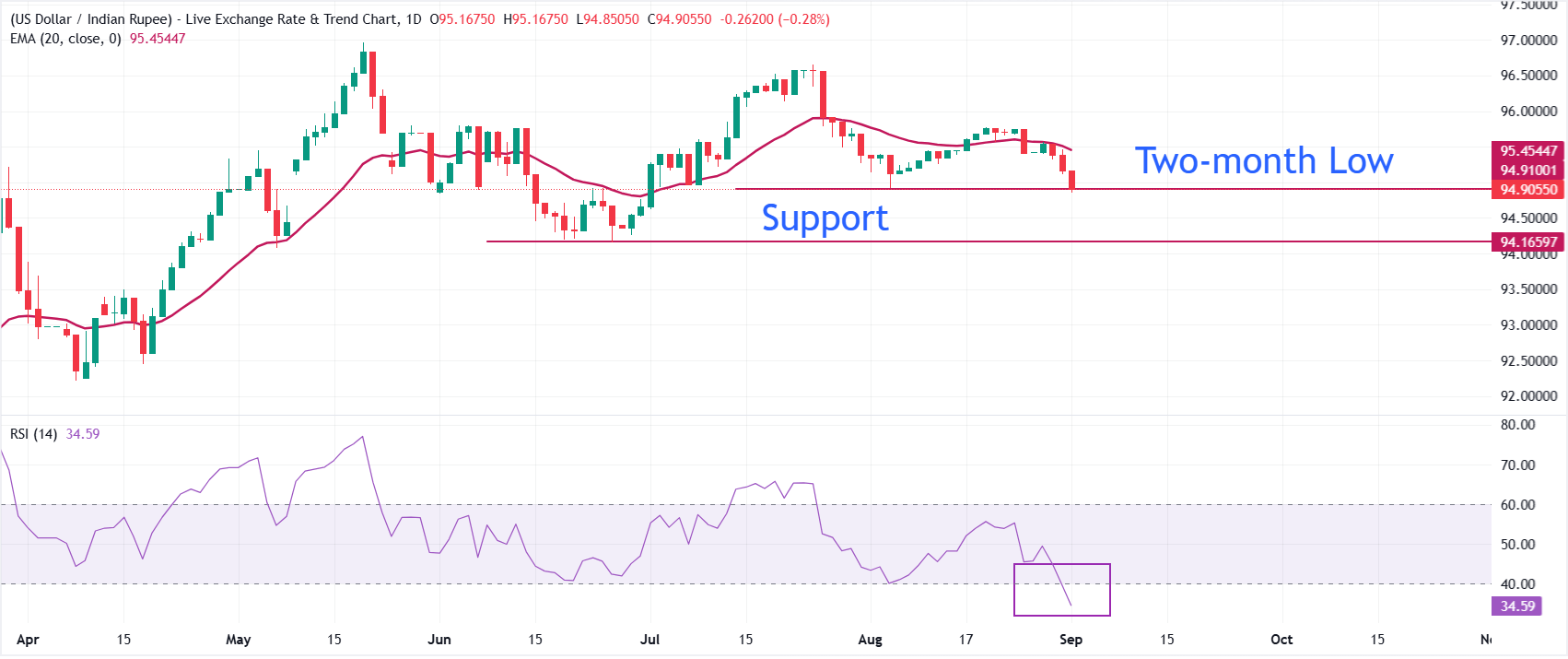
In the daily chart, USD/INR trades at 94.88, keeping a bearish near-term tone as spot holds below the 20-period exponential moving average (EMA) at 95.4545.
The Relative Strength Index (14) slips below 40.00 for the first time in almost a year, signaling the onset of a bearish reversal.
On the topside, initial resistance is located at the 20-period EMA around 95.45, which is the first level bulls would need to reclaim to ease immediate downside pressure and open the way for a corrective bounce. Looking down, the pair could extend the decline to 94.50, followed by the June low at 94.19 if it fails to hold the fresh two-month low at 94.88.
(The technical analysis of this story was written with the help of an AI tool. Know more.)
Indian Rupee FAQs
The Indian Rupee (INR) is one of the most sensitive currencies to external factors. The price of Crude Oil (the country is highly dependent on imported Oil), the value of the US Dollar – most trade is conducted in USD – and the level of foreign investment, are all influential. Direct intervention by the Reserve Bank of India (RBI) in FX markets to keep the exchange rate stable, as well as the level of interest rates set by the RBI, are further major influencing factors on the Rupee.
The Reserve Bank of India (RBI) actively intervenes in forex markets to maintain a stable exchange rate, to help facilitate trade. In addition, the RBI tries to maintain the inflation rate at its 4% target by adjusting interest rates. Higher interest rates usually strengthen the Rupee. This is due to the role of the ‘carry trade’ in which investors borrow in countries with lower interest rates so as to place their money in countries’ offering relatively higher interest rates and profit from the difference.
Macroeconomic factors that influence the value of the Rupee include inflation, interest rates, the economic growth rate (GDP), the balance of trade, and inflows from foreign investment. A higher growth rate can lead to more overseas investment, pushing up demand for the Rupee. A less negative balance of trade will eventually lead to a stronger Rupee. Higher interest rates, especially real rates (interest rates less inflation) are also positive for the Rupee. A risk-on environment can lead to greater inflows of Foreign Direct and Indirect Investment (FDI and FII), which also benefit the Rupee.
Higher inflation, particularly, if it is comparatively higher than India’s peers, is generally negative for the currency as it reflects devaluation through oversupply. Inflation also increases the cost of exports, leading to more Rupees being sold to purchase foreign imports, which is Rupee-negative. At the same time, higher inflation usually leads to the Reserve Bank of India (RBI) raising interest rates and this can be positive for the Rupee, due to increased demand from international investors. The opposite effect is true of lower inflation.
Nothing in this material constitutes investment advice, personal recommendation, investment research, an offer, or a solicitation to buy or sell any financial instrument. The content has been prepared without consideration of your individual investment objectives, financial situation, or needs, and should not be treated as such.
Past performance is not a reliable indicator of future performance and/or results. Forward-looking scenarios or forecasts are not a guarantee of future performance. Actual results may differ materially from those anticipated.
Mitrade makes no representation or warranty as to the accuracy or completeness of the information provided and accepts no liability for any loss arising from reliance on such information.
Recommended Articles


