



AUD/USD Price Forecast: Recovers further as RBA reiterates commitment to bring inflation down
- AUD/USD rises to near 0.7122 after RBA’s hawkish remarks.
- RBA’s Bullock warns that some upside risks to inflation appear to be materializing.
- The US Dollar remains firm as the Fed is expected to deliver more interest rate hikes this year.
The Australian Dollar (AUD) outperforms its currency peers on Friday, trading 0.18% higher at around 0.7122 against the US Dollar (USD) during the European trading session. The antipodean strengthens as Reserve Bank of Australia (RBA) Governor Michele Bullock warns of upside inflation risks.
Australian Dollar Price Today
The table below shows the percentage change of Australian Dollar (AUD) against listed major currencies today. Australian Dollar was the strongest against the Japanese Yen.
| USD | EUR | GBP | JPY | CAD | AUD | NZD | CHF | |
|---|---|---|---|---|---|---|---|---|
| USD | -0.03% | -0.02% | 0.80% | -0.01% | -0.18% | 0.08% | -0.04% | |
| EUR | 0.03% | 0.00% | 0.83% | 0.00% | -0.18% | 0.13% | -0.01% | |
| GBP | 0.02% | -0.00% | 0.84% | 0.04% | -0.17% | 0.15% | -0.01% | |
| JPY | -0.80% | -0.83% | -0.84% | -0.78% | -0.99% | -0.70% | -0.84% | |
| CAD | 0.00% | -0.00% | -0.04% | 0.78% | -0.20% | 0.10% | -0.05% | |
| AUD | 0.18% | 0.18% | 0.17% | 0.99% | 0.20% | 0.30% | 0.16% | |
| NZD | -0.08% | -0.13% | -0.15% | 0.70% | -0.10% | -0.30% | -0.14% | |
| CHF | 0.04% | 0.01% | 0.00% | 0.84% | 0.05% | -0.16% | 0.14% |
The heat map shows percentage changes of major currencies against each other. The base currency is picked from the left column, while the quote currency is picked from the top row. For example, if you pick the Australian Dollar from the left column and move along the horizontal line to the US Dollar, the percentage change displayed in the box will represent AUD (base)/USD (quote).
Earlier in the day, RBA’s Bullock in a testimony before the Parliamentary Committee that inflation remains “too high” and recent developments suggest that “some upside risks to inflation appear to be materializing” due to Middle East risks, The Wall Street Journal (WSJ) reported.
Separately comments from RBA Deputy Governor Andrew Hauser indicated that the RBA could hike interest rates further to tame inflation. “Key question is whether monetary tightening to date will be enough to return inflation to target in reasonable time,” Hauser said.
Meanwhile, the US Dollar is also trading firmly as traders have priced in at least one more interest rate hike by the Federal Reserve (Fed) this year.
Strategists at OCBC note that the USD “extended its rebound” after the Fed raised rates 25bp and delivered “a sizeable upward shift in the dots.” They point out that the US Dollar Index initially “traded around 100 following the decision but pushed towards 100.3 during Warsh’s press conference as front-end UST yields moved higher.”
According to OCBC, Warsh kept the focus firmly on inflation, saying recent data had shown “little improvement in underlying trends.” He also highlighted that “the economy had strengthened and the labour market was around full employment,” while characterising the rate increase as “removing a dose of accommodation.”
AUD/USD Technical Analysis
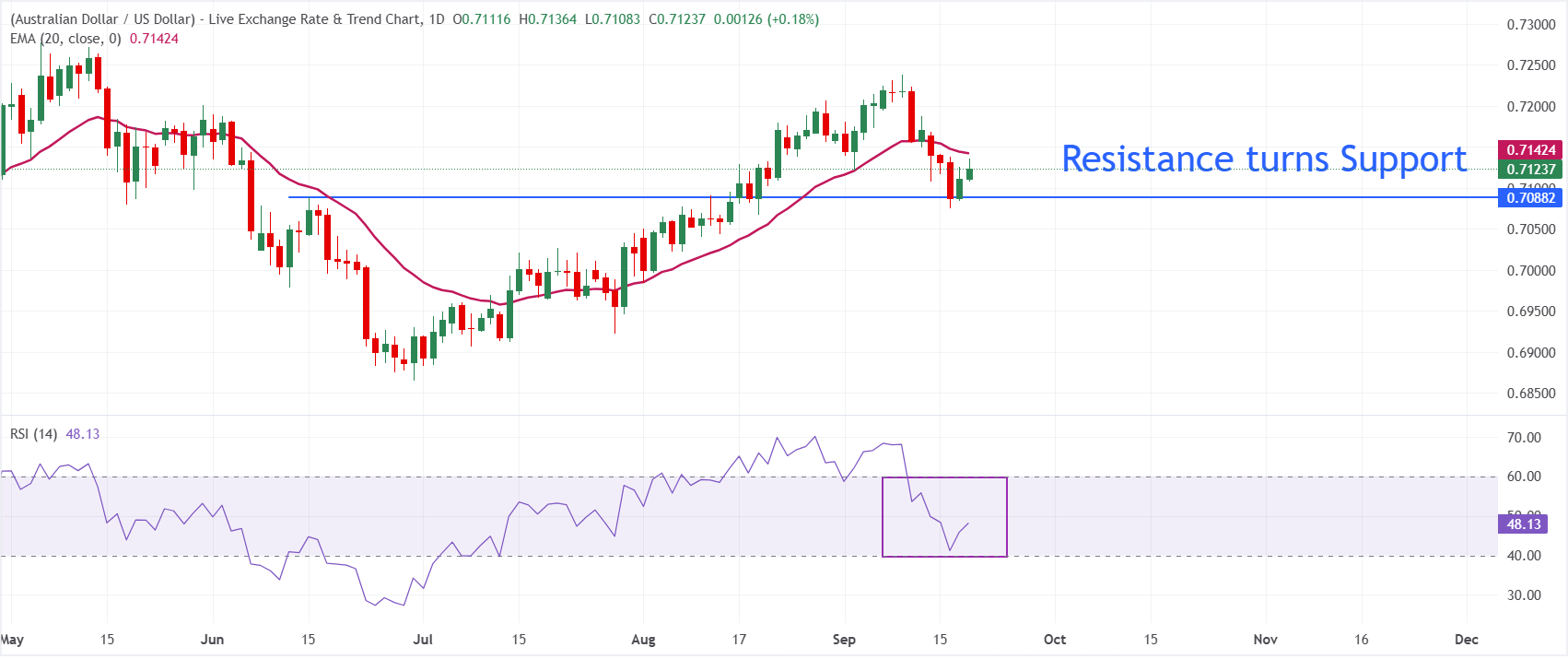
In the daily chart, AUD/USD trades at 0.7124, keeping a mildly bearish near-term tone as spot remains capped by the 20-day exponential moving average (EMA) at 0.7142. Price trades just under this short-term trend reference, suggesting rallies are struggling to regain the previous upside structure, while the Relative Strength Index (RSI) at 48 stays around neutral, hinting at a loss of bullish momentum rather than outright oversold conditions.
On the topside, immediate resistance is located at the 20-day EMA at 0.7142, and a sustained break above this barrier would be needed to reopen scope for a broader recovery. On the downside, the September 16 low at 0.7075 is the immediate support level.
(The technical analysis of this story was written with the help of an AI tool. Know more.)
RBA FAQs
The Reserve Bank of Australia (RBA) sets interest rates and manages monetary policy for Australia. Decisions are made by a board of governors at 11 meetings a year and ad hoc emergency meetings as required. The RBA’s primary mandate is to maintain price stability, which means an inflation rate of 2-3%, but also “..to contribute to the stability of the currency, full employment, and the economic prosperity and welfare of the Australian people.” Its main tool for achieving this is by raising or lowering interest rates. Relatively high interest rates will strengthen the Australian Dollar (AUD) and vice versa. Other RBA tools include quantitative easing and tightening.
While inflation had always traditionally been thought of as a negative factor for currencies since it lowers the value of money in general, the opposite has actually been the case in modern times with the relaxation of cross-border capital controls. Moderately higher inflation now tends to lead central banks to put up their interest rates, which in turn has the effect of attracting more capital inflows from global investors seeking a lucrative place to keep their money. This increases demand for the local currency, which in the case of Australia is the Aussie Dollar.
Macroeconomic data gauges the health of an economy and can have an impact on the value of its currency. Investors prefer to invest their capital in economies that are safe and growing rather than precarious and shrinking. Greater capital inflows increase the aggregate demand and value of the domestic currency. Classic indicators, such as GDP, Manufacturing and Services PMIs, employment, and consumer sentiment surveys can influence AUD. A strong economy may encourage the Reserve Bank of Australia to put up interest rates, also supporting AUD.
Quantitative Easing (QE) is a tool used in extreme situations when lowering interest rates is not enough to restore the flow of credit in the economy. QE is the process by which the Reserve Bank of Australia (RBA) prints Australian Dollars (AUD) for the purpose of buying assets – usually government or corporate bonds – from financial institutions, thereby providing them with much-needed liquidity. QE usually results in a weaker AUD.
Quantitative tightening (QT) is the reverse of QE. It is undertaken after QE when an economic recovery is underway and inflation starts rising. Whilst in QE the Reserve Bank of Australia (RBA) purchases government and corporate bonds from financial institutions to provide them with liquidity, in QT the RBA stops buying more assets, and stops reinvesting the principal maturing on the bonds it already holds. It would be positive (or bullish) for the Australian Dollar.
Nothing in this material constitutes investment advice, personal recommendation, investment research, an offer, or a solicitation to buy or sell any financial instrument. The content has been prepared without consideration of your individual investment objectives, financial situation, or needs, and should not be treated as such.
Past performance is not a reliable indicator of future performance and/or results. Forward-looking scenarios or forecasts are not a guarantee of future performance. Actual results may differ materially from those anticipated.
Mitrade makes no representation or warranty as to the accuracy or completeness of the information provided and accepts no liability for any loss arising from reliance on such information.
Recommended Articles


