



Gold approaches $4,500 amid rising geopolitical risks and a weaker US Dollar
- Gold extends its rally into uncharted territory, supported by heightened geopolitical risks.
- A softer US Dollar and expectations of further Fed easing into 2026 provide an additional tailwind.
- Technically, XAU/USD remains in a strong uptrend above rising moving averages despite an overbought RSI.
Gold (XAU/USD) continues to attract steady buying interest on Tuesday, pushing deeper into uncharted territory as escalating geopolitical tensions keep safe-haven demand firmly in play. At the time of writing, XAU/USD is trading around $4,485, up nearly 1.0% on the day.
Meanwhile, sustained expectations that the Federal Reserve (Fed) could lower interest rates further into 2026 keep the US Dollar (USD) on the defensive, offering an additional tailwind to Bullion. A softer Greenback makes Gold more attractive for overseas buyers, while lower interest rates reduce the opportunity cost of holding the non-yielding asset.
The latest leg higher also reflects year-end repositioning as markets head into the long holiday period. While some profit-taking at elevated levels could trigger short-term consolidation, the broader trend remains constructive, with Gold on course for its strongest annual performance since 1979, up nearly 70% year to date.
Looking ahead, market focus shifts to key US data releases later on Friday, including the ADP Employment Change four-week average, the delayed preliminary Q3 Gross Domestic Product (GDP) report, Durable Goods Orders, Industrial Production, and Consumer Confidence.
Market movers: Fed outlook, geopolitics shape market sentiment
- The US Dollar Index (DXY), which tracks the Greenback's value against a basket of six major currencies, trades around 97.90, hovering near over two-month lows and extending losses for a second consecutive day.
- Geopolitical tensions between the United States and Venezuela remain high after President Donald Trump imposed a blockade on sanctioned oil tankers entering and leaving Venezuela. Speaking on Monday, Trump said the US is “actually pursuing” a tanker that had departed from Venezuela and was under sanctions. US authorities have already seized two Venezuelan-linked oil tankers this month, including one over the weekend.
- Trump also said the United States will retain control of the seized oil, signalling a tough stance toward Caracas. Speaking at a press conference at Mar-a-Lago, he said the oil would not be returned and could be sold, stored, or added to US strategic reserves, although no final decision has been made.
- Beyond Geopolitics, markets are currently pricing in two rate cuts in 2026, though policymakers remain divided after delivering a cumulative 75 basis points of easing this year. Fed Governor Stephen Miran said on Monday that recent economic data should “push people in a dovish direction,” warning that failing to ease policy could raise recession risks. In contrast, Cleveland Fed President Beth Hammack told the Wall Street Journal on Sunday that she sees no need for rate cuts in the coming months, citing persistent inflation risks and signalling that rates could remain in the 3.50%-3.75% range into the spring.
- Attention is also focused on a potential leadership change at the Fed, as Chair Jerome Powell’s term is set to end in May 2026. US President Donald Trump has repeatedly signalled his preference for a Fed Chair who would favour lower interest rates. A CNBC report published on Monday, citing people familiar with the matter, said Trump could announce his decision as early as the first week of January. So far, Trump has interviewed Fed Governor Christopher Waller, while other leading contenders include US National Economic Council Director Kevin Hassett and former Fed Governor Kevin Warsh.
Technical analysis: Strong bullish trend holds despite overbought RSI
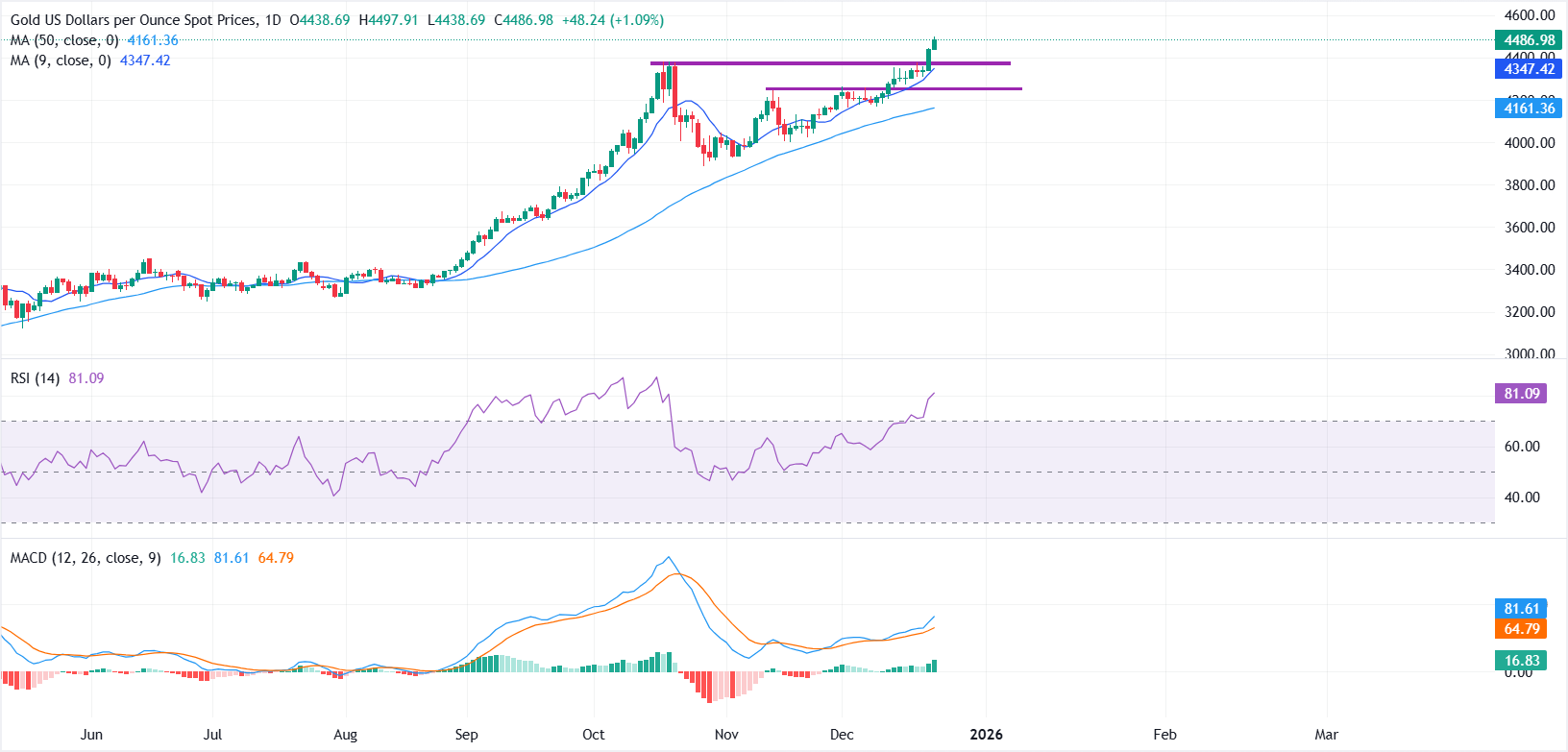
On the daily chart, XAU/USD is trading comfortably in uncharted territory after breaking above the October 20 peak near $4,381. The technical backdrop remains firmly bullish, with the 9-day Simple Moving Average (SMA) crossing above the 50-day SMA and both indicators sloping higher, signalling strong upward momentum.
Price holds above its key SMAs, with the 9-day SMA at $4,348.07 offering nearby dynamic support. The Moving Average Convergence Divergence (MACD) histogram expands positively, with the MACD line extending above the Signal line and both standing in positive territory. The Relative Strength Index (RSI) sits at 81 (overbought), which could cap near-term upside and prompt consolidation.
Short-term momentum remains supported by rising averages, while a pullback would likely find deeper support at the 50-day SMA at $4,161.48. The bullish alignment, with the short-term average above the longer one, keeps buyers in control. A sustained positive MACD profile above zero reinforces the upbeat tone, while a contracting histogram would hint at fading momentum. With RSI stretched, bulls may prefer to stabilize above moving-average support to secure the trend, and another daily close above the short-term average would keep the bias higher.
(The technical analysis of this story was written with the help of an AI tool)
Gold FAQs
Gold has played a key role in human’s history as it has been widely used as a store of value and medium of exchange. Currently, apart from its shine and usage for jewelry, the precious metal is widely seen as a safe-haven asset, meaning that it is considered a good investment during turbulent times. Gold is also widely seen as a hedge against inflation and against depreciating currencies as it doesn’t rely on any specific issuer or government.
Central banks are the biggest Gold holders. In their aim to support their currencies in turbulent times, central banks tend to diversify their reserves and buy Gold to improve the perceived strength of the economy and the currency. High Gold reserves can be a source of trust for a country’s solvency. Central banks added 1,136 tonnes of Gold worth around $70 billion to their reserves in 2022, according to data from the World Gold Council. This is the highest yearly purchase since records began. Central banks from emerging economies such as China, India and Turkey are quickly increasing their Gold reserves.
Gold has an inverse correlation with the US Dollar and US Treasuries, which are both major reserve and safe-haven assets. When the Dollar depreciates, Gold tends to rise, enabling investors and central banks to diversify their assets in turbulent times. Gold is also inversely correlated with risk assets. A rally in the stock market tends to weaken Gold price, while sell-offs in riskier markets tend to favor the precious metal.
The price can move due to a wide range of factors. Geopolitical instability or fears of a deep recession can quickly make Gold price escalate due to its safe-haven status. As a yield-less asset, Gold tends to rise with lower interest rates, while higher cost of money usually weighs down on the yellow metal. Still, most moves depend on how the US Dollar (USD) behaves as the asset is priced in dollars (XAU/USD). A strong Dollar tends to keep the price of Gold controlled, whereas a weaker Dollar is likely to push Gold prices up.
Nothing in this material constitutes investment advice, personal recommendation, investment research, an offer, or a solicitation to buy or sell any financial instrument. The content has been prepared without consideration of your individual investment objectives, financial situation, or needs, and should not be treated as such.
Past performance is not a reliable indicator of future performance and/or results. Forward-looking scenarios or forecasts are not a guarantee of future performance. Actual results may differ materially from those anticipated.
Mitrade makes no representation or warranty as to the accuracy or completeness of the information provided and accepts no liability for any loss arising from reliance on such information.
Recommended Articles


