



Gold remains under pressure as global interest rate outlook weighs on demand
- Gold remains under pressure, hovering near multi-week lows as higher global interest rate expectations weigh on demand.
- The metal is on track for a third straight weekly loss, despite ongoing geopolitical tensions in the Middle East.
- Technically, XAU/USD tests support at the 100-day SMA as bearish pressure builds.
Gold (XAU/USD) struggles to gain traction on Friday following a sharp two-day decline that pushed prices to their lowest level since early February, near the $4,500 mark. The drop comes as markets increasingly price in a “higher-for-longer” global interest rate environment following this week’s major central bank monetary policy announcements.
At the time of writing, XAU/USD is trading around $4,687, pulling back from an intraday high near $4,735, and remains on track to post a third consecutive week of losses.
Gold loses shine as hawkish central banks tighten grip
The Federal Reserve (Fed), Bank of Japan (BoJ), Swiss National Bank (SNB), Bank of England (BoE), Bank of Canada (BoC) and European Central Bank (ECB) all kept interest rates unchanged, while the Reserve Bank of Australia (RBA) raised rates, with policymakers highlighting upside inflation risks driven by higher Oil and energy prices amid ongoing war in the Middle East.
Gold, despite being an inflation hedge and a safe-haven asset, has struggled to attract demand. Prices are down by more than 10% since the US-Israel war with Iran erupted, as Oil-driven inflation concerns led traders to reprice global interest rates in a more hawkish direction, with recent central bank signals reinforcing this shift.
Market participants now expect the Fed to remain on hold through 2026, compared to earlier bets of at least two rate cuts within this year. The ECB, previously seen staying on hold, is now priced to deliver a rate hike by July and another by year-end.
The BoE was earlier expected to cut rates, but is now priced for around two hikes this year. The BoJ remains on a gradual tightening path. The BoC is expected to hold rates, though persistent inflation could push the Ottawa-based institution toward tightening. Meanwhile, the RBA is expected to deliver more rate hikes.
Higher interest rates increase the opportunity cost of holding Gold, making yield-bearing assets more attractive. Another factor weighing on the metal is a broadly stronger US Dollar (USD).
As both Gold and Oil are priced in USD, rising energy prices tend to boost demand for the Greenback, which in turn pressures Gold. In addition, the USD’s role as the world’s primary reserve currency supports demand during periods of heightened geopolitical uncertainty, as investors seek liquidity and safety.
At the same time, fading expectations for Fed rate cuts have lifted US Treasury yields, further supporting the USD and adding to the downside pressure on the non-yielding metal.
On the geopolitical front, tensions in the Middle East remain elevated with no clear signs of easing, although Israel has signaled it may refrain from further attacks on Iran’s energy infrastructure. Meanwhile, the Trump administration is considering plans to occupy or blockade Iran’s Kharg Island to pressure Tehran into reopening the Strait of Hormuz, Axios reported on Friday, citing sources familiar with the matter.
Technical analysis: Bearish momentum strengthens with RSI nearing oversold
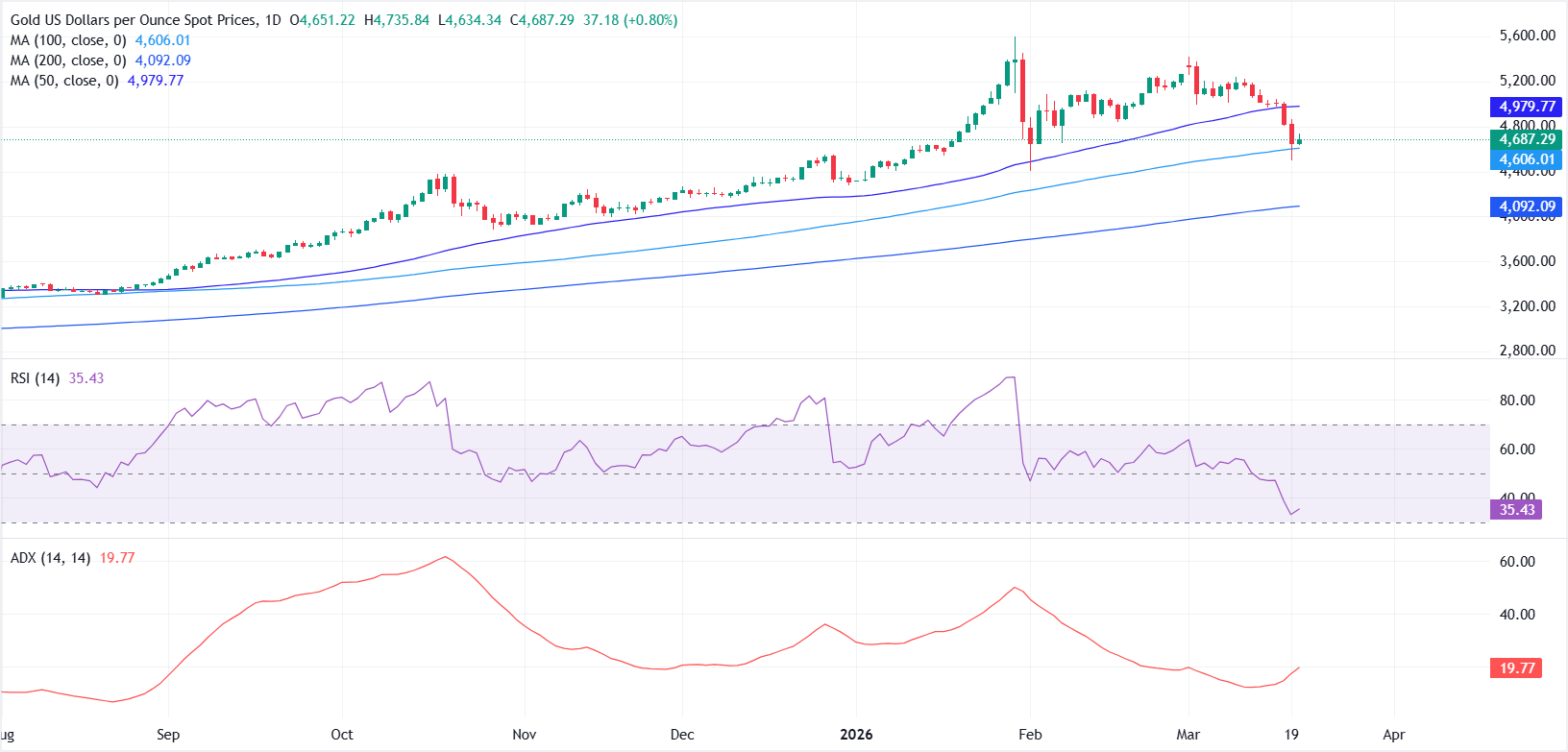
On the daily chart, Gold is attempting to stabilize above the 100-day Simple Moving Average (SMA) near $4,605 after sliding below the 50-day SMA around $4,979 earlier this week, highlighting growing selling pressure in the near term.
Momentum indicators continue to support the bearish outlook. The Relative Strength Index (RSI) is hovering near 33, approaching oversold territory and reinforcing downside pressure. Meanwhile, the Average Directional Index (ADX) is rising toward 20, suggesting that the current downswing is gaining traction after a period of weaker trend conditions.
On the downside, a decisive break below the 100-day SMA and Thursday’s low at $4,502 could expose the February 2 low at $4,402. A move below this level would open the door toward the 200-day SMA at $4,091.
On the upside, if prices manage to hold above the 100-day SMA, Gold could attempt a recovery toward the 50-day SMA at $4,979, with the $5,000 psychological level acting as immediate resistance. A sustained move above this zone could pave the way toward $5,200, a key resistance level needed to revive bullish momentum.
Gold FAQs
Gold has played a key role in human’s history as it has been widely used as a store of value and medium of exchange. Currently, apart from its shine and usage for jewelry, the precious metal is widely seen as a safe-haven asset, meaning that it is considered a good investment during turbulent times. Gold is also widely seen as a hedge against inflation and against depreciating currencies as it doesn’t rely on any specific issuer or government.
Central banks are the biggest Gold holders. In their aim to support their currencies in turbulent times, central banks tend to diversify their reserves and buy Gold to improve the perceived strength of the economy and the currency. High Gold reserves can be a source of trust for a country’s solvency. Central banks added 1,136 tonnes of Gold worth around $70 billion to their reserves in 2022, according to data from the World Gold Council. This is the highest yearly purchase since records began. Central banks from emerging economies such as China, India and Turkey are quickly increasing their Gold reserves.
Gold has an inverse correlation with the US Dollar and US Treasuries, which are both major reserve and safe-haven assets. When the Dollar depreciates, Gold tends to rise, enabling investors and central banks to diversify their assets in turbulent times. Gold is also inversely correlated with risk assets. A rally in the stock market tends to weaken Gold price, while sell-offs in riskier markets tend to favor the precious metal.
The price can move due to a wide range of factors. Geopolitical instability or fears of a deep recession can quickly make Gold price escalate due to its safe-haven status. As a yield-less asset, Gold tends to rise with lower interest rates, while higher cost of money usually weighs down on the yellow metal. Still, most moves depend on how the US Dollar (USD) behaves as the asset is priced in dollars (XAU/USD). A strong Dollar tends to keep the price of Gold controlled, whereas a weaker Dollar is likely to push Gold prices up.
Nothing in this material constitutes investment advice, personal recommendation, investment research, an offer, or a solicitation to buy or sell any financial instrument. The content has been prepared without consideration of your individual investment objectives, financial situation, or needs, and should not be treated as such.
Past performance is not a reliable indicator of future performance and/or results. Forward-looking scenarios or forecasts are not a guarantee of future performance. Actual results may differ materially from those anticipated.
Mitrade makes no representation or warranty as to the accuracy or completeness of the information provided and accepts no liability for any loss arising from reliance on such information.
Recommended Articles


